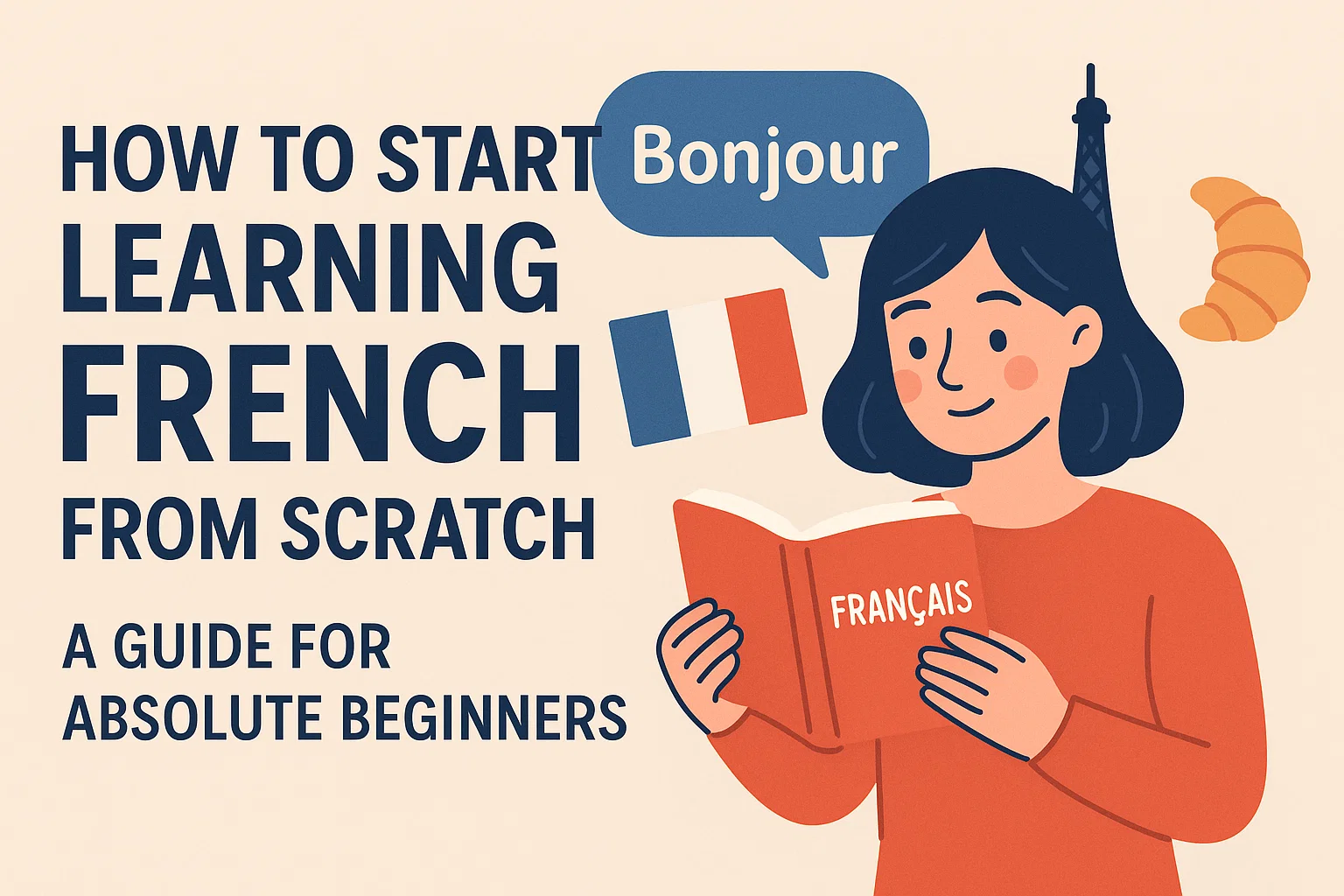
How to Learn French for Beginners: Step-by-Step Guide to Start from Scratch
So you’ve decided to learn French—bravo! 🎉 Whether you’re planning to move to Canada, travel to Paris, or just want to impress your friends with a charming “bonjour,” you’re in the right place.
Learning a new language might feel overwhelming at first, but don’t worry. This post is your ultimate roadmap on how to learn French for beginners—filled with steps, tools, tips, and even some fun along the way! 🥖📚
🧠 Why Learn French?
Before we jump into the how to learn French for beginners roadmap, let’s talk about why this language is worth your time:
🌍 Spoken in over 29 countries
🗣 Over 300 million speakers worldwide
🎓 Useful for immigration, jobs, education, travel
💬 It’s the language of love, culture, and diplomacy
🔑 Step 1: Set Your Learning Goals 🎯
When starting any new skill, you need a clear “why.”
Ask yourself:
Are you learning for TEF or DELF exam prep?
Do you want to travel or move to Quebec?
Are you learning just for fun?
Setting a goal is the first key step in how to learn French for beginners. Write it down. Keep it visible.
🎯 Example:
“I want to reach A2 level French in 3 months to prepare for TEF Canada.”
📚 Step 2: Learn the Basics – Alphabet, Sounds & Greetings 🗣️
French has its own alphabet sounds and pronunciation rules.
🔤 Start with:
French alphabet 🅰️
Vowel sounds (é, è, ê, etc.)
Nasal sounds (on, an, in)
Basic greetings
💬 Common phrases:
Bonjour – Hello
Merci – Thank you
Ça va ? – How are you?
Je m’appelle… – My name is…
🎧 Tip: Use YouTube or free apps to hear pronunciation and repeat it aloud!
🧩 Step 3: Master Core Vocabulary & Phrases
You don’t need 10,000 words to start speaking French. Begin with the most common 500–1000 words, especially those used in daily life.
📦 Categories to focus on:
Numbers, days, months
Family, food, travel
Question words (quoi, quand, pourquoi…)
Common verbs (être, avoir, aller, faire)
💡 Flashcards (like Anki or Quizlet) are great for memorizing!
🔑 This step is critical in how to learn French for beginners—small, frequent exposure builds big results.
📝 Step 4: Start Speaking Early (Yes, Now!) 🗣️💬
Don’t wait until you’re “ready”—you’ll never feel ready! 😅
Find simple ways to use French daily:
Talk to yourself in French
Describe your routine aloud
Join beginner speaking groups (try HelloTalk, Tandem, or language exchange meetups)
💬 Practice Sentence:
“Je vais au marché aujourd’hui.” (I’m going to the market today.)
✅ Real use builds real fluency. This is a must in how to learn French for beginners.
📖 Step 5: Learn Basic Grammar (But Don’t Get Stuck!)
Grammar can feel scary at first—but it’s manageable when learned gradually.
🔤 Start with:
Subject pronouns (je, tu, il, etc.)
Present tense conjugation
Articles (le, la, un, une)
Negative structure: ne…pas
🧠 Learn grammar through sentences, not isolated rules.
💡 Example:
Instead of memorizing: “être means to be”
Practice: “Je suis étudiant.” = I am a student.
🎧 Step 6: Listen Daily to Train Your Ear 🎧🎙️
Understanding native speakers is one of the toughest challenges.
Build this skill early by listening every day—even 10 minutes helps.
🧰 Tools:
YouTube (FrenchPod101, Learn French with Alexa)
Podcasts (Coffee Break French ☕)
Netflix/YouTube with French subtitles
Songs (Stromae, Zaz, Angèle)
👂 Even passive listening improves pronunciation and rhythm.
. 🗣️ Step 7: Practice Speaking with Others
Find a language partner or tutor. Speaking is the fastest way to grow.
👥 Try:
iTalki or Preply (paid tutors)
Tandem or HelloTalk (free exchange apps)
Join Facebook/Whatsapp groups for French learners
💬 You don’t need to be perfect. Mistakes = progress!
This is one of the most important takeaways in how to learn French for beginners—real conversations build real confidence.
🧪 Step 8: Test Yourself & Track Progress ✅
Use CEFR levels (A1–C2) as your progress guide.
📊 Assessments:
Free placement tests (Alliance Française, Kwiziq)
TEF/DELF practice papers
Self-check: “Can I introduce myself?” “Can I describe my day?”
Tracking gives you motivation and clarity. Progress = momentum.
🛠️ Recommended Tools for Beginners 📱📘
Here’s your starter toolkit for how to learn French for beginners:
| Tool | Purpose |
|---|---|
| Duolingo | Vocabulary & basics |
| Anki | Spaced repetition flashcards |
| LingQ | Reading & listening |
| iTalki/Preply | Speaking with tutors |
| YouTube | Listening & pronunciation |
😬 Common Mistakes Beginners Make (And How to Avoid Them)
🚫 ❌ Mistake: Waiting to speak until you’re “fluent”
✅ Speak from Day 1
🚫 ❌ Mistake: Only studying grammar rules
✅ Balance all 4 skills: read, write, listen, speak
🚫 ❌ Mistake: Cramming vocabulary without context
✅ Learn words in full sentences and real usage
Avoiding these mistakes will make your journey in how to learn French for beginners smoother and more enjoyable! 🛤️✨
💬 Essential Phrases to Practice Right Now
Start using these every day:
Je suis débutant(e) – I’m a beginner
Je ne comprends pas – I don’t understand
Pouvez-vous répéter ? – Can you repeat?
Où est la gare ? – Where is the train station?
J’apprends le français – I’m learning French
Practice these in your head, in the mirror, or with a partner.
🎯 Final Thoughts: You Can Learn French—One Day at a Time!
Learning a new language is like planting a tree 🌱. It takes time, patience, and daily nurturing.
Remember, the key to how to learn French for beginners is not perfection, but persistence.
Make mistakes. Laugh at yourself. Keep going.
📌 Quick Summary: Your Beginner French Roadmap
✅ Set your goal
✅ Learn sounds, greetings, and basic grammar
✅ Build core vocabulary
✅ Speak early, listen often
✅ Use apps, songs, podcasts
✅ Test your progress
✅ Keep having fun 🎉
🚀 Ready to Begin?
Why not take 10 minutes today to:
Say “Bonjour!” to yourself in the mirror
Watch a beginner French video
Learn 5 new words
Book a free demo class or join a learning group
Your French journey starts right now. 💙🇫🇷
❓ FAQs – How to Learn French for Beginners
Q1: Can I really learn French on my own as a beginner?
✅ Yes! Many people successfully teach themselves French using apps, books, YouTube, and podcasts. The key to how to learn French for beginners is consistency, realistic goals, and daily practice—even 15 minutes a day helps!
Q2: What’s the first thing I should learn in French?
📘 Start with basic greetings, the French alphabet, common vocabulary, and simple phrases like:
Bonjour (Hello)
Je m’appelle… (My name is…)
Merci (Thank you)
These will help you feel confident and conversational from Day 1.
Q3: How long does it take to become fluent in French?
⏳ It depends! Most learners can reach conversational fluency (B1–B2) in 6–12 months with daily study. For complete beginners asking how to learn French for beginners, progress will depend on your time, tools, and practice consistency.
Q4: Do I need to take a class or can I just use apps?
👨🏫 Apps are great, but nothing replaces real conversation practice. Classes or speaking with a tutor can speed up progress. That said, many beginners use a mix of both—which is a great strategy for how to learn French for beginners.
Q5: What are the best apps for beginner French learners?
📱 Top-rated apps for beginners include:
Duolingo
Busuu
Babbel
Memrise
LingQ
All of them are beginner-friendly and perfect for those exploring how to learn French for beginners.
Q6: Should I focus on grammar or vocabulary first?
🧠 Start with essential vocabulary and useful phrases. Grammar will become easier once you’ve seen it used in context. In how to learn French for beginners, it’s best to learn by doing, not memorizing rules.
Q7: How can I improve my French speaking skills as a beginner?
🗣️ Speak from Day 1—even if it’s just to yourself! Try:
Recording your voice
Repeating YouTube videos
Practicing with a language partner
Speaking is a key part of how to learn French for beginners that many people skip—don’t be one of them!
Q8: What’s the most common mistake beginners make when learning French?
😬 The biggest mistake? Waiting too long to speak or overthinking grammar. Just start! Mistakes are part of the journey. Remember, fluency is built through use, not perfection.
Trusted Resources for French Learners