
French levels explained: From A1 to C2 (and what they mean for Canadians)
French levels — if you’re learning French for Canadian immigration, work, or travel, you’ve likely seen terms like A1, B2, or NCLC. But what do these French levels actually mean? Which one do you need for Express Entry? How long does each level take? At Toronto French Academy, we’ve guided over 1,200 students through every French level, from complete beginner to professional fluency. This complete guide breaks down the CEFR French levels (A1, A2, B1, B2, C1, C2), maps them to Canadian immigration scores (NCLC/CLB), and helps you identify your current level.
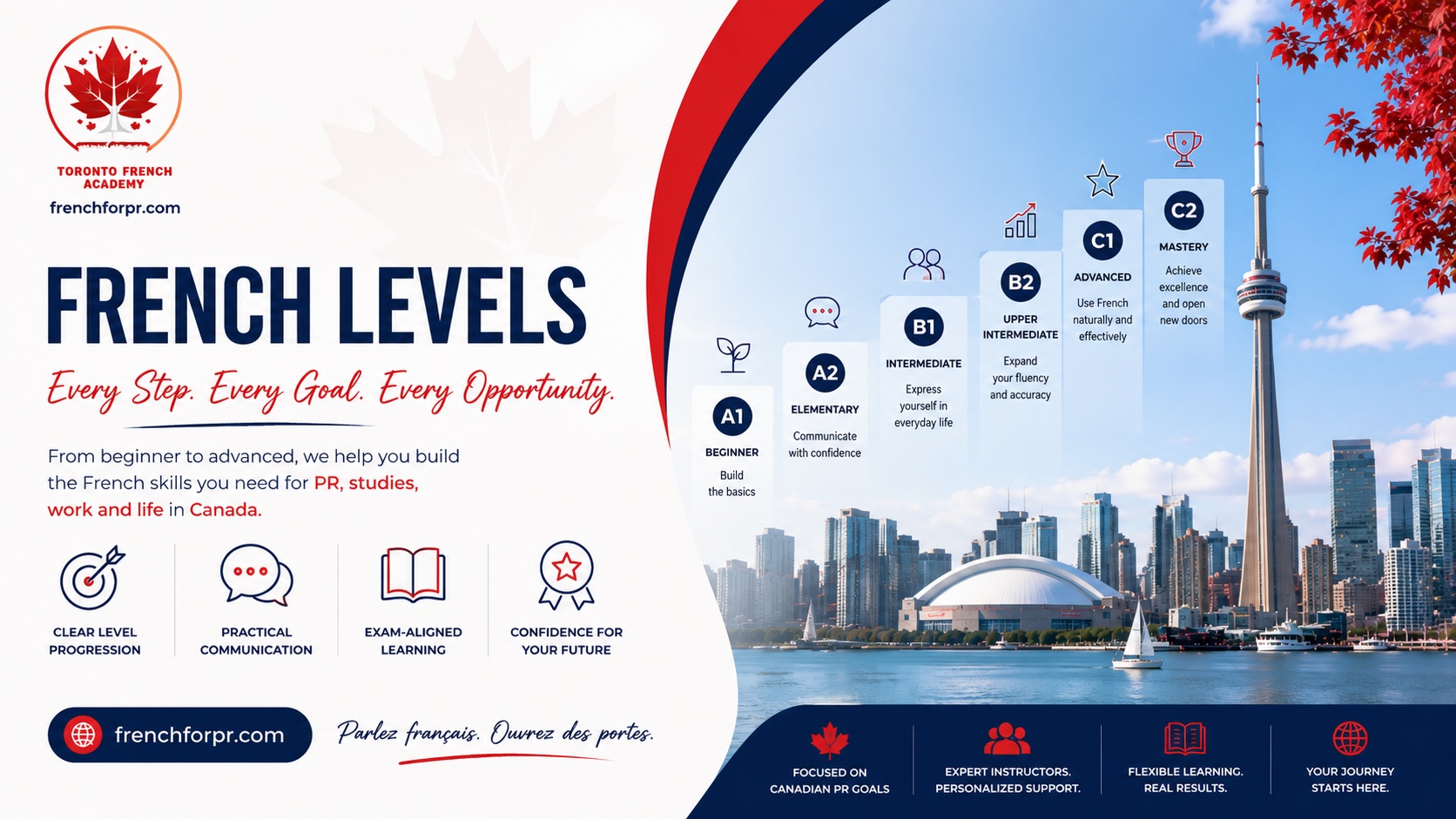
French levels follow the CEFR standard: A1 (Beginner) → A2 (Elementary) → B1 (Intermediate) → B2 (Upper Intermediate) → C1 (Advanced) → C2 (Mastery). For Canadian immigration, NCLC 7 = B2 level is the target for 50 CRS points. If you are working toward the intermediate stage first, start with our full B1 guide.
📖 What you’ll learn +
What are French levels? Understanding the CEFR standard
The Common European Framework of Reference for Languages (CEFR) is the international standard for measuring language ability. It divides French levels into six stages: A1, A2, B1, B2, C1, and C2. Each French level describes what you can do in speaking, listening, reading, and writing. Immigration Canada uses these French levels to assess language proficiency through the NCLC (Niveaux de compétence linguistique canadiens).
Understanding your current French level is the first step toward choosing the right course, setting realistic goals, and tracking your progress. Below, we break down every French level in detail.
Complete breakdown of every French level (A1 to C2)
A1 French level — Beginner / Découverte
At the A1 French level, you can understand and use familiar everyday expressions. You can introduce yourself, ask basic questions, and interact simply if the other person speaks slowly. This French level takes about 80-100 hours of study. Perfect for travelers or complete beginners.
A2 French level — Elementary / Intermédiaire
The A2 French level lets you understand sentences about familiar topics (family, shopping, work). You can describe your background and immediate needs. This French level requires 160-200 total hours. Many learners reach A2 before citizenship applications (minimum NCLC 4).
B1 French level — Intermediate / Seuil
At B1 French level, you can handle most travel situations, describe experiences, and give opinions. You understand TV news and work emails. This French level takes 350-400 hours. B1 is the threshold for basic professional French.
B2 French level — Upper Intermediate / Avancé
The B2 French level is the most important for Canadian immigration. At this French level, you can discuss complex topics, argue a position, and understand nuanced media. B2 = NCLC 7 = 50 CRS points for Express Entry. This French level requires 500-650 total hours.
C1 French level — Advanced / Autonome
C1 French level represents fluent, spontaneous communication for professional or academic settings. You can write detailed reports and understand subtle cultural references. This French level takes 700-800 hours. C1 = NCLC 8-9.
C2 French level — Mastery / Maîtrise
C2 is the highest French level. You understand virtually everything, summarize complex information, and express finer shades of meaning. This French level requires 1,000+ hours and is rarely needed for immigration unless maximum points are desired.
📊 Hours needed to reach each French level
Quick self-assessment: Which French level fits you?
Answer these 6 questions honestly to get an approximate French level. Then verify with our free professional assessment.
1. Can you introduce yourself and say where you live?
2. Can you order food at a restaurant and ask for the bill?
3. Can you describe your job or studies in detail?
4. Can you watch French TV news and understand the main points?
5. Can you give a clear presentation or argue a position at work?
6. Can you read a French novel or write a professional report?
Your estimated French level: (Score your answers: mostly ✅ = B2-C1, mostly 🤔 = A2-B1, mostly ❌ = A1)
Get Professional Verification →French levels mapped to Canadian immigration (NCLC/CLB)
Immigration, Refugees and Citizenship Canada (IRCC) uses the NCLC (French) and CLB (English) scales. Here’s how each French level converts to NCLC and what it means for your PR application:
| CEFR French level | NCLC Score | CRS Points (with English) | Typical Use Case |
|---|---|---|---|
| A1 | NCLC 1-2 | 0 points | Travel, basic greetings |
| A2 | NCLC 3-4 | 0 points | Citizenship minimum (NCLC 4) |
| B1 | NCLC 5-6 | 0-25 points | Some PNP streams |
| B2 | NCLC 7 | 50 CRS points | Express Entry target — most common |
| C1 | NCLC 8-9 | 50 points (max) | Maximum language points |
| C2 | NCLC 10+ | 50 points (max) | Academic/professional mastery |
Most Canadians need B2 French level (NCLC 7) to unlock 50 additional CRS points for Express Entry. This French level typically requires 9-12 months of consistent study (500-650 hours).
How French levels compare to other languages
CEFR French levels are the same standard used for English, Spanish, German, and Italian. Here’s how they align with popular language tests:
| CEFR French level | IELTS (English) | DELE (Spanish) | Goethe (German) |
|---|---|---|---|
| A1 (Beginner) | 1.0 – 2.0 | A1 | A1 |
| A2 (Elementary) | 2.5 – 3.0 | A2 | A2 |
| B1 (Intermediate) | 3.5 – 4.0 | B1 | B1 |
| B2 (Upper Intermediate) | 5.0 – 6.0 | B2 | B2 |
| C1 (Advanced) | 6.5 – 7.5 | C1 | C1 |
| C2 (Mastery) | 8.0 – 9.0 | C2 | C2 |
💡 If you’ve taken IELTS before, this table helps you understand where your French level would approximately land. B2 French = IELTS 5.0-6.0 in difficulty.
How to find your current French level
Not sure which French level you’re at? Here are three reliable methods:
- Take a free online placement test — Many official organizations offer sample tests for each French level.
- Self-assess using the “can-do” statements — Ask yourself: Can I order food? (A1). Can I discuss my job? (B1). Can I debate politics? (B2+).
- Book a professional assessment — At Toronto French Academy, we offer free in-person or virtual level assessments to place you in the right course.
📝 Self-assessment checklist
A1: “I can introduce myself.”
A2: “I can shop and order food.”
B1: “I can explain my opinions.”
B2: “I can discuss complex topics.”
C1: “I speak fluently for work.”
🎯 Free level assessment
Not sure which French level fits you? Our academic team will assess your speaking, listening, reading, and writing — then recommend the perfect starting point. Book your free assessment →
Which French level do you need for your goal?
| Goal | Required French level | NCLC Equivalent |
|---|---|---|
| Tourism / Basic conversation | A1 – A2 | NCLC 1-4 |
| Canadian Citizenship | A2 (minimum) | NCLC 4 |
| Express Entry (50 CRS points) | B2 | NCLC 7 |
| Quebec Immigration (CSQ) | B2 (listening/speaking) | NCLC 7 |
| Bilingual job (gov’t or corporate) | B2 – C1 | NCLC 7-8 |
| University in French | C1 | NCLC 8-9 |
Common questions about French levels
How long does it take to go from A1 to B2 French level?
What’s the difference between French levels and NCLC?
Can I skip French levels if I already speak some French?
Which French level is hardest to achieve?
Official resources for understanding French levels in Canada
For authoritative information, visit IRCC Express Entry language requirements and the official CEFR level descriptions from the Council of Europe. These sources confirm the French levels described above.
What can you actually DO at each French level?
Here are concrete “can-do” statements for each French level — what real communication looks like in daily life.
- Say hello, goodbye, please, thank you
- Introduce yourself (name, age, country)
- Order coffee or a meal
- Ask for the time and price
- Describe your family and job
- Shop for groceries
- Make a hotel reservation
- Talk about past weekend plans
- Explain your opinion with reasons
- Describe a movie or book
- Write a simple email
- Handle most travel situations
- Participate in meetings
- Understand TV news
- Write a formal letter
- Pass TEF/TCF for PR
Show C1 & C2 can-do statements →
- Present complex topics spontaneously
- Write detailed reports and essays
- Understand subtle humor and cultural references
- Work effectively in French-speaking environments
- Express yourself with precision and nuance
- Understand virtually everything heard or read
- Summarize complex information from multiple sources
- Perform at the level of an educated native speaker
Time and cost investment by French level
Based on group classes at Toronto French Academy (2 classes/week, ~6 hours/week plus homework).
| French level | Study Hours Needed | Typical Duration | Estimated Cost (Group) |
|---|---|---|---|
| A1 (Beginner) | 80-100 hrs | 8-10 weeks | $600 – $750 |
| A2 (Elementary) | 80-100 hrs | 8-10 weeks | $600 – $750 |
| B1 (Intermediate) | 150-200 hrs | 14-18 weeks | $1,050 – $1,350 |
| B2 (Upper Intermediate) | 150-200 hrs | 14-18 weeks | $1,050 – $1,350 |
| C1 (Advanced) | 150-200 hrs | 14-18 weeks | $1,050 – $1,350 |
| 💰 Private tutoring accelerates progress by 30-40% but costs more per hour ($75/hr). Compare options → | |||
Many students reach B2 French level (NCLC 7) in 12 months with: 2 group classes/week + 1 private lesson/week + daily 15-min practice. Total investment: ~$3,500-4,500. Compare to 50 CRS points — priceless for PR.
Your roadmap to each French level
A realistic timeline for adult learners studying 8-10 hours per week (2 group classes + practice).
Real students, real progress: Success at every French level
A1 → B2 in 10 months
“I started knowing zero French. Within 10 months of French courses Toronto, I reached B2 and passed my TEF. The level system kept me motivated.”
B1 → C1 in 6 months
“I needed C1 for my job promotion. The private tutoring track got me from B1 to C1 faster than I thought possible.”
A2 → B2 in 5 months (intensive)
“The intensive bootcamp was tough but worth it. I reached B2 just in time for my Express Entry draw.”
How to certify your French level for immigration
To prove your French level to IRCC, you need an official test: TEF Canada or TCF Canada. Here’s how to prepare for each level.
For A2 (Citizenship)
Focus on everyday topics: family, work, weekend plans. Practice listening to slow news (RFI Français facile).
Recommended prep: 3-4 months of A1-A2 group classes
For B2 (Express Entry) ⭐
Focus on: argumentative essays, professional vocabulary, news comprehension, time management.
Recommended prep: B2/TEF specialized course + mock exams
For C1 (Maximum points)
Focus on: complex debates, academic vocabulary, subtle expressions, spontaneous speaking.
Recommended prep: Advanced B2-C1 classes + private coaching
Not sure if you’re ready for your target French level exam? Take our free mock test and get a detailed score report. Request your mock exam →
Find your French level with a free assessment
Stop guessing which French level you’re at. Get a professional evaluation, course recommendation, and personalized learning path — all free.
Book Your Free Assessment →