5 Surprising Truths About the TEF vs. TCF for Canadian PR
With Express Entry cut-off scores remaining prohibitively high, the 50-point bonus for French proficiency has shifted from a “luxury” to a survival requirement. For candidates facing a nearing Post-Graduation Work Permit (PGWP) expiry, achieving a NCLC 7 (Niveau de compétence linguistique canadien) in all four modules—Reading, Writing, Listening, and Speaking—is often the only remaining path to an Invitation to Apply (ITA).
While Immigration, Refugees and Citizenship Canada (IRCC) treats the TEF Canada and the TCF Canada as equals, they are fundamentally different machines. As an immigration consultant, my role is risk mitigation. Choosing the wrong test doesn’t just cost you $450 CAD; it costs you a month of processing time and potentially your status in Canada.
Here are the five truths you need to know before booking your seat.
1. The “B2 Floor” Advantage: TCF’s Secret Scoring Hack
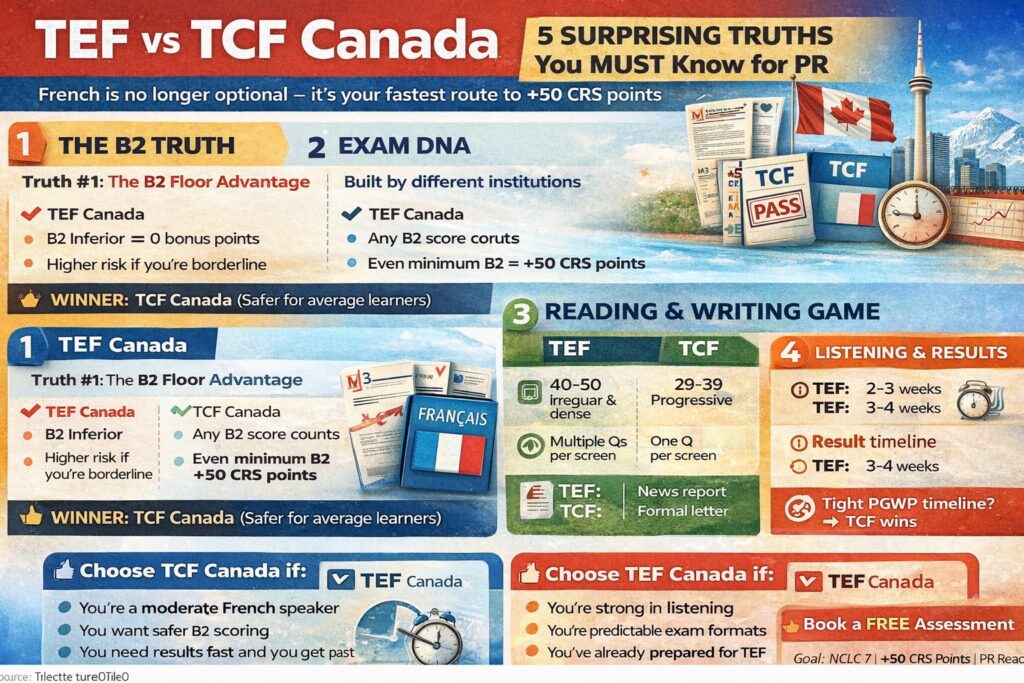
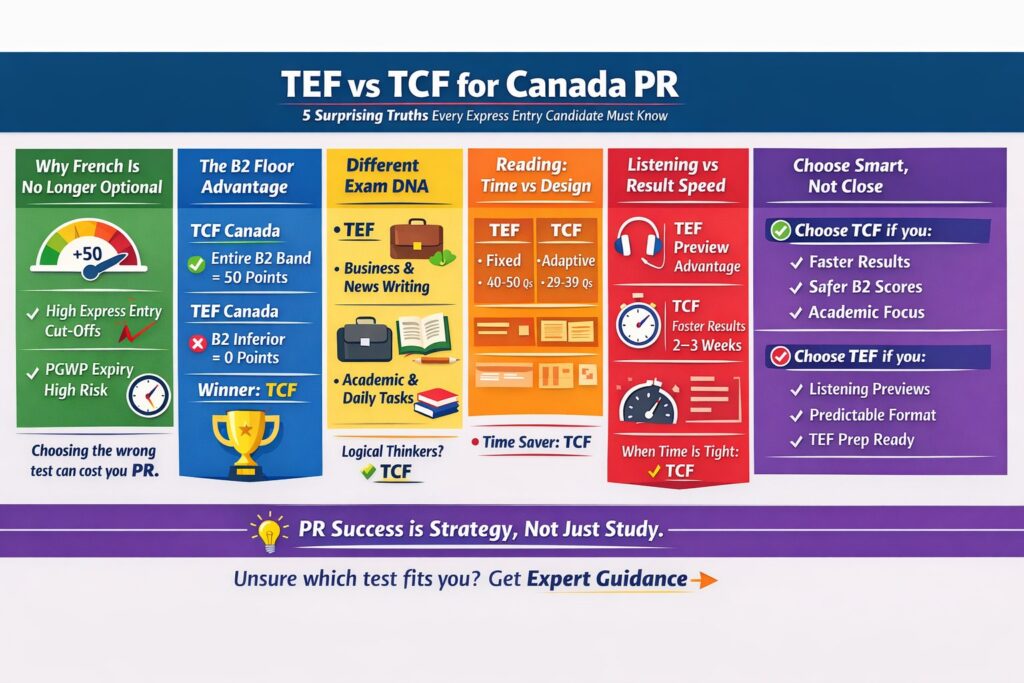
The most critical technical distinction lies in how each test defines the NCLC 7 threshold. In the TEF, the B2 level is historically split into “inferior” and “superior” bands. If you land in the B2 inferior bracket, you receive zero bonus points for that module.
In contrast, the TCF Canada is significantly more forgiving at the intermediate level. To secure your 50 points in the TCF, you simply need to hit the absolute “floor” of the B2 band. As one successful candidate noted:
“TCF Canada does not have a B2 inferior… if you get a B2 in TCF Canada, let’s say for example by scoring 10/20, you will still get your 50 points.”
While a December 2023 reform slightly lowered some TEF thresholds (for instance, the NCLC 7 writing requirement dropped from 450 to 428), the TCF remains the safer bet for those hovering at a moderate fluency level because it credits the entire B2 range.
2. Institutional Logic: Business vs. Academia
The tests feel different because they are built by different institutions with divergent philosophies:
- TEF Canada: Created by the Chambre de Commerce et d’industrie de Paris (CCI Paris). Its DNA is economic and professional. This is why the writing section includes the infamous “fait divers”—requiring you to transform a provocative headline into a news story. It demands journalistic creativity and a specific, often dramatic, vocabulary.
- TCF Canada: Created by France Éducation International, the same body under the French Ministry of Education that designs the DELF/DALF. Its tasks are academic and pedagogical, focusing on daily life. Instead of writing tabloid stories, you handle practical tasks like blog posts or document syntheses.
If you are a logical thinker who struggles with “creative writing” in your second language, the TEF’s news-reporting task can be a deal-breaker.
3. Reading: Computer-Adaptive vs. The “Time Game”
The TCF Canada is computer-adaptive, meaning the test adjusts its difficulty based on your performance—it “gets harder as you do better.” While this sounds intimidating, the user interface provides a massive psychological edge: one question per page. This layout is intuitive and prevents the cognitive overload of staring at a wall of text.
The TEF, conversely, is a fixed-format “time game.” It often buries dense, literary extracts in the middle of the exam, forcing you to burn precious minutes.
Side-by-Side: Reading & Writing Comparison
|
Feature |
TEF Canada |
TCF Canada |
|
Reading Format |
40-50 questions |
29-39 questions (Adaptive) |
|
Reading Difficulty |
Non-linear/Literary spikes |
Intuitive/Progressive |
|
Writing Tasks |
2 (Fait Divers + Formal Letter) |
3 (Short Letter + Blog + Synthesis) |
|
Interface |
Multiple questions per view |
One question per page |
4. The Listening Paradox and Result Velocity
The one area where the TEF often wins is the Listening module. The TEF typically allows candidates to preview questions before the audio plays, allowing you to “prime” your brain for specific keywords. In the TCF, the audio often plays with almost no time to read the multiple-choice options beforehand, demanding intense real-time processing.
However, for candidates on a tight timeline, the TCF offers a critical logistical advantage: Result Velocity.
- TCF Results: Usually available in 2–3 weeks.
- TEF Results: Usually take 3–4 weeks.
When your work permit expires in 30 days, those fourteen days of difference are an eternity.
5. The Strategic Pivot: Avoiding the 1-Month Lockout
A common mistake is assuming you are “locked in” to one test ecosystem. IRCC and the testing organizations enforce a mandatory one-month waiting period before you can retake the same exam.
However, there is no rule preventing you from a Strategic Pivot. If you fail to hit NCLC 7 on the TEF on a Monday, you can legally sit for the TCF the following week. This “test-switching” hack is a vital emergency measure for high-stakes candidates who cannot afford to wait 30 days for a second attempt.
Conclusion: Your Decision Matrix
Choosing the right test is about matching your profile to the exam’s mechanics. As a rule of thumb:
- Choose TCF Canada if: You are a “traditional” learner (familiar with DELF), you struggle with time management in reading, you need results quickly, or your writing lacks journalistic flair.
- Choose TEF Canada if: You are an “exam-driller” who thrives on predictable formats, you rely on previewing questions to succeed in listening, or you have already invested heavily in TEF-specific prep materials.
Both exams cost roughly 400–450, but the real cost is the time lost to a failing grade. Are you choosing the test that aligns with your NCLC 7 goals, or are you simply booking the one with the nearest test center? Strategy, not just study, is what secures the PR.
Why Toronto French Academy is Your Best Partner for TEF or TCF Success

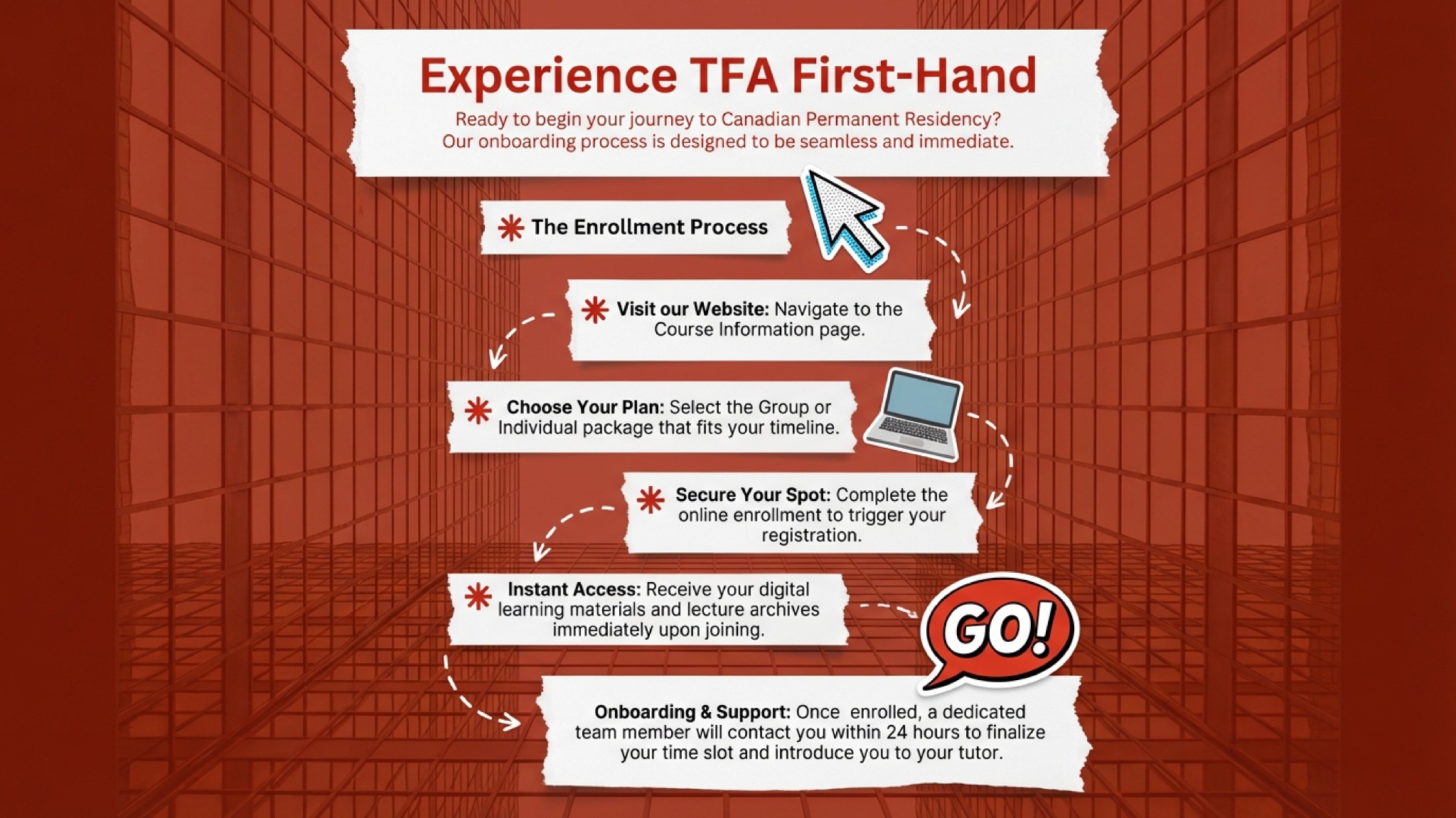
Choosing between the TEF and TCF is only the first step; the second is choosing the right training environment to ensure you don’t waste $450 on a failing grade. At Toronto French Academy, we specialize in helping Express Entry candidates navigate this high-stakes decision. Here is why students across Toronto, Ontario choose us to secure their 50-point bonus:
-
Tailored Test Strategy: We don’t believe in a “one-size-fits-all” approach. Our instructors assess your natural strengths—whether it’s the professional logic of the TEF or the academic structure of the TCF—to recommend the exam that offers you the highest probability of hitting NCLC 7.
-
Fast-Track to PR: Our accelerated curriculum is specifically designed for candidates on a tight timeline, with proven results taking students from A1 to B2 in as little as 6–8 months.
-
Small Group Focus: Forget crowded classrooms. We keep our French classes in Toronto small (often 2-3 students) to ensure you get the intensive speaking and writing feedback required to beat the “B2 Floor.”
-
Native-Led Expertise: Learn from C1/C2 certified instructors who understand the cultural nuances of the fait divers (TEF) and the document synthesis (TCF).
-
Flexible Scheduling for Professionals: We know you’re balancing work and immigration deadlines. That’s why we offer flexible morning, evening, and weekend slots to fit your busy GTA lifestyle.
Don’t leave your Canadian Permanent Residency to chance. Whether you’re pivoting from a failed attempt or starting from scratch, Toronto French Academy provides the strategic coaching you need to turn French proficiency into your golden ticket for an ITA.
Ready to boost your CRS score? Book your free placement assessment with Toronto French Academy today!
Trusted Resources for French Learners
For international education insights
Value-added language learning tips
Niveaux de compétence linguistique canadiens
Canada immigration & Citizenship

JOIN US – Achieve Excellence with Toronto French Academy
Contact Us for Expert Guidance
-
About Us
-
Course Information
-
Check Our Latest Posts
-
FAQs
-
Join Our WhatsApp Community
-
Reach us
-
A1 & A2
-
Intermediate – B1
-
Professional – B2
-
Group Classes
-
Private Tutoring
-
Professional Classes – B2+TEF
-
TEF & DELF