

French-language draws in the Express Entry system now carry CRS cut-offs 50 to 80 points lower than general draws. A candidate with 400 CRS points and NCLC 7 in French received an ITA in 2025, while someone sitting at 507 points without French is still waiting. That is the reality of Canadian immigration in 2026: French is no longer a “nice bonus.” It is often the difference between getting your PR and watching draw after draw pass you by.
That is the reality of Canadian immigration in 2026: French is no longer a “nice bonus.” It is often the difference between getting your PR and watching draw after draw pass you by. The online language learning market has responded: it hit $22.1 billion in 2024, with tutoring as the fastest-growing segment at 18.1% annually, driven in large part by immigration-focused exam prep.
So you have decided to learn French. The next question is critical: online French classes vs offline French classes, which one will get you there? This is not just a preference question. The format you choose affects how much personal attention you get, how fast you reach NCLC 7, and whether you can even fit French study into your life while working full-time on a PGWP.
At Toronto French Academy, we have trained hundreds of PR applicants across both formats. Here is what we have seen work, and what does not.
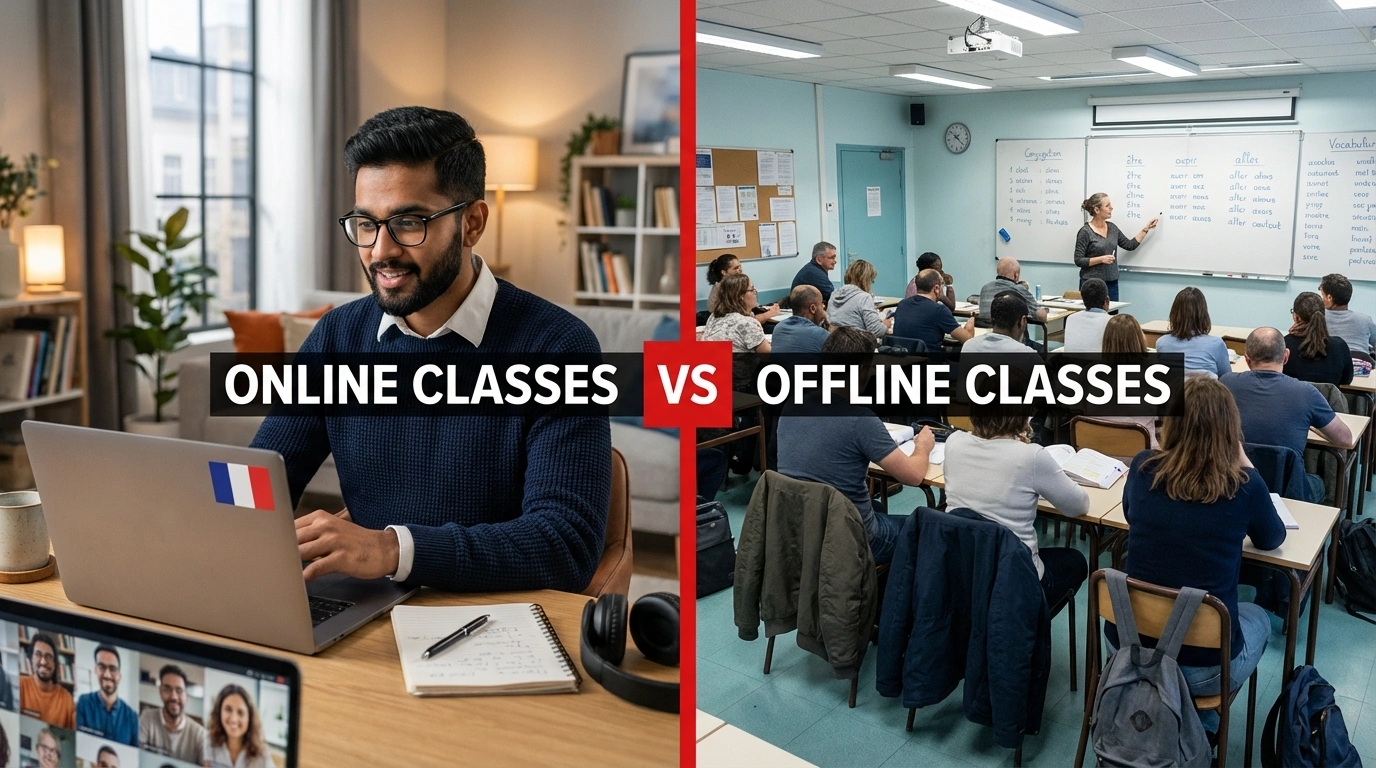
When comparing online French classes vs offline French classes for Canadian PR, online formats typically deliver faster results because of smaller class sizes (5-10 students vs 20-50 offline), more speaking time per student, flexible scheduling around work permits, and personalized feedback. Offline classes offer structured routine but often lack the individual attention needed to hit CLB 7 across all four TEF skills.
50+ Bonus CRS points for NCLC 7 in French + CLB 5 in English 379-428 CRS cut-offs for French-language draws (vs 508+ for CEC) 8-12 mo Typical timeline from zero French to NCLC 7Why do you need French for Canadian PR in 2026?
French is the single most powerful lever left in the Express Entry system. After IRCC removed arranged employment (LMIA) points in March 2025, candidates lost 50-200 points overnight. French proficiency fills that gap and then some.
Here is how the math works. Scoring NCLC 7 or higher across all four French skills (listening, reading, writing, speaking) on the TEF Canada or TCF Canada exam earns you 25 bonus CRS points. If you also have English at CLB 5 or above, that jumps to 50 bonus points. And those are just the direct points. French also qualifies you for dedicated French-language proficiency draws, which in 2025 cleared at CRS scores as low as 379, compared to 508+ for Canadian Experience Class draws.
Canada’s federal target is for 9% of all new permanent residents outside Quebec to be Francophone in 2026, climbing to 12% by 2029. That means French-language draws will keep running, with high volume, for years. If you are sitting in the Express Entry pool with a mid-range CRS score, learning French is not optional. It is your fastest path to an ITA.
What do online French classes look like for TEF preparation?
Online French classes for PR applicants are live, instructor-led sessions conducted over Zoom, Google Meet, or a dedicated platform. The key difference from offline classes is the class size: most reputable online programs cap groups at 5-10 students, and many offer 1-on-1 private sessions.
That smaller group size changes everything. In a class of 6, each student gets roughly 8-10 minutes of active speaking time per hour. In a class of 30, that drops to under 2 minutes. When your TEF speaking exam is a 15-minute face-to-face interview, the amount of speaking practice you get in class is directly tied to your exam score.
At Toronto French Academy, our online group classes are designed specifically for PR applicants. Sessions are small, interactive, and structured around the four TEF skill areas. Students also get access to recorded lessons, digital exercises, and writing assignments with personal instructor feedback.
What a typical online French class session includes
- Warm-up conversation (10 min): Every student speaks. The instructor corrects pronunciation and grammar in real time.
- Structured lesson (20 min): Grammar, vocabulary, or a TEF skill focus (listening drills, reading comprehension, writing structure).
- Paired speaking practice (15 min): Breakout rooms where you practice with a partner, simulating TEF oral scenarios.
- Review and homework (15 min): Instructor highlights individual weak points and assigns targeted practice for the next session.
What happens in a typical offline French classroom?
Offline French classes take place in a physical location (a language school, community centre, or college). You attend at a fixed time, sit with other students, and follow a curriculum set by the school. Class sizes typically range from 15 to 50 students, depending on the institution.
The structure has clear benefits. You show up, the teacher teaches, you listen and participate. There is no temptation to check your phone or multitask the way there is at home. The social pressure of being in a room with other learners keeps you engaged. And face-to-face interaction with the instructor lets you pick up on body language, lip movements for pronunciation, and the natural rhythm of French conversation.
But here is the core problem in the online French classes vs offline French classes debate for PR applicants: most offline classrooms follow a generalized curriculum designed for a wide range of learners. The student next to you might be learning French for travel. The person behind you is preparing for DELF A2. And you need NCLC 7 across all four skills in 8 months. The instructor cannot tailor the lesson to your TEF timeline when 25 other students have different goals.
The class size problem
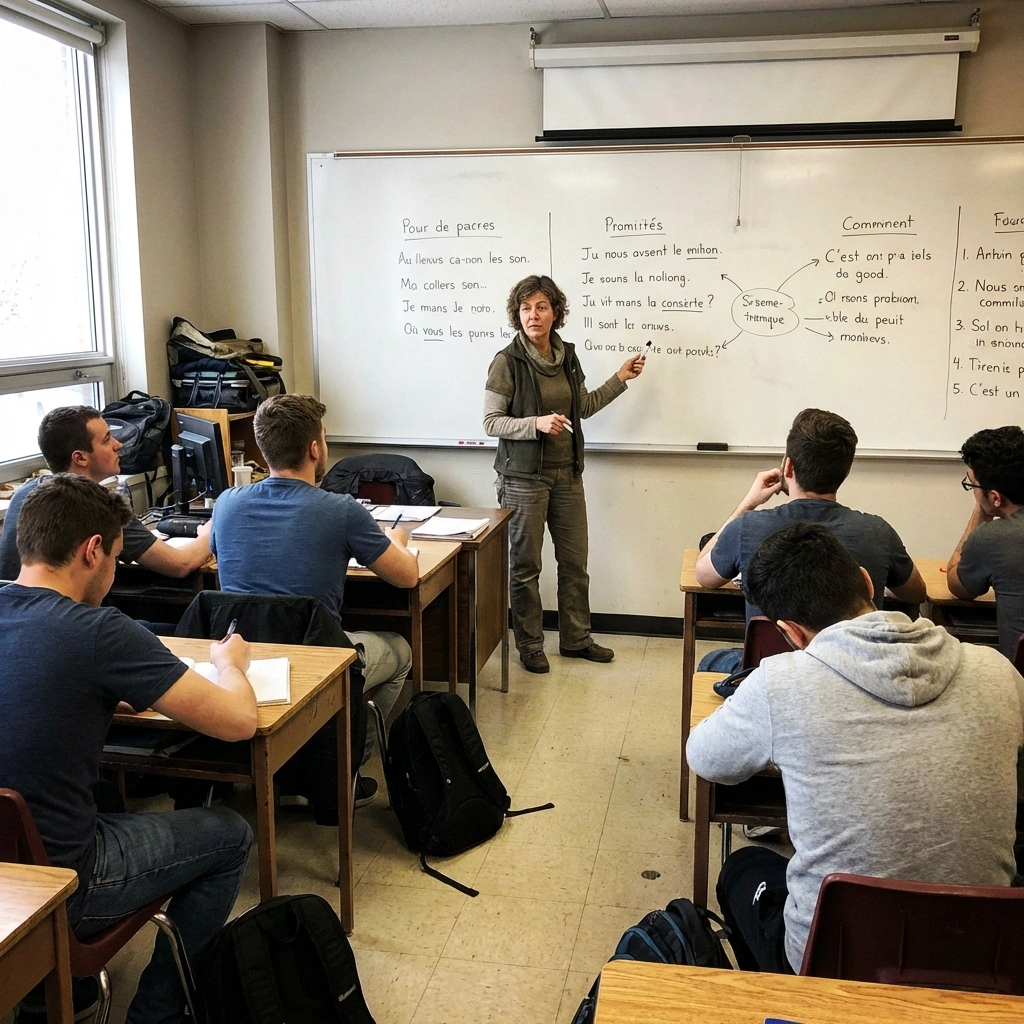
In a room of 30 students with a 60-minute class, the instructor speaks for approximately 40 minutes. The remaining 20 minutes are split across all students. That gives you roughly 40 seconds of individual speaking practice per class. Over a week with two classes, you get about 80 seconds of personalized speaking practice.
Compare that to an online class of 6 students where each person gets 8-10 minutes of speaking time, or a 1-on-1 session where you speak for 30+ minutes per hour. For an exam where speaking is 25% of your total score, the math speaks for itself.
Why does personalized attention matter for reaching NCLC 7?
Reaching NCLC 7 is not about “learning French.” It is about reaching a specific proficiency benchmark across four separate skills, each with its own scoring rubric, within a limited time window. That requires a targeted approach, not a general education.
Most PR applicants have uneven skill profiles. You might pick up listening quickly because you watch French YouTube videos, but your writing stays weak because nobody corrects your essays. Or your reading comprehension is strong from studying grammar books, but you freeze during speaking because you never practice out loud.
| Feature | Online (Small Group / 1-on-1) | Offline (Large Classroom) |
|---|---|---|
| Class size | 5-10 students (group) or 1-on-1 | 15-50 students |
| Speaking time per student/hour | 8-10 min (group), 30+ min (private) | Under 2 minutes |
| Personalized feedback | After every session, tailored to your weak skills | Generic feedback to the whole class |
| Curriculum flexibility | Adjusts to your TEF target and timeline | Fixed syllabus for the whole group |
| Weak-skill targeting | Instructor shifts focus based on your progress | All students cover the same material at the same pace |
| Writing correction | Individual essay feedback, tracked revisions | May only review 1-2 essays per student per month |
| Mock TEF practice | Regular 1-on-1 mock oral interviews | Rare, hard to simulate with 30 students |
The bottom line: NCLC 7 requires precision training, not general exposure. The more personalized your instruction, the faster you close the gaps between your current level and your target score. Online formats (especially small groups and private sessions) make that personalization possible in ways that crowded classrooms cannot.
How do online French classes vs offline French classes compare for PR applicants?
When you frame this debate around what PR applicants actually need (NCLC 7 on the TEF, within a tight timeline, while working full-time), the differences become stark.
| Factor | Online French Classes | Offline French Classes |
|---|---|---|
| Scheduling | Morning, evening, weekend options; study from home | Fixed days/times; requires commuting |
| Missed classes | Recorded sessions available to review later | Missed is missed; catch-up is your problem |
| Instructor pool | Native speakers from across the Francophone world | Limited to teachers available in your city |
| TEF-specific focus | Programs built around TEF exam structure and scoring | Often general French; TEF prep may be an add-on |
| Commute time | Zero | 30-90 minutes per class day in the GTA |
| Self-discipline required | Higher (you manage distractions at home) | Lower (classroom enforces focus) |
| Networking with peers | Online community, WhatsApp groups | Strong in-person connections |
| Best for | PGWP holders, full-time workers, anyone on a tight PR timeline | Full-time students, those who struggle to focus at home |
Which format gives you more speaking practice for the TEF?
The TEF speaking section (expression orale) is a 15-minute face-to-face interview conducted at a test centre. It accounts for 450 points out of the total TEF score and is the section where most candidates lose the points they need for NCLC 7.
You cannot pass the TEF speaking section by reading grammar books. You pass it by speaking French, out loud, with someone who corrects you, over and over again. In the online French classes vs offline French classes comparison, the format that gives you the most speaking repetitions wins.
In an online 1-on-1 session at Toronto French Academy, you spend 30-40 minutes per hour actively speaking. Your tutor simulates TEF interview scenarios, gives immediate feedback on pronunciation, grammar, and fluency, and adjusts the difficulty to push you just past your comfort zone. Over a 6-month program, that adds up to roughly 50-70 hours of focused speaking practice.

In a traditional offline class of 25 students meeting twice a week, you might accumulate 3-5 hours of individual speaking practice over the same 6 months. That is not enough to reach NCLC 7.
The single most important predictor of oral proficiency is the amount of time a learner spends actively producing speech with corrective feedback. Passive exposure, no matter how many hours, does not build speaking fluency.
Dr. Paul Nation, Professor of Applied Linguistics, Victoria University of Wellington
How much do online French classes vs offline French classes cost in Canada?
Cost matters when you are already spending money on IELTS retakes, credential assessments, and immigration consultants. When comparing the two formats, online classes are typically 20-40% cheaper, even before you factor in commuting.
| Cost Factor | Online | Offline |
|---|---|---|
| Group classes (per month) | $150 – $400 CAD | $250 – $600 CAD |
| Private tutoring (per hour) | $30 – $80 CAD | $50 – $120 CAD |
| Monthly commute (GTA) | $0 | $80 – $200 CAD (gas/transit) |
| Study materials | Included digitally in most programs | $30 – $80 for textbooks |
| Time lost to commuting (6 months) | 0 hours | 50-100+ hours |
Over a 6-month TEF preparation program, online learners save an estimated $1,000-$2,500 CAD compared to attending classes in person. And those 50-100 hours not spent commuting? You can use them for extra practice, mock exams, or rest (burnout is a real threat during intensive language study).
For a detailed breakdown of programs and pricing, visit our course information page.
Can you combine both formats for the best results?
Yes. And for many PR applicants, this is the smartest strategy. Brookings Institution research from 2024 found that blended learning students score 25% higher on standardized tests than those using a single format.
Here is a practical hybrid plan for a PR applicant targeting NCLC 7:
- Online group classes (2-3x per week): Cover grammar, vocabulary, listening, and reading through Toronto French Academy’s small-group sessions. You get personal attention in a class of 5-10, not 30.
- Weekly private online tutoring (1x per week): A 1-on-1 session focused entirely on your weakest skill. If your writing is dragging, the tutor drills expression ecrite. If speaking needs work, you do 45 minutes of mock oral interviews.
- Self-study between sessions: Review recorded lessons, complete writing assignments, practice listening with French podcasts and news.
- Monthly mock TEF exams: Full simulation of all four sections under timed conditions. This builds stamina and reveals exactly where you stand.
This approach gives you the flexibility and personalization of online learning while building the exam confidence that comes from regular, structured practice.
How do you choose the right format for your PR timeline?
Stop thinking about online French classes vs offline French classes as a lifestyle preference. Think about it as a strategic decision tied to your immigration timeline.
Choose online French classes if:
- You are working full-time on a PGWP and cannot attend fixed daytime classes
- You need NCLC 7 within 6-10 months and want maximum speaking practice per hour
- You live far from a quality French school (or outside the GTA entirely)
- Budget is tight and you need to save where you can
- You want TEF-focused instruction, not general French education
Choose offline French classes if:
- You consistently lose focus when studying at home
- You are a full-time student with a flexible daytime schedule
- You want the routine and social accountability of showing up in person
- You live walking distance from a good French school
Choose a hybrid approach if:
- You want the speed of online personalization plus in-person speaking confidence
- You have a specific weak skill (speaking, writing) that needs targeted 1-on-1 work
- Your PR timeline is tight and you cannot afford to waste months on the wrong approach
- You are at an intermediate level (B1) and need to push through to B2/NCLC 7
Ready to Start Your French Exam Preparation?
Toronto French Academy has helped 1,200+ students choose the right exam and hit their target NCLC 7 scores. Get a personalized recommendation in a free 15-minute consultation.
Book a Demo Class →Frequently asked questions about online French classes vs offline French classes
Can I reach NCLC 7 with online French classes alone?
Yes. Many Toronto French Academy students reach NCLC 7 entirely through online classes, including small-group sessions and private tutoring. The key is that your program includes regular live speaking practice with an instructor. Self-paced apps and recorded videos alone are not sufficient for the speaking and writing sections of the TEF.
How long does it take to go from zero French to NCLC 7?
For a complete beginner studying consistently (8-10 hours per week), expect 8-12 months to reach NCLC 7 across all four skills. Students with prior French knowledge from school can often reach NCLC 7 in 6-8 months. The timeline depends heavily on how much speaking practice you get, which is why class format matters so much.
Is the TEF exam taken online or in person?
The TEF Canada exam must be taken in person at an approved test centre in Canada. There is no online option for the exam itself. However, all preparation (classes, mock exams, practice exercises) can be done online. Your preparation format does not affect your exam eligibility.
Do I need both French and English for the CRS bonus points?
To get the full 50 bonus CRS points, you need NCLC 7+ in all four French skills and CLB 5+ in English. If you have French at NCLC 7+ but English below CLB 5, you still receive 25 bonus points. For most PR applicants who already have strong IELTS scores, the 50-point bonus is achievable. Learn more in our Express Entry French requirements guide.
Are large offline classrooms effective for TEF preparation?
Large classrooms (20-50 students) can teach grammar and vocabulary effectively, but they fall short on speaking and writing practice. With limited individual attention, it is difficult for instructors to identify and address each student’s weak areas. For TEF preparation specifically, smaller online groups or private tutoring deliver faster, more targeted results.
What if I am not disciplined enough to study online?
This is a valid concern. If you know you lose focus at home, consider a hybrid approach: attend live scheduled online sessions (not self-paced), which create accountability, and supplement with occasional in-person sessions. Programs with fixed weekly schedules, homework deadlines, and instructor check-ins also help build discipline. Toronto French Academy’s WhatsApp community also provides peer support and accountability.
Which is better for TEF, private tutoring or group classes?
Both work well, but they serve different purposes. Group classes (5-10 students) are cost-effective and provide peer interaction for conversation practice. Private tutoring gives you 100% of the instructor’s attention and is ideal for targeting specific weak skills. Many successful TEF candidates use a combination: group classes for structure and private sessions for intensive speaking or writing work.
What is the final verdict on online vs offline French classes for Canada PR?
If you are learning French for Canadian permanent residency, the online French classes vs offline French classes decision comes down to one question: which format gives you the most personalized, TEF-focused instruction in the time you have?
For most working PR applicants, online classes win. Smaller groups, more speaking time, flexible scheduling, lower cost, and the ability to work with TEF-specialized instructors from anywhere in Canada. Offline classes still have a place for learners who need external structure or prefer face-to-face interaction, but the large class sizes common in physical schools make it harder to get the individual attention you need to reach NCLC 7.
The smartest approach combines both: online classes for the core of your learning, supplemented by targeted speaking practice that simulates real TEF conditions. That is exactly what Toronto French Academy’s TEF preparation program is built to deliver. Get in touch and let us help you build a study plan that fits your timeline, your budget, and your PR goals.
With over 8 years of experience in French language education and 1,200+ students guided through TEF and TCF preparation, Jasmine leads TFA’s mission to help Canadian immigration applicants achieve their French proficiency goals.