

The short answer
Quick answer: NCLC (Niveaux de compétence linguistique canadiens) is Canada’s French-proficiency scale, the French twin of the English CLB. For Canadian PR the target is NCLC 7 in all four skills — the low end of CEFR B2.
| Skill | TEF Canada — NCLC 7 | TCF Canada — NCLC 7 |
|---|---|---|
| Listening | 249–279 out of 360 | 458–502 out of 699 |
| Reading | 207–232 out of 300 | 453–498 out of 699 |
| Writing | 310–348 out of 450 | 10–11 out of 20 |
| Speaking | 310–348 out of 450 | 10–11 out of 20 |
NCLC 7 in all four skills earns the Express Entry French bonus (+25 with little or no English, +50 with CLB 5+ English) and French-language draws. Convert any score with the TEF score chart or TCF score chart. CEFR crosswalk: NCLC 5–6 is roughly B1, NCLC 7–8 roughly B2 (CEFR levels guide). Bands verified against IRCC (canada.ca), August 21, 2026.
Achieving NCLC 7 is the single most important milestone for any French learner looking to secure permanent residency in Canada. If you are navigating the Express Entry pool, you’ve likely realized that while international schools talk about A1 or B2, the Canadian government only speaks in NCLC (Niveaux de compétence linguistique canadiens). This can feel like learning a second language just to understand your test results, but knowing this scale inside out is what ultimately separates a profile that sits in the pool from one that gets an Invitation to Apply (ITA).
For most of our students, the target isn’t just “being good at French”; it’s hitting that specific threshold where the points jump and new pathways open up. Whether you are taking the TEF Canada or TCF Canada, your raw scores are immediately converted into these benchmarks across four individual skills: reading, writing, listening, and speaking. Understanding where you sit on the 1-to-12 scale tells you exactly how much further you need to go to earn the French-language bonus or qualify for a French-language category draw.
On this page
- What Are NCLC Levels?
- NCLC vs CLB: The French and English Equivalents
- All NCLC Levels in Simple Terms
- What Is NCLC 7, Exactly?
- How Many CRS Points Is NCLC 7 Worth?
- French-Language Draws: The Other Door NCLC 7 Opens
- How TEF and TCF Scores Convert to NCLC
- NCLC and Quebec Immigration
- How NCLC Levels Compare with CEFR
- What Level of French Is Required for Canada PR?
- NCLC Levels in Provincial Nominee Programs (PNPs)
- How Long Does It Take to Reach NCLC 7?
- What Reaching NCLC 7 Changes: A Worked Example
- NCLC Levels FAQ
What Are NCLC Levels?
The Niveaux de compétence linguistique canadiens (NCLC) is the official national standard used by the Canadian government to measure and recognize the French language proficiency of adult immigrants. It is a 12-level framework, ranging from Level 1 (initial basic) to Level 12 (advanced professional), and Immigration, Refugees and Citizenship Canada (IRCC) uses it to set the eligibility floors for its immigration programs.
For anyone sitting the TEF Canada or TCF Canada, understanding the NCLC scale is a practical necessity. Your raw test results do not translate to NCLC levels on a 1:1 basis; instead, they are automatically converted into these benchmarks across the four skills of reading, writing, listening, and speaking. This conversion is what ultimately determines your Express Entry eligibility and your overall Comprehensive Ranking System (CRS) point potential.
NCLC vs CLB: The French and English Equivalents
You might be more familiar with the Canadian Language Benchmarks (CLB) — but the CLB is strictly for English. The NCLC is its French-language counterpart, and although they are separate frameworks, they are not simple translations of one another. Both function as 12-level scales built on the same structure, which is why immigration programs state their requirements as “CLB/NCLC” levels.
One distinction we correct in almost every first consultation: the NCLC is a framework, not an exam. The Centre for Canadian Language Benchmarks — the body that maintains it — publishes it as a descriptive standard, not a test you sit. You never “take the NCLC.” You take the TEF Canada or TCF Canada, and your scores are read against the NCLC ruler.
| Language | Benchmark scale | Accepted tests |
|---|---|---|
| English | CLB (Canadian Language Benchmarks) | IELTS General, CELPIP-General |
| French | NCLC (Niveaux de compétence linguistique canadiens) | TEF Canada, TCF Canada |
Your French test result is reported as an NCLC level for each skill separately, so four skills can land on four different levels — and for most requirements, your lowest skill is the one that counts.
All NCLC Levels in Simple Terms
Understanding where you fall within the NCLC levels is the most practical step you can take toward your Canadian immigration goals. Here is what these benchmarks actually look like in your day-to-day life and career.
| NCLC Level | Proficiency Stage | Practical Communication Ability | Impact on Canadian PR |
|---|---|---|---|
| NCLC 9 to 12 | Advanced / Expert | Can handle complex, professional debates and specialized technical topics with ease. | Maximizes core CRS points; highly competitive in general draws. |
| NCLC 7 & 8 | Upper Intermediate | Can discuss abstract ideas, follow professional conversations, and write structured texts. | The PR target band: qualifies you for French-category draws and the French-language bonus. |
| NCLC 5 & 6 | Intermediate | Can manage daily interactions and short work discussions on familiar topics. | Minimum for some trades and lower-TEER occupations; no bonus points. |
| NCLC 1 to 4 | Basic / Elementary | Can handle basic survival French, such as simple introductions and routine shopping. | Generally insufficient for skilled PR; NCLC 4 is the citizenship minimum. |
Basic Proficiency (Levels 1–4)
At this stage, you are handling the absolute essentials. You aren’t debating policy or writing reports, but you can navigate a French-speaking environment without getting lost.
- At work: You can manage simple, routine tasks where the language is predictable.
- Daily life: You can handle basic social interactions, like shopping for groceries or asking for simple directions.
- Concrete example: You can greet a coworker in the morning and successfully explain which desk is yours.
Intermediate Proficiency (Levels 5–8)
This is the “bridge” zone — and note that the immigration-critical line runs through the middle of it: NCLC 7 is where the PR benefits start. You can function independently in both professional and personal contexts, though you might still struggle with high-level nuance or complex, abstract arguments.
- At work: You can contribute to team meetings, understand most of what is said, and write clear emails about your tasks.
- Daily life: You can navigate government services, tell detailed stories about your past, and make appointments over the phone.
- Concrete example: You write a follow-up email to your manager summarizing the key action items from your weekly status meeting.
Advanced Proficiency (Levels 9–10+)
At this level, French is a tool for your expertise. You can handle complexity, respond to unexpected challenges, and understand implied meaning, which is critical for senior roles.
- At work: You can lead meetings, negotiate solutions with colleagues, and provide detailed technical or professional advice.
- Daily life: You can discuss abstract concepts — politics, social issues, complex personal experiences — with confidence and precision.
- Concrete example: You lead a brainstorming session where you have to disagree with a colleague’s idea and propose a strategic alternative, all while maintaining a professional tone.
What Is NCLC 7, Exactly?
NCLC 7 is the “adequate intermediate” proficiency benchmark on the Canadian language scale, and it is the functional gatekeeper for your permanent residency application. Think of it as the point where your French stops being something you are just studying and becomes a tool you actually use to navigate a professional Canadian environment.
To be clear, hitting NCLC 7 isn’t about becoming a poet or a specialist in obscure French literature; it is about independence. On the European CEFR scale, it sits at the low end of B2 (Upper Intermediate). You are past the survival phase. You can handle a heated team meeting, parse a complex government policy document, and write a report that makes your point clearly without needing a dictionary for every third word.
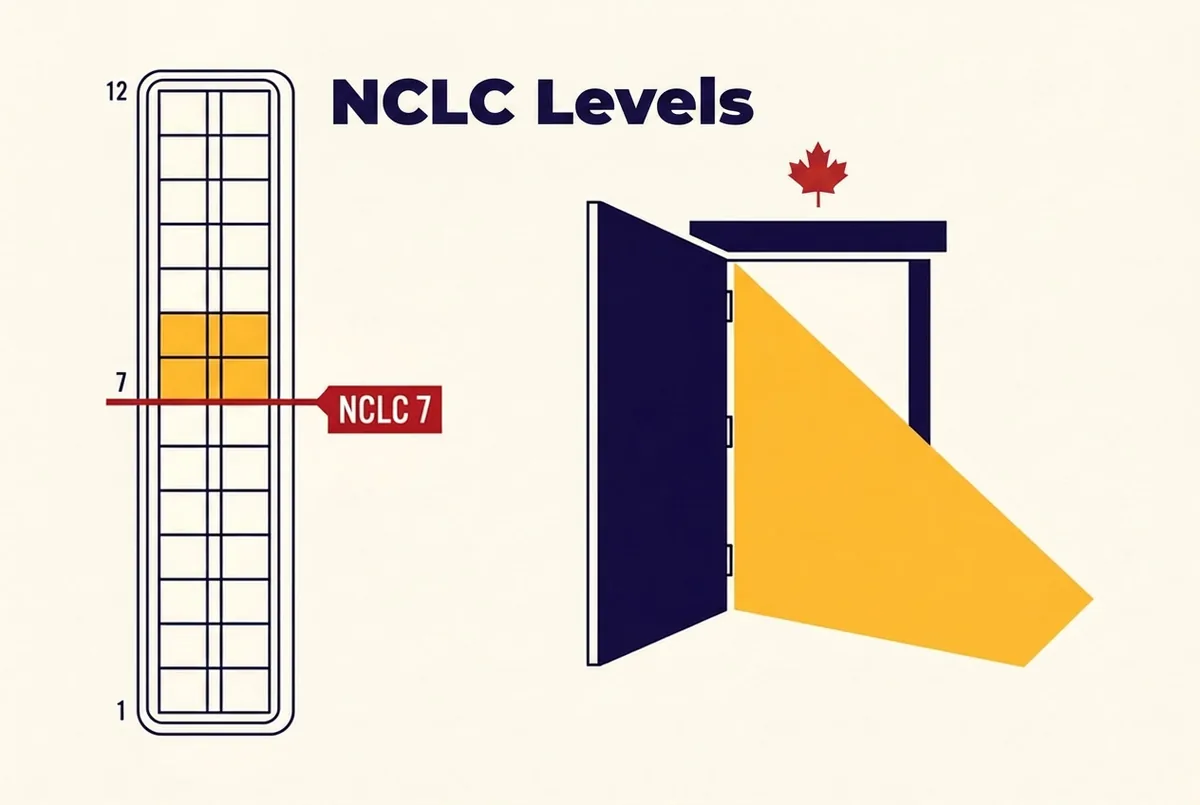
Here is what NCLC 7 actually demands across the board:
- Listening: You don’t just hear words; you capture the tone and the intent. You can follow abstract discussions in a meeting and understand when someone is hinting at a problem rather than stating it outright.
- Speaking: You can hold your own. You can defend an idea, pivot when the conversation changes topics, and adjust your register whether you’re talking to a client or a colleague.
- Reading: You can process argumentative texts and news articles. You get the main idea and the supporting details, and you understand the underlying purpose of the writer.
- Writing: You can produce organized, coherent text. Your paragraphs follow a logical structure, and you use connectors properly to build a cohesive argument.
Why does this specific number matter so much? Because in the eyes of IRCC, NCLC 7 is the “all-or-nothing” threshold. If you score NCLC 8 in three categories but NCLC 6 in one, you don’t “average” your way to a win. You lose the French bonus points, and you miss the cut-off for French-category draws entirely. For immigration, NCLC 7 is the floor that validates your profile.
How Many CRS Points Is NCLC 7 Worth?
If you are hunting for permanent residency, stop looking at French as just a “nice to have” skill. It is your single most effective lever for boosting your CRS score outside of a provincial nomination. Under current Express Entry rules, French doesn’t just grant you core language points — it triggers a dedicated, high-value French-language bonus.
The “All-or-Nothing” Threshold
Before we talk about points, you must understand the condition: to access any bonus points or French-category draw eligibility, you must score at least NCLC 7 in all four French skills — reading, writing, listening, and speaking. If you score NCLC 8 in three categories but NCLC 6 in one, you get zero bonus points and zero French-category eligibility. Your profile is assessed on your weakest skill.
If you clear that threshold across the board, your bonus depends entirely on your English proficiency (measured by CLB level):
| French result (all four skills) | English result | CRS bonus |
|---|---|---|
| NCLC 7 or higher | CLB 4 or lower, or no English test | +25 points |
| NCLC 7 or higher | CLB 5 or higher in all four skills | +50 points |
Why This Matters
If you already have decent English (CLB 5 is intermediate), adding that second language is the fastest way to double your bonus from 25 to 50 points. This is separate from the core “second official language” points you earn for each ability level. When you stack those core French points on top of the 50-point bonus, a single applicant is looking at a total potential gain of up to 74 CRS points (the second-language cap is 24 points if you’re applying alone, 22 with a spouse) — a gap large enough to completely change your rank in the Express Entry pool and get you that Invitation to Apply (ITA).
Do not guess your level. Take a mock test, identify your weakest skill, and train until all four hit the NCLC 7 line. That is the only way to lock in your CRS boost.
French-Language Draws: The Other Door NCLC 7 Opens
If you are relying solely on your age, work experience, or education to get you into Canada, you are playing the “points race” — and it is a race that is getting significantly harder to win. The real strategic shift for many of our students isn’t just the 50-point CRS bonus for bilingualism; it is eligibility for French-language category Express Entry draws.
How IRCC’s Targeted Draws Actually Work
Since 2023, IRCC has used “category-based selection” to reach past the general pool rankings. When IRCC holds a French-language draw, it stops looking at the general pool of candidates and zooms in exclusively on those who have verified French proficiency. If you meet the requirement, you aren’t competing against every engineer, manager, and tech worker in the system; you are competing only against other French speakers.
The NCLC 7 Floor
To get into this specific pool, the barrier to entry is non-negotiable: you must demonstrate NCLC 7 proficiency in all four skills. There is no averaging your scores here. This is why we tell our students: do not book your test until you are consistently hitting 7s in your practice exams.
Why the Math Favours You
The difference between these targeted draws and general draws is massive. Look at the 2026 data: the ten French-language draws held to mid-August cleared CRS cut-offs between 382 and 420, while Canadian Experience Class (CEC) draws have consistently remained above 500 (as of August 2026, per IRCC’s published rounds). That is a 100+ point gap.
In practical terms, this means that while a candidate in the general pool is stuck waiting for their CRS to climb — hoping for extra work experience or another degree — you can receive an Invitation to Apply with a score that would be considered “non-competitive” in a general round. This isn’t just about French; it is about using the system exactly as IRCC designed it. If you can reach the level, stop waiting for the general cut-off to drop and start aiming for the French-category draw — our French for Canada PR guide walks through the full strategy.
How TEF and TCF Scores Convert to NCLC
When you are preparing to hit NCLC 7, you aren’t just learning French — you are learning to work with a scoring system. IRCC does not look at your raw exam results; it looks at the NCLC level those results convert into. Whether you choose the TEF Canada or the TCF Canada, both exams report your performance in bands that map to the 1-to-12 NCLC scale for every single skill.
- The conversion logic: the two exams use different scoring scales. TCF Canada, for instance, uses a 0–699 scale for listening and reading but a 0–20 scale for writing and speaking. If you don’t use the correct conversion chart, you are flying blind.
- The one-weak-skill trap: you cannot “average out” a bad result. If you score NCLC 8 in three skills but land in the NCLC 6 band in the fourth, you have missed the NCLC 7 threshold. Your application requires a 7 in all four.
The TEF two-column trap. If you take the TEF Canada, your attestation shows two sets of numbers — a newer “Score /699” column and an “Équivalence ancien score” column. For Express Entry, IRCC’s conversion table currently reads from the ancien score values. We regularly see students target the wrong column and believe they’ve cleared NCLC 7 when they haven’t — or panic when they actually have. Our TEF Canada score chart breaks down both columns band by band. TCF Canada test-takers can relax: that scale never changed, so there is only one set of numbers to read.
How the conversion works in practice. Take a hypothetical TEF result (ancien-score values): Speaking 335, Listening 260, Reading 215, Writing 309. Each skill converts separately against the IRCC table:
| Skill | TEF score | NCLC level |
|---|---|---|
| Speaking | 335 | NCLC 7 |
| Listening | 260 | NCLC 7 |
| Reading | 215 | NCLC 7 |
| Writing | 309 | NCLC 6 |
Three skills clear the bar — and this candidate still does not have NCLC 7, because writing landed one point under the 310 floor. One point, in one skill, and the French-language bonus and the French-category draws are off the table until a retake. This is exactly why we drill students on their weakest skill in the final weeks of prep, not their strongest.
Two more mistakes worth naming, because we see them weekly: preparing against an outdated conversion chart (tables from before the TEF score revision still circulate on forums — always work from the current IRCC page or our score charts, which we keep synced to it), and checking only one program’s requirements (your threshold depends on your exact program and TEER category — confirm your program’s page, not a generic “NCLC 7” rule of thumb).
Here are the TEF Canada bands around the NCLC 7 line (per-skill scores):
| Skill | NCLC 7 (B2) | NCLC 8 | NCLC 9+ (C1) |
|---|---|---|---|
| Listening | 249–279 | 280–297 | 298+ |
| Reading | 207–232 | 233–247 | 248+ |
| Writing | 310–348 | 349–370 | 371+ |
| Speaking | 310–348 | 349–370 | 371+ |
So if your TEF Canada listening score is 260, you are at NCLC 7 for that skill — on track for the French bonus, provided the other three skills reach the line too. Know your exact targets before you even start test prep: our TEF Canada score chart and TCF Canada score chart map the current IRCC bands for every skill and every level from NCLC 4 to 10. Use them to diagnose your practice level and set a concrete numerical target for each skill.

NCLC and Quebec Immigration
If you are applying through Quebec, note that Quebec runs its own selection system — and its own 12-level French scale (the échelle québécoise) rather than the NCLC. The levels are broadly comparable, and French carries heavy weight in Quebec’s Arrima points grid.
| Quebec Program | Minimum French Requirement | Notes |
|---|---|---|
| Quebec Skilled Worker Program (QSWP) | B2 (level 7 oral) | Needed for strong points in the selection grid |
| PEQ (Experience Program) | B2 (speaking & listening) | Required for eligibility |
| Quebec Business Immigration | Intermediate French | Additional points for French ability |
The stronger your French level, the stronger your profile becomes for Quebec selection — the same B2 preparation that earns NCLC 7 federally serves a Quebec application too.
How NCLC Levels Compare with CEFR
If you have studied French using CEFR levels (A1–C2), this chart connects the two systems.
| CEFR | NCLC | Description |
|---|---|---|
| A1 | NCLC 1–2 | Beginner |
| A2 | NCLC 3–4 | Elementary |
| B1 | NCLC 5–6 | Intermediate |
| B2 | NCLC 7–8 | Upper Intermediate |
| C1 | NCLC 9–10 | Advanced |
| C2 | NCLC 11–12 | Near-native fluency |
The mapping is approximate — the two scales were built for different purposes — but it is a reliable planning anchor: when preparing for the TEF Canada or TCF Canada, aim for solid B2 competency to reach NCLC 7 or higher.
What Level of French Is Required for Canada PR?
The answer isn’t a single number — it depends on your immigration pathway. That said, NCLC 7 has become the functional standard for most competitive candidates in the Express Entry system. Here is the breakdown by scenario:
1. Express Entry & Federal Skilled Worker Program (FSWP): if you are declaring French as your first official language, you need NCLC 7 in all four language abilities to meet the program minimum and claim competitive points.
2. French-language category draws: to qualify for targeted French draws — which have significantly lower CRS cut-offs than general draws — you must reach at least NCLC 7 in all four skills. There is no averaging; NCLC 8 in three skills with NCLC 6 in one does not qualify.
3. Canadian Experience Class (CEC): your requirement depends on your job’s TEER category — TEER 0 or 1 occupations need NCLC 7 in all four skills; TEER 2 or 3 occupations need NCLC 5 in all four skills.
4. The CRS French-language bonus: the 25 or 50 additional points require NCLC 7 or higher in all four French skills. This is an all-or-nothing threshold; one skill below NCLC 7 disqualifies you from the bonus entirely.
5. Canadian citizenship (ages 18–54): the bar is much lower because the goal is community integration rather than economic selection — NCLC 4 in speaking and listening only. Reading and writing are not assessed.
The bottom line: if your goal is Express Entry, stop looking for the “minimum” and start aiming for NCLC 7. It is the threshold that earns the bonus points, opens the targeted draws, and gives you the highest probability of receiving an Invitation to Apply.
NCLC Levels in Provincial Nominee Programs (PNPs)
Several provinces outside Quebec run French-speaking immigration streams — Ontario’s French-Speaking Skilled Worker stream is the best known, and provinces including Manitoba and New Brunswick operate francophone initiatives of their own. Each province sets its own French threshold, typically somewhere in the NCLC 5–7 range, and verifies it with the same TEF Canada or TCF Canada results.
These programs exist to grow francophone communities outside Quebec, so they actively favour candidates with proven French. Requirements change often, though — always confirm the current threshold on the province’s official immigration page before building your plan around a stream.
How Long Does It Take to Reach NCLC 7?
There is no universal answer, but there is a clear reality based on the hundreds of students we’ve coached. If you are starting from zero — no functional French at all — you are looking at a 12-to-18-month commitment with consistent study. That is roughly 600 to 750 hours of active, focused work: the ~500–600 guided-study hours it takes to reach functional B2, plus test-specific preparation on top.
Realistic Timelines Based on Your Starting Point
Your current level dictates your roadmap. Don’t look at best-case-scenario marketing; look at the math of language acquisition:
| Starting point | Typical time to NCLC 7 | What the phase looks like |
|---|---|---|
| Beginner (A0–A1) | 12–18 months | Building grammar and vocabulary from scratch — a marathon, not a sprint |
| Elementary (A2) | 8–10 months | You have the basics; now structure them for test performance |
| Intermediate (B1) | 3–6 months | The final push: test-specific precision, vocabulary breadth, and speed |
Why Intensity Changes Everything
Study intensity is the biggest variable in your timeline. Studying 30 minutes, three times a week, will not get you to NCLC 7; it will barely keep you at your current level. To hit this benchmark, you need a daily habit — ideally 1 to 2 hours of focused work.
Consistency is the multiplier. A student who studies 1 hour every single day will reach their target months faster than a student who tries to cram 8 hours into a Saturday. Your brain needs time to consolidate the language patterns, vocabulary, and nuances before you can deploy them under the pressure of a test.
The Plateaus That Slow You Down
Everyone hits a wall, usually right around the B1 level. You feel like you “speak French,” but you realize you cannot yet handle the abstract, argumentative, or technical topics that NCLC 7 demands.
- The B1-to-B2 trap: many students stall here because they stop studying actively and just consume content. Understanding a French podcast is great, but it is not the same as writing a cohesive, structured argument or holding your own in a formal discussion.
- Test-specific blind spots: if you ignore the format of the TEF or TCF Canada until the last minute, you will waste months. You need to shift from “general French learner” to “test candidate” — learn how to structure your thoughts within the constraints of the test, from formal email formats to timed speaking tasks.
If you are serious about PR, treat your learning as a project. Measure your progress, identify your weakest skill, and adjust your study plan weekly. It is a long climb, but it is entirely predictable if you put in the hours.
For the TEF Canada version of that project — the exact scores per module, a week-by-week study plan and what changes at each starting level — see our guide on how to get CLB 7 in TEF Canada.
What Reaching NCLC 7 Changes: A Worked Example
Most of the questions we get from students start the same way: “I’m stuck at 470 CRS — is learning French from zero actually worth the year of study?” The answer isn’t in a brochure; it’s in the math. Take a hypothetical candidate — call them Alex — who is 30 years old, holds a Master’s degree, has three years of foreign work experience, and has strong English (CLB 9).
Before French: Alex’s CRS score is 470. In the current Express Entry landscape that is respectable but insufficient: with general draw cut-offs consistently above 500, Alex is waiting in the pool for a low-cut-off event that may never come, purely reactive to draw cycles.
After reaching NCLC 7 in all four skills:
- Core points: 470 (unchanged)
- Second official language: +12
- French-language bonus: +50 (English CLB 5+ in all four skills, French NCLC 7+ in all four)
- New total CRS: 532
With 532, Alex moves from “waiting” to “competitive” for general draws — and, more importantly, opens a second door: the French-language category draws, where 2026 cut-offs have ranged from 382 to 420. By reaching NCLC 7, Alex now has two different paths to an Invitation to Apply. That is why NCLC 7 isn’t just another language milestone — it is a structural change to your entire immigration plan.
A Real TFA Student Outcome
The math is not hypothetical for our students. Amandeep came to Toronto French Academy with CLB 9 English and a CRS score of 465. After 8 months of French study he reached NCLC 7, and his score jumped to 515 — earning him an ITA in the next draw. That is the practical power of the French-language bonus, and why understanding NCLC levels early can change your entire immigration strategy.
NCLC Levels FAQ
What are NCLC levels?
NCLC (Niveaux de compétence linguistique canadiens) is Canada’s 12-level scale for French proficiency — the French equivalent of the English CLB. IRCC uses your NCLC results to assess eligibility and award points in Express Entry.
What is NCLC 7?
NCLC 7 is upper-intermediate French, roughly the low end of CEFR B2. On the TEF Canada it means listening 249+, reading 207+, writing 310+ and speaking 310+; on the TCF Canada, listening 458+, reading 453+, and 10+ in writing and speaking.
What is the difference between NCLC and CLB?
They are the same 12-level Canadian benchmark scale in two languages: CLB (Canadian Language Benchmarks) measures English, NCLC measures French. CLB 7 and NCLC 7 describe the same proficiency level.
What level of French is required for Canada PR?
For most Express Entry programs the working target is NCLC 7 in all four skills. CEC accepts NCLC 5 for TEER 2–3 occupations, and Canadian citizenship requires only NCLC 4 in speaking and listening (ages 18–54).
How many CRS points does NCLC 7 give you?
NCLC 7 or higher in all four French skills earns 25 additional CRS points if your English is CLB 4 or lower (or untested), and 50 points if you also have CLB 5 or higher in all four English skills. It also qualifies you for French-language category draws.
What NCLC level is B2?
NCLC 7–8 corresponds roughly to CEFR B2 (upper-intermediate). NCLC 5–6 maps to B1, and NCLC 9–10 reaches into C1.
Which exams give you an NCLC level?
IRCC accepts two French tests: TEF Canada and TCF Canada. Both report raw scores that convert to NCLC levels using IRCC’s published equivalency charts.
Do all four skills need NCLC 7 for the French bonus?
Yes. IRCC assesses listening, reading, writing and speaking separately, and the French bonus requires NCLC 7 or higher in all four. If one skill falls below 7, the bonus and French-draw eligibility are lost regardless of the other results.
How long are my language test results valid?
Two years from the test date. Your results must still be valid when you submit your Express Entry profile and when you file your PR application — if they expire before then, you need to retest.
Is NCLC 7 required for the Francophone Mobility work permit?
No. Francophone Mobility requires NCLC 5 in speaking and listening only. It is often confused with Express Entry French draws, which do require NCLC 7, but the work permit is a separate, lower-threshold program.
Should I pick TEF Canada or TCF Canada for NCLC 7?
Both are fully accepted by IRCC, and neither is systematically easier. Choose the format that suits your test-taking style — TEF often feels more structured, TCF more straightforward — and stick with it to learn its question types.
Does NCLC 7 guarantee an Invitation to Apply?
No. NCLC 7 qualifies you for French-language draws and earns the bonus points, which drastically improve your odds, but your CRS score and each draw’s cut-off still determine whether you receive an ITA.
Is the NCLC a French test I can take?
No — and this confuses almost everyone at first. The NCLC is the measuring scale, not a test. The only way to get an official NCLC level for immigration is to take an approved test — TEF Canada or TCF Canada — and convert each of your four scores using IRCC’s table.
Does Quebec use the same NCLC rules?
Not necessarily. Quebec runs its own immigration programs with its own French-evaluation rules and accepted test versions. The NCLC thresholds in this guide apply to federal programs like Express Entry. If you are applying through a Quebec program, verify the current requirements on Quebec’s own immigration pages.
Toronto French Academy
Getting to NCLC 7
Reaching NCLC 7 is a long climb, but you don’t have to make it alone. At Toronto French Academy, we have specialized in taking students from B1 to NCLC 7 for Canadian immigration since 2018 — with a 4.8-star average across 316+ Google reviews. Whether you prefer group classes starting at $249/month or personalized private tutoring, we are here to get you there. When you are ready, book a demo class and get assessed against both exam formats.
Book a Demo ClassTutor-led level check