
On this page
Reaching NCLC 7 is not about memorizing one perfect essay or a speaking script. You need enough French to understand unfamiliar material, organize an argument, interact under pressure — and repeat that performance across four different test formats. The efficient route: find your weakest required skill, train the real TEF task, get regular feedback, and let timed simulations tell you when you are ready.
CLB 7 or NCLC 7? Let’s Fix the Label First
For French, the correct immigration label is NCLC 7, not CLB 7: IRCC uses Canadian Language Benchmarks (CLB) for English and Niveaux de compétence linguistique canadiens (NCLC) for French.
People search “how to get CLB 7 in TEF Canada,” so this guide uses the familiar phrase where it helps. But your French result is assessed as NCLC. That distinction is not pedantry — it helps you read official tables correctly and keeps English and French results out of the same mental soup.
NCLC 7 is often described as approximately B2 on the CEFR scale. Treat that as orientation, not an immigration conversion: a B2 certificate does not replace the skill-by-skill NCLC score IRCC uses. Our NCLC levels guide covers the full framework.
And if IELTS is your reference point: CLB 7 is roughly an IELTS 6.0 across all four skills. But IELTS only proves English — for French, IRCC accepts exactly two exams: TEF Canada and TCF Canada.
What TEF Canada Score Do You Need for CLB 7?
The TEF Canada CLB 7 score is four separate minimums: 207 reading, 249 listening, 310 writing and 310 speaking in the “Équivalence ancien score” column.
Your certificate also shows a newer “Score / 699” column. Both are legitimate TEF scales. Only one currently goes into Express Entry.
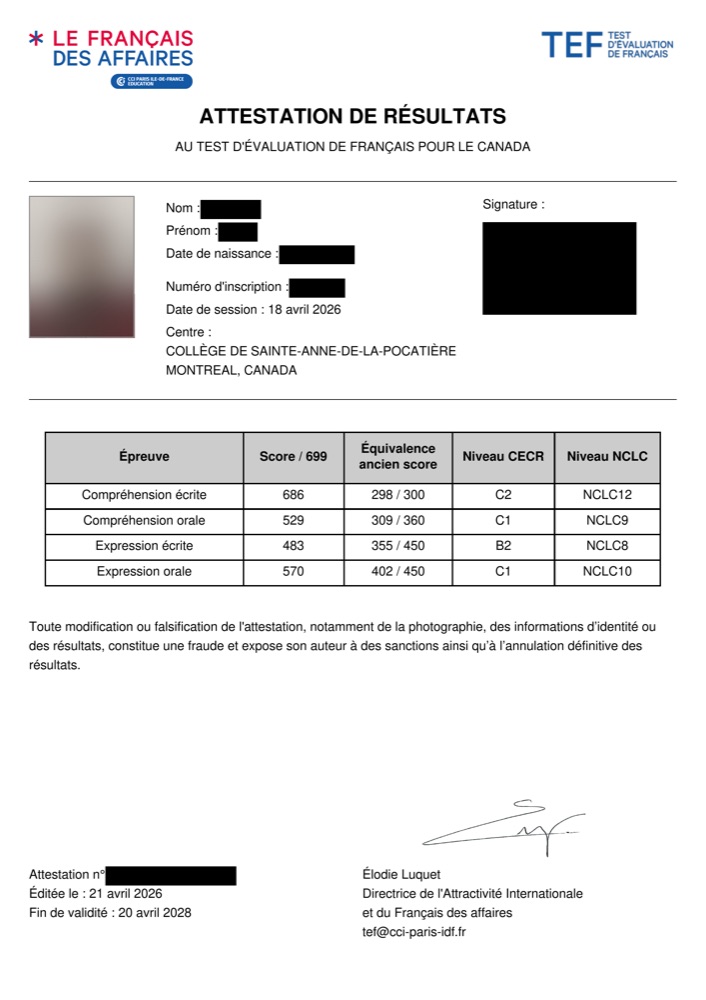
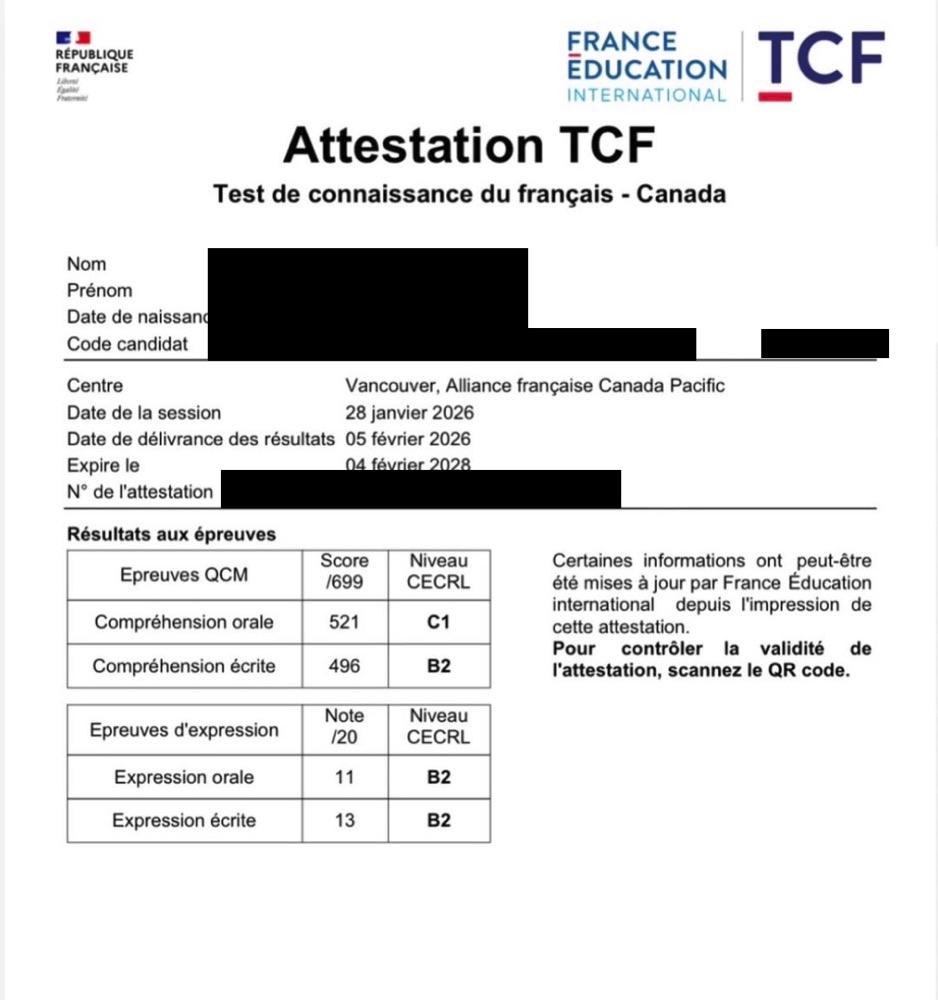
Real TEF Canada results from real students — proving CLB 7 is possible.
| Skill | NCLC 7 · Score / 699 | NCLC 7 · Équivalence ancien | Minimum for Express Entry |
|---|---|---|---|
| Reading (compréhension écrite) | 434–461 | 207–232 | 207 |
| Listening (compréhension orale) | 434–461 | 249–279 | 249 |
| Writing (expression écrite) | 428–471 | 310–348 | 310 |
| Speaking (expression orale) | 456–493 | 310–348 | 310 |
Do not mix the two scales. IRCC says to enter only the “Équivalence ancien score” values in your Express Entry profile — explicitly not the “Score / 699” figures. Several ranking pages publish one column without naming it; at least one misstates the legacy scores. When your PR application is involved, “close enough” is a terrible data-entry strategy. Check your scores against your certificate with our TEF score chart.
Finally: you need NCLC 7 in every required skill. Reading at NCLC 10 does not compensate for speaking at NCLC 6. There is no overall average that rescues the weak score.
Why CLB 7 Is Important for PR
CLB 7 matters because it can unlock 25 or 50 additional CRS points for French and eligibility for the French-language proficiency category — provided you reach it in all four French skills.
IRCC’s current CRS criteria award:
- 25 additional CRS points for CLB 7 or higher in all four French skills when your English is CLB 4 or lower, or you did not take an English test.
- 50 additional CRS points for CLB 7 or higher in all four French skills when your English is CLB 5 or higher in all four skills.
And here is the part most people miss.
The 50 points are not even the main prize. The main prize is the French-language draws — dedicated Express Entry rounds reserved for candidates with CLB 7+ French, under IRCC’s category-based selection.
In 2026, every French-language draw so far has invited at CRS 382–420. Canadian Experience Class draws in the same months cleared 516+.
That is a 100-plus-point discount, just for French. A profile that would wait years in the general pool can be invited in months through the French category. (Cut-offs from IRCC’s published rounds, checked August 26, 2026.)
For program eligibility: the Federal Skilled Worker Program requires CLB 7 in all four abilities when French is your first official language; under the Canadian Experience Class, TEER 0 or 1 work requires CLB 7 and TEER 2 or 3 requires CLB 5. Those are thresholds, not promises of an invitation — your full profile still matters.
How Hard Is It to Get CLB 7 in French?
Yes — absolutely.
Let’s not sugarcoat this: if you’re a complete beginner learning French for the first time, getting to CLB 7 is genuinely hard.
And there is no way to hack the TEF exam.
The scoring is calibrated. The listening plays once (and briefly turns reasonable adults into Victorian ghosts). The speaking test is a live conversation with a real examiner. The format is built so that only real French survives it — which is why the bottleneck is usually speaking or writing, where every gap shows.
What you can do is prepare so thoroughly that your result stops depending on luck.
Train on mock tests in the real TEF Canada format. Attack your weakest points deliberately — not what feels comfortable. And keep going until you score CLB 7 consistently across your mocks, not once on a good day. The same logic applies to TCF Canada.
To get CLB 7 in TEF Canada: practise mock tests, consistently.
How Long Does It Take to Get CLB 7 in French?
This is the number-one question we get asked.
And the truthful answer is: it depends.
Generally speaking, a complete beginner starting from scratch needs about 8 to 12 months to reach CLB 7.
If you already have some basics — roughly A2 or B1 — plan for about 4 to 6 months of consistent, TEF-focused practice.
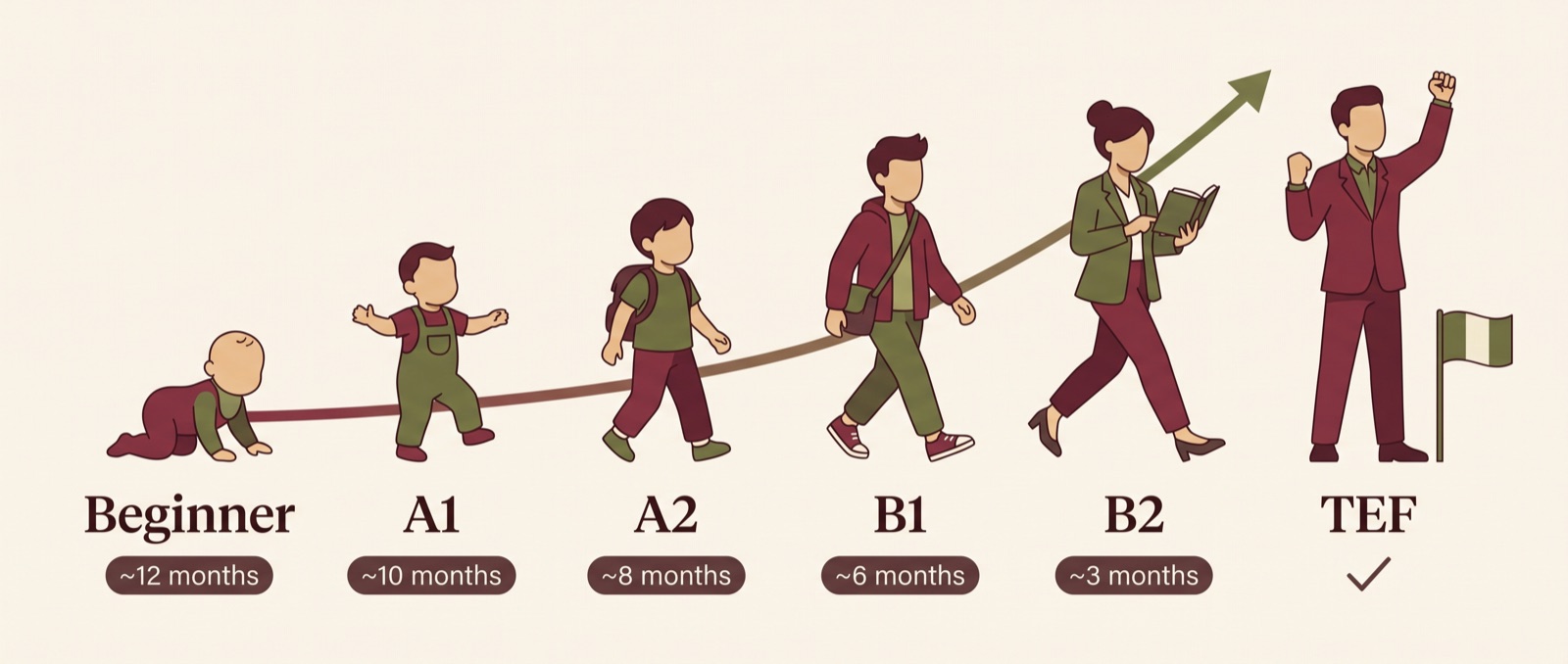
Can it go faster? A rare candidate with several productive hours a day and strong coaching might beat those ranges. That is not a plan — that is a lottery ticket.
Measure progress by what you can do under time pressure: understand unfamiliar audio once, finish both writing tasks, sustain both role-plays. Calendar pages do not speak French.
Want to Get to CLB 7? Start With an Evaluation First.
Our demo class is a personalized assessment with a TEF-certified C1/C2 instructor — you leave knowing your exact level, your weakest skill, and a step-by-step roadmap to achieve CLB 7 within one year.
The same instructors teach our online French classes — live Eastern-time courses that take you from A1 to B2.
The Study Plan: How to Actually Get CLB 7 in TEF Canada
So how do you actually get CLB 7 in TEF Canada?
You don’t start with grammar books. You start with a diagnostic.
Take one timed mock in each skill — reading, listening, writing, speaking — under real exam conditions. No pausing, no replays, no dictionary.
Now you know your weakest skill. That skill gets 40% of your week. The other three share the rest. For a stable B1 learner, 10–14 focused hours a week is the realistic budget — and “focused” means timed tasks and corrected work, not podcasts in the background.
One warning before you start: mock percentages don’t convert neatly into official scores, because TEF scoring is calibrated. Track your accuracy and your error types — don’t manufacture imaginary /699 predictions. And for writing and speaking, get real feedback on communication, organization, vocabulary, grammar and fluency. “Sounds good to me” is not feedback; it’s what friends say before dessert.
The exam’s full format is covered in our TEF Canada guide. Here is how to train each skill, with the exact score you need next to each one.
How to Get 249+ in TEF Listening
The audio plays once. Train like it.
The full listening guide, with eight practice items with audio and both score columns: TEF Canada compréhension orale.
- Practise scored sets in one play only — replaying before answering builds fake confidence. The official format is 40 questions in 40 minutes, no going back.
- Read the choices first and predict what matters: purpose, tone, a number, the next action.
- Miss one? Reset instantly. Carrying a mistake into the next question costs more than the miss itself.
- In review, replay with the transcript, find the exact phrase you lost, and shadow it aloud.
Keep an error log by cause — vocabulary, lost number, negation, panic. “Listening is bad” is not a diagnosis.
How to Get 207+ in TEF Reading
Reading is the most learnable section on the paper — 40 questions in 60 minutes, and you can navigate freely.
- Bank the quick factual questions first; flag the slow inference ones and come back with a time reserve.
- Every answer needs evidence in the text. “Sounds French-adjacent” is not evidence.
- Watch the contrast words — pourtant, en revanche, bien que. They flip meanings, and answers.
- Learn vocabulary in chunks (poser sa candidature, mettre en œuvre) — you read faster when you recognize phrases, not single words.
Twice a week, do a timed set and classify every miss. If you “understood the article” but missed the questions, you understood the topic — not the task.
How to Get 310+ in TEF Writing
Two tasks, 60 minutes: continue a news story (80+ words) and argue a position (200+ words). This is where CLB 7 is usually won or lost.
Finish both. An elegant half-answer is still half an answer.
- Plan for 3–5 minutes so the text has a direction before you type.
- Task one: keep the story’s tense logic and move the event forward — don’t rewrite the prompt.
- Task two: position early, two solid reasons with concrete examples, one counterargument, clean conclusion.
- Save the last minutes for agreement, verb endings and accents.
Then the step almost everyone skips: get your work corrected, and rewrite it from memory. Reading feedback without rewriting is like reading a gym program from the sofa.
For the full picture of how the TEF writing format works, with 40 practice topics and three full sample answers, read our TEF writing guide.
How to Get 310+ in TEF Speaking
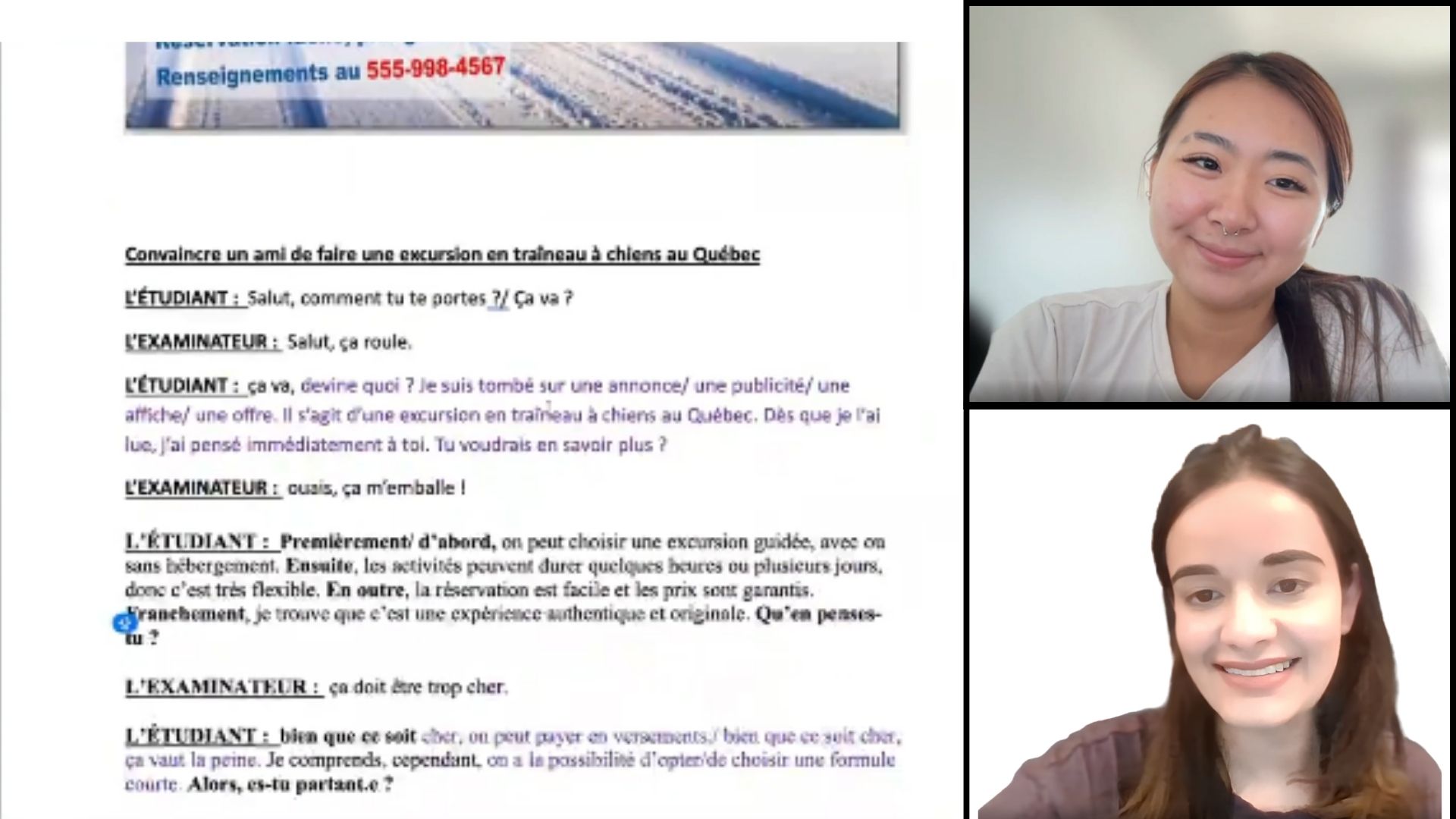
It’s a conversation, not a TED talk — two live role-plays in 15 minutes, face to face with a real examiner.
- Role-play one: obtain information. Prepare question families — price, schedule, conditions, cancellation — and react to the answers instead of reading a mental list.
- Role-play two: convince. Benefit, reason, example. Then hear the objection and answer it directly.
- Record two role-plays a week. Listen back for fillers, flat answers and unanswered objections.
- Practise with someone who pushes back. Agreeing too quickly removes the entire exam.
Speaking faster is not speaking better. Sometimes it is merely panic with liaison.
For the full picture of how the TEF speaking format works, with 40 practice prompts and two model dialogues, read our expression orale guide.
The 12-Week Plan (Only If You’re Already at B1)
This 12-week TEF preparation schedule is appropriate only for a stable B1 learner who can already discuss familiar topics, understand the main points of standard speech and write connected text. If your diagnostic says A2, do foundation work first. A calendar cannot negotiate with your actual level.
| Week | Main focus | Required deliverable |
|---|---|---|
| 1 | Full diagnostic and format | One timed baseline in all four skills; error log; weakest-skill ranking |
| 2 | Repair map | Three recurring errors per skill; personal grammar and vocabulary priorities |
| 3 | Listening + reading method | Two one-play listening sets; two timed reading sets; categorized corrections |
| 4 | Writing mechanics | Two continuation and two argument drafts; corrected and rewritten |
| 5 | Speaking mechanics | Four recorded information role-plays; question-bank audit |
| 6 | Persuasion | Four recorded persuasion role-plays with objections and follow-up responses |
| 7 | Weakest-skill sprint | Five targeted sessions on the lowest skill; measurable before/after comparison |
| 8 | Mixed timing | Two half-mocks plus two corrected productive tasks |
| 9 | Full simulation | One complete timed mock; score and error analysis within 24 hours |
| 10 | Precision repair | Redo every Week 9 miss; two speaking and two writing corrections |
| 11 | Second simulation | One complete timed mock under strict conditions; readiness decision by skill |
| 12 | Taper and stabilize | Short daily drills, two light role-plays, reviewed functions; no cramming marathon |
The deliverable matters more than “studied for two hours.” Time is an input; corrected performance is the product. If Week 11 still shows one skill consistently below target, postpone if your circumstances allow — a booking confirmation is not a pedagogical strategy.
Mistakes to Avoid for CLB 7
Most people who miss CLB 7 don’t fail because their French is bad — they fail because they repeat broad practice instead of fixing the one behaviour holding a skill under the line. The same patterns appear in class and in candidate forums:
- They divide time equally. If speaking is NCLC 6 and reading is NCLC 10, a democratic schedule is absurd. Feed the bottleneck.
- They delay speaking. Months of apps and videos can create impressive recognition with almost no ability to negotiate an objection in real time.
- They memorize answers. Examiners interact. A script collapses when the other person asks an inconveniently human question.
- They speak too fast. Speed multiplies agreement errors, swallows endings and gives you no time to develop examples. Fluency includes control.
- They count exposure as practice. Podcasts help, but passive hours do not replace one-play questions, transcripts, corrections and retesting.
- They chase a magic raw-score formula. The official body uses calibrated scoring. Track mock accuracy and error types; do not manufacture a precise /699 prediction.
- They mistake “B2” for automatic NCLC 7. The frameworks overlap imperfectly. Read the NCLC result for each skill.
- They retake without changing the plan. Another exam after the same preparation is not a new strategy; it is an expensive rerun.
- They enter the wrong score column. Use “Équivalence ancien score” for Express Entry until IRCC changes its instructions.
Being “stuck” usually means your current routine has stopped producing new information. Change the feedback loop, not just the playlist.
Frequently Asked Questions
What TEF score do I need for CLB 7?
For NCLC 7 on TEF Canada, you need at least 207 in reading, 249 in listening, 310 in writing and 310 in speaking in the “Équivalence ancien score” column. Your /699 bands are 434–461, 434–461, 428–471 and 456–493 respectively. IRCC currently tells Express Entry applicants to enter the ancien-score values.
Do I need NCLC 7 in all four TEF skills, or is it averaged?
You need NCLC 7 or higher in each of reading, listening, writing and speaking for the French-language category and the 25- or 50-point French bonus. Scores are assessed skill by skill. Three high results cannot average away one NCLC 6, so your lowest required ability is the practical gatekeeper.
Can I go from zero to CLB 7 in six months?
It is possible for an unusual candidate with substantial daily study, excellent feedback and prior language-learning advantages, but it is not a sensible default promise. For most complete beginners, plan roughly 8–12 months of consistent work. From a solid A2 or B1 base, four to six months of TEF-focused practice is realistic, depending on weekly hours and your weakest skill.
Is CLB 7 the same as B2 French?
NCLC 7 is often described as approximately B2, but the frameworks are not interchangeable for immigration. TEF reports each skill, and the same broad CEFR label can cover more than one NCLC band. For Express Entry, use the official TEF-to-NCLC scores — not “B2” as a substitute.
Which TEF score column do I enter in Express Entry?
Enter the score for each ability from the “Équivalence ancien score” column. IRCC explicitly says not to enter the “Score / 699” figures because its system is not currently compatible with them. Check the live IRCC page again when completing your profile; this is administrative information worth verifying, not trusting to memory.
I got NCLC 6 in speaking but higher scores elsewhere. What should I do?
Treat speaking as the primary project while maintaining the other skills. Diagnose whether you lack follow-up questions, developed reasons, objection handling, fluency or grammatical control. Record role-plays, obtain detailed correction and repeat the same function with a new prompt. Retaking without changing that practice loop usually reproduces the same result.
Why doesn’t my mock-test percentage convert neatly to a TEF score?
Le français des affaires says the number of correct reading and listening answers is converted into a calibrated score that accounts for differences in question difficulty. A mock percentage therefore cannot reliably predict an exact official score. Use mocks to track accuracy, timing and error patterns, then use your official certificate for NCLC conversion.
Is TEF easier than TCF for NCLC 7?
Neither test is universally easier; the better fit depends on how you perform under each format. Some candidates prefer TEF’s conversational speaking and two writing tasks, while others prefer TCF’s structure. Try official samples before choosing — and don’t switch tests merely because one Reddit comment found the other friendlier.
When should I book the TEF Canada exam?
Book when recent timed work shows all four skills safely above the target, not when one excellent mock creates euphoria. Complete at least two strict simulations separated by correction and repair. Because official scoring is calibrated, readiness should combine stable mock performance, completed tasks, pacing and expert feedback on speaking and writing.
What is CLB 7 in IELTS?
CLB 7 corresponds to roughly IELTS 6.0 in each of the four skills — but IELTS is an English test. To prove French for immigration you must take TEF Canada or TCF Canada, the only French exams IRCC accepts. A solid IELTS plus CLB 7 French is exactly the combination that earns the 50-point CRS bonus.
Do I need CLB 5 or CLB 7 in French?
It depends on the program. Some routes accept CLB 5 — for example, Canadian Experience Class eligibility for TEER 2–3 jobs. But the French-language draws and the 25- or 50-point CRS bonus both require CLB 7 in all four skills. If you want French to actively pull your application forward, CLB 7 is the target.
How much is CLB 7 in French?
On TEF Canada, CLB 7 means at least 207 in reading, 249 in listening, 310 in writing and 310 in speaking (the “Équivalence ancien score” column). On TCF Canada it means 453 in reading, 458 in listening, and 10 out of 20 in both writing and speaking. You need the minimum in all four skills. Full tables: TEF Canada score chart and TCF Canada score chart.
The Takeaway
How to reach CLB 7 in TEF is not mysterious: know the correct score column, clear all four skill thresholds, diagnose honestly and spend disproportionate effort on the weakest result. A stable B1 learner may use the 12-week plan; a beginner needs a longer runway. That is less glamorous than a viral shortcut — but it is much more useful.
Train With TEF Experts Who Get You to CLB 7
Everything in this guide — the weakest-skill plan, the timed mocks, the corrected rewrites — is exactly how our TEF Canada prep runs, week by week. Bring your test date and your diagnostic, and we’ll build the plan backward from both. 1,200+ students taught since 2018 · 4.8★ across 316+ Google reviews.
See the TEF preparation course Book a demo class
- IRCC — Express Entry: language test results
- IRCC — Comprehensive Ranking System criteria
- IRCC — Express Entry category-based selection
- Le français des affaires — TEF Canada: understand your results
- Le français des affaires — TEF Canada: take the test
Last reviewed: August 26, 2026 · Immigration requirements change; confirm current rules on the IRCC pages above before applying.