
On this page
TCF Speaking Format: What the 12-Minute Expression Orale Actually Tests
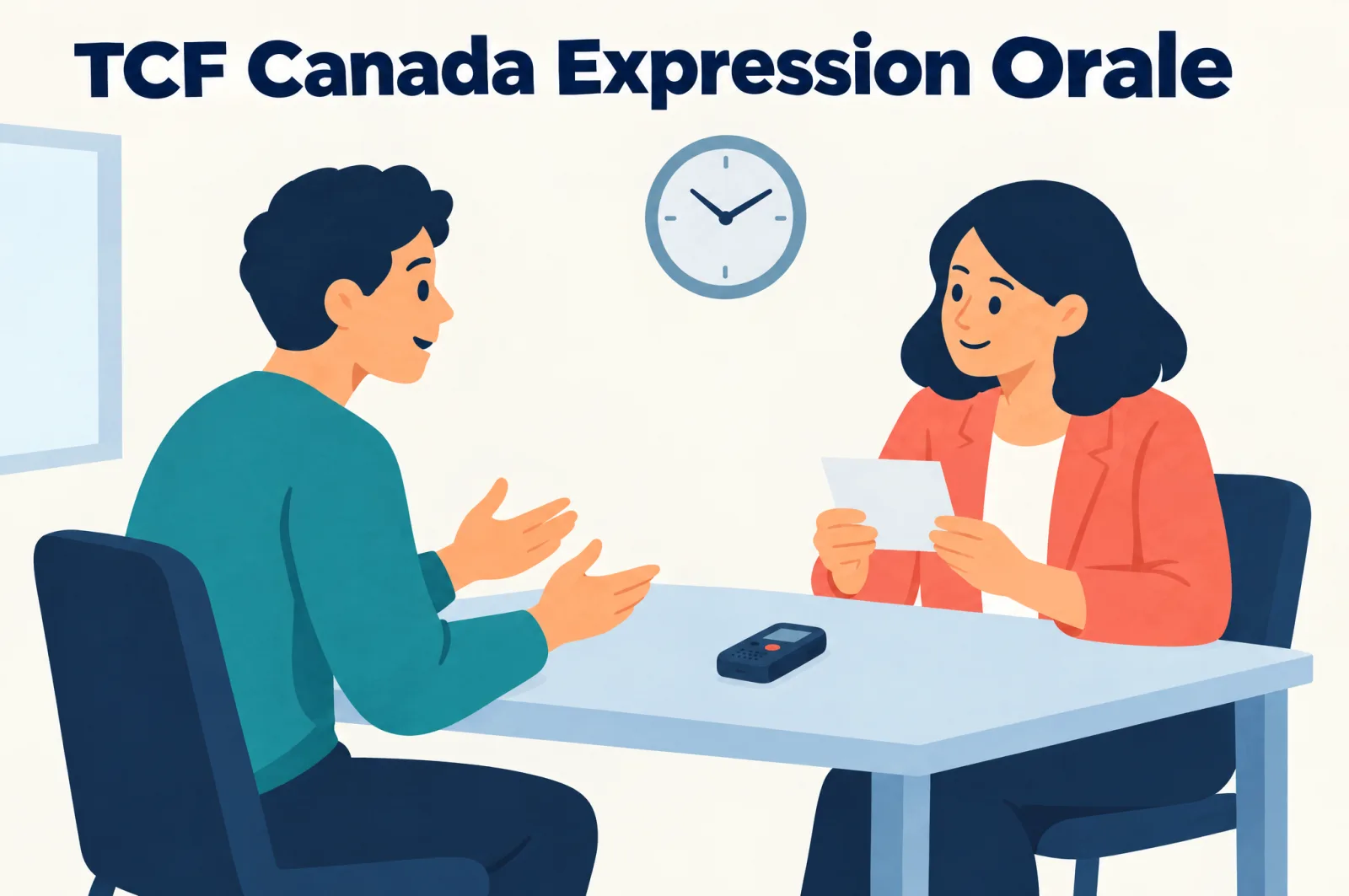
The TCF speaking format tests three things in twelve minutes: whether you can talk about yourself with a stranger, whether you can get information out of someone by asking the right questions, and whether you can hold an opinion under pressure. In the TCF Canada speaking test only Task 2 gives you preparation time; Tasks 1 and 3 start the moment the examiner finishes the question.
The examiner will ask your name and repeat it for the recording before Task 1, then lead the interview, play your conversation partner, listen to your opinion and follow up; at the end they check, in front of you, that the recording worked. What they are scoring is interaction and argument, not recitation. France Éducation International’s own criteria are linguistic (range and accuracy, pronunciation, fluency), pragmatic (interaction, structure, coherence, development) and sociolinguistic (is your French right for the situation).
The whole TCF Canada sits in one session of about 2 hours 47 minutes: listening, reading and writing first, then your individual speaking slot. Speaking is the one section that stays face to face even when the rest of the test is on a computer. The other three sections are covered in the TCF Canada exam guide; centres, dates and fees are on the TCF Canada booking page.
TEF speaking is a different animal: two role-plays over 15 minutes, both built around an advertisement, and nothing like the personal interview. If you are still choosing, TEF vs TCF compares the two exams; the TEF Canada expression orale guide covers the TEF side.
| Task | Time | Preparation | What you do |
|---|---|---|---|
| 1 · Guided interview | 2 min | None | You answer the examiner’s questions about yourself, your work or studies, your city, your plans. |
| 2 · Obtaining information | 5.5 min in total | 2 min | You read a short situation, prepare, then ask the questions you need. The examiner plays the other person; the instructions say who you both are. |
| 3 · Defending an opinion | 4.5 min | None | You answer a question chosen by the examiner with a clear, developed position and hold it through the follow-ups. |
| Individual and face to face · recorded in the centre and marked a second time, blind, by a trained assessor · rated out of 20 · all four TCF Canada sections in one sitting of about 2 h 47. | |||
Source: France Éducation International — TCF Canada test structure and marking, checked September 15, 2026.
TCF Speaking Task 1: The Guided Interview (2 Minutes, No Preparation)
TCF speaking task 1 is a two-minute conversation about you, with no preparation. Entretien dirigé means guided interview: the examiner asks, you answer, and the official aim is simply to show that you can talk with someone you have never met.
Use vous. Give two or three connected sentences on your work, your city, your habits or your plans. I want an answer to the question, not your entire biography, and not one word either.
The 10 question families in TCF speaking task 1
- IdentityComment vous présenteriez-vous ?
How would you introduce yourself? - HomeAvec qui habitez-vous ?
Who do you live with? - WorkQu’appréciez-vous dans votre travail ?
What do you enjoy about your work? - StudiesPourquoi avez-vous choisi vos études ?
Why did you choose your field of study? - CityQu’aimez-vous dans votre ville ?
What do you like about your city? - RoutineComment se passe une journée habituelle pour vous ?
What is a typical day like for you? - LeisureQue faites-vous pour vous détendre ?
What do you do to relax? - PlansQu’aimeriez-vous faire l’année prochaine ?
What would you like to do next year? - FrenchPourquoi apprenez-vous le français ?
Why are you learning French? - CanadaQu’est-ce qui vous attire au Canada ?
What attracts you to Canada?
Task 1 answers that sound like NCLC 7
Build each answer as fact, reason, example. Here is the same question, « Qu’aimez-vous dans votre ville ? », answered twice.
J’aime ma ville. Elle est grande. Il y a des magasins.
J’aime surtout les espaces verts de ma ville, parce qu’ils me permettent de faire une pause après le travail. Par exemple, je vais souvent marcher au parc près de chez moi. Même quand je n’ai que vingt minutes, ça me fait du bien.
These are teaching labels, not marks. The second answer develops one idea through connected, varied sentences, which is exactly what the marking grid rewards under “development” and “range”.
TCF Speaking Task 2: The Role-Play to Obtain Information (5.5 Minutes, 2 to Prepare)
TCF speaking task 2 gives you two minutes to prepare and about three and a half minutes to obtain information. Of the three TCF Canada speaking tasks, this is the one where you lead: you read a short situation, the instructions tell you who you are and who the examiner is playing, and then you ask.
For TCF expression orale tâche 2, my training target is ten or more relevant questions with follow-ups. That is a target, not an official quota; what the grid measures is whether your questions fit the situation and whether you react to the answers.
Open with « Bonjour, je voudrais me renseigner sur… » and close with « Merci pour ces renseignements. Bonne journée ! » Adjust the register to the person you are talking to.
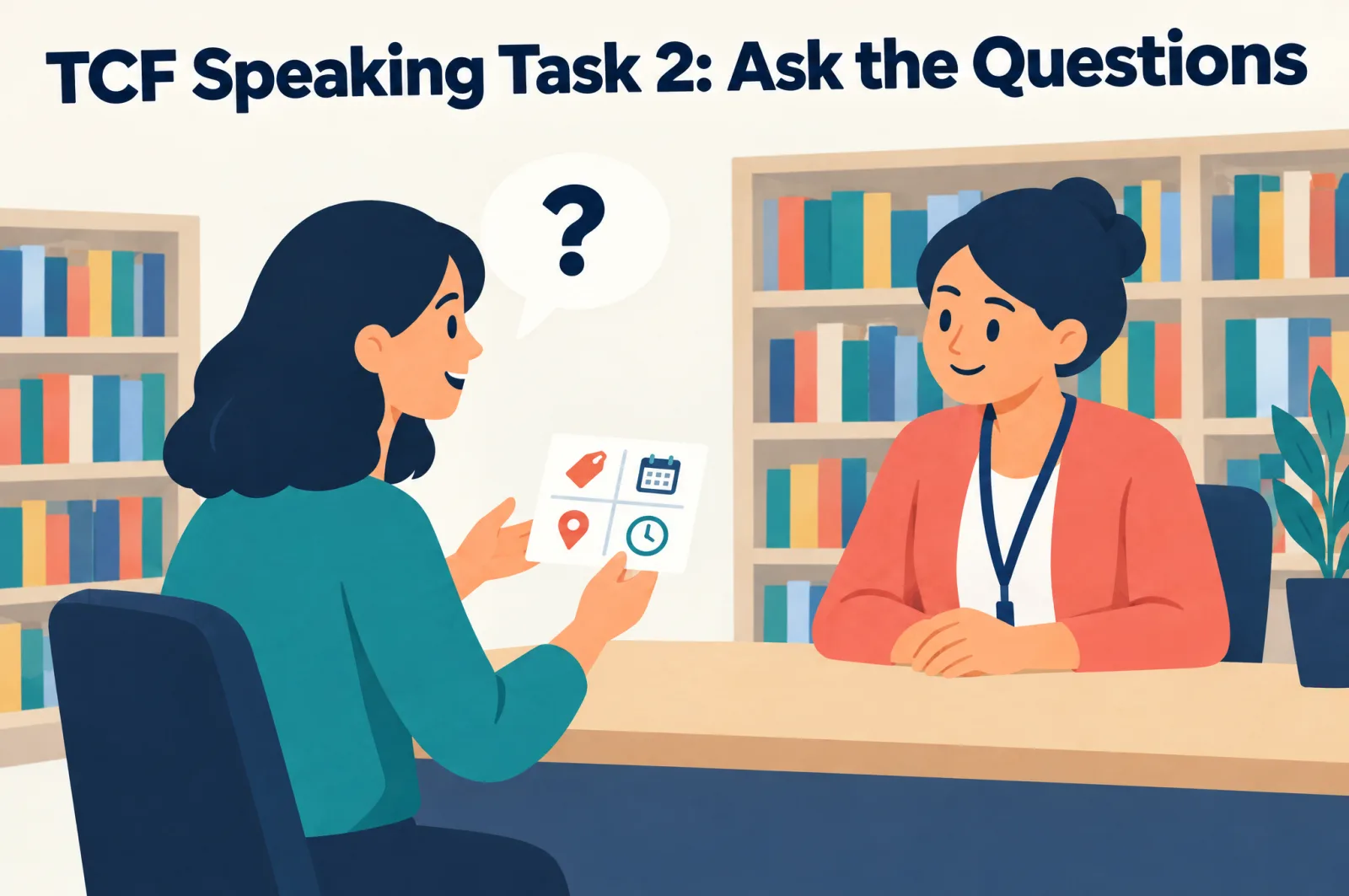
The 8 question types you must be able to ask in Task 2
- Price and feesQuels frais faut-il prévoir au total ?
What are the total fees? - Dates and scheduleQuels jours proposez-vous cette activité ?
Which days is this activity available? - Location and accessComment peut-on venir en transports en commun ?
How can we get there by public transport? - Conditions and requirementsFaut-il avoir de l’expérience pour participer ?
Is experience required to take part? - What is includedLe matériel est-il compris dans le prix ?
Is the equipment included in the price? - RegistrationComment se passe l’inscription ?
How does registration work? - Cancellation and refundSi j’annule, puis-je être remboursé ?
Can I get a refund if I cancel? - Contact and next stepQui dois-je contacter pour confirmer ?
Who should I contact to confirm?
How to use the 2 minutes of preparation
Prepare a question grid, not sentences: prix · horaires · accès · conditions · matériel · inscription · annulation · contact. Decide what you actually need to find out, pick the categories that fit the situation, and plan one follow-up per category.
Candidates who do well tend to walk in with five or six question stems and build the rest from what the examiner says. A memorised list of ten collapses the moment an answer surprises you. Practise that flexibility: ask, listen, then ask about what you just heard.
What to do when the examiner gives you nothing
Narrow the question: « Quand vous dites “flexible”, vous parlez des horaires ou de la durée ? » Ask for a detail: « Pourriez-vous me donner un exemple ? »
Reformulate what you heard: « Autrement dit, est-ce que je peux changer de créneau ? » Confirm the next step, then thank the person and close. A short, complete exchange beats a long one that trails off.
TCF Speaking Task 3: Defending an Opinion (4.5 Minutes, No Preparation)
TCF speaking task 3 asks you to defend a point of view on a question of general interest, chosen by the examiner, for four and a half minutes without preparation. The official brief is to speak spontaneously, continuously and convincingly, and to handle the follow-ups.
Here is my first check in every mock: does each reason explain anything? Development is what separates NCLC 6 from NCLC 7 in this task, although the whole speaking performance is marked, not Task 3 alone.
Pushback is part of the task. If the examiner questions your reasoning, explain a limit or defend the point; it isn’t personal, and folding is worse than disagreeing politely.
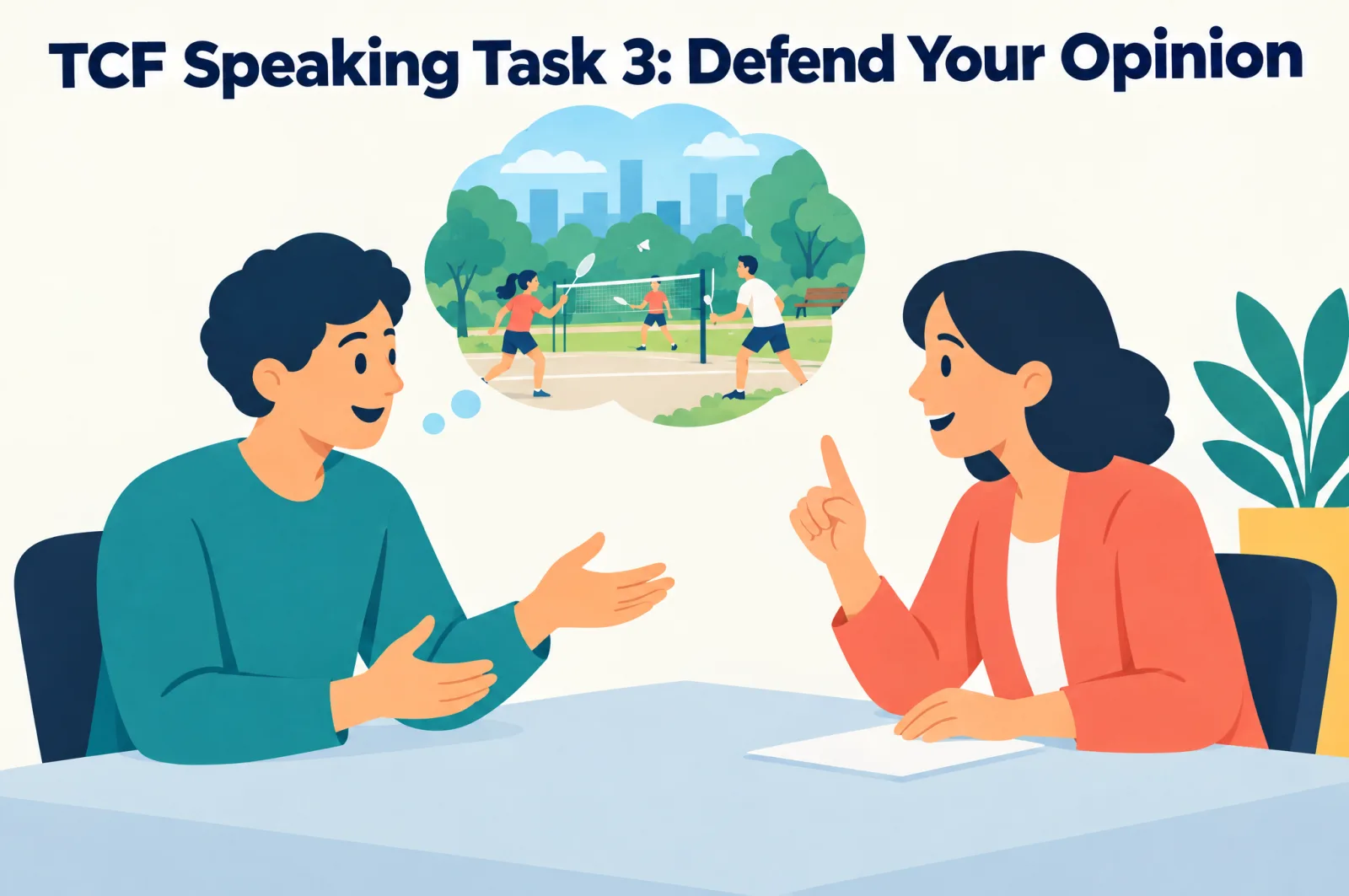
The 4-move structure for a TCF Task 3 answer
Position, reason, example, concession, then a close. Repeat the reason-and-example move for a second argument before you concede anything.
« À mon avis, … D’abord, … parce que… Par exemple, … Ensuite, … Cela permet de… C’est vrai que… mais… Pour ces raisons, je pense que… »
The connectors that mark B2 in the expression orale
- OrganiseD’abord… Ensuite…
- ExplainEn effet…
- IllustratePar exemple…
- ContrastEn revanche… / Cependant… / C’est vrai que… mais…
- ConsequencePar conséquent…
- CloseEn fin de compte…
Connectors cannot rescue an undeveloped idea. Saying « par conséquent » does not give you something to say next.
TCF Speaking Topics: 40 Practice Prompts for Task 1, Task 2 and Task 3
These TCF speaking topics cover the three tasks: 10 personal questions, 15 information role-plays and 15 opinion questions. All 40 TCF speaking questions are original practice prompts written in the style of the exam, with English glosses; none is presented as a recalled paper.
Candidates report personal follow-ups about family and hobbies, class-registration role-plays and travel or social-media opinion questions. Treat those as broad themes, not predictions, and use these TCF expression orale sujets in random order. Change one detail on the second attempt so you have to think again.
| # | Task | Theme | The prompt | Your task |
|---|---|---|---|---|
| 01 | Task 1 | Daily life | Quel endroit de votre quartier fréquentez-vous le plus ?Which place in your neighbourhood do you visit most? | Answer the examiner’s question (about 2 minutes, no preparation). |
| 02 | Task 1 | Work and studies | Qu’avez-vous appris récemment dans votre travail ou vos études ?What have you recently learned at work or in your studies? | Answer the examiner’s question (about 2 minutes, no preparation). |
| 03 | Task 1 | Daily life | Comment organisez-vous vos soirées en semaine ?How do you organise your weekday evenings? | Answer the examiner’s question (about 2 minutes, no preparation). |
| 04 | Task 1 | Leisure | Quelle activité aimeriez-vous essayer ?Which activity would you like to try? | Answer the examiner’s question (about 2 minutes, no preparation). |
| 05 | Task 1 | Family and friends | Comment gardez-vous le contact avec vos proches ?How do you stay in touch with the people close to you? | Answer the examiner’s question (about 2 minutes, no preparation). |
| 06 | Task 1 | Daily life | Quel changement améliorerait votre quotidien ?What change would improve your daily life? | Answer the examiner’s question (about 2 minutes, no preparation). |
| 07 | Task 1 | Leisure | Racontez-moi une sortie que vous avez appréciée.Tell me about an outing you enjoyed. | Answer the examiner’s question (about 2 minutes, no preparation). |
| 08 | Task 1 | Language | Dans quelles situations utilisez-vous le français ?In which situations do you use French? | Answer the examiner’s question (about 2 minutes, no preparation). |
| 09 | Task 1 | Plans | Quel projet personnel souhaitez-vous réaliser ?What personal project would you like to complete? | Answer the examiner’s question (about 2 minutes, no preparation). |
| 10 | Task 1 | Canada | Qu’aimeriez-vous découvrir au Canada ?What would you like to discover in Canada? | Answer the examiner’s question (about 2 minutes, no preparation). |
| 11 | Task 2 | Housing | Je loue une chambre près d’un collège. Vous cherchez un logement et vous m’interrogez.The examiner rents out a room near a college. You are looking for somewhere to live. | Ask the questions you need to get the information (2 minutes to prepare, then about 3.5 minutes). |
| 12 | Task 2 | Housing | Je gère une résidence avec des espaces communs. Vous souhaitez y habiter et vous m’interrogez.The examiner manages a residence with shared spaces. You are thinking of living there. | Ask the questions you need to get the information (2 minutes to prepare, then about 3.5 minutes). |
| 13 | Task 2 | Work and training | Je travaille dans une école de langues. Vous m’interrogez sur les cours du soir.The examiner works at a language school. You want to know about the evening classes. | Ask the questions you need to get the information (2 minutes to prepare, then about 3.5 minutes). |
| 14 | Task 2 | Work and training | J’organise un atelier de préparation aux entretiens d’embauche. Vous souhaitez participer et vous m’interrogez.The examiner runs a job-interview workshop. You would like to take part. | Ask the questions you need to get the information (2 minutes to prepare, then about 3.5 minutes). |
| 15 | Task 2 | Leisure and sport | Je travaille dans une salle de sport. Vous m’interrogez pour comparer les abonnements.The examiner works at a gym. You are comparing memberships. | Ask the questions you need to get the information (2 minutes to prepare, then about 3.5 minutes). |
| 16 | Task 2 | Leisure and sport | J’anime un atelier de photographie pour débutants. Vous souhaitez vous inscrire et vous m’interrogez.The examiner runs a photography workshop for beginners. You want to sign up. | Ask the questions you need to get the information (2 minutes to prepare, then about 3.5 minutes). |
| 17 | Task 2 | Services and consumer life | Je répare les petits appareils électroménagers. Votre cafetière est en panne ; vous m’interrogez.The examiner repairs small appliances. Your coffee maker has broken down. | Ask the questions you need to get the information (2 minutes to prepare, then about 3.5 minutes). |
| 18 | Task 2 | Services and consumer life | Je loue des outils aux particuliers. Vous préparez des travaux et vous m’interrogez.The examiner rents tools to the public. You are planning some home repairs. | Ask the questions you need to get the information (2 minutes to prepare, then about 3.5 minutes). |
| 19 | Task 2 | Community and volunteering | Je coordonne les bénévoles d’une bibliothèque. Vous souhaitez nous rejoindre et vous m’interrogez.The examiner coordinates a library’s volunteers. You would like to join. | Ask the questions you need to get the information (2 minutes to prepare, then about 3.5 minutes). |
| 20 | Task 2 | Community and volunteering | J’organise une collecte de vêtements. Vous m’interrogez pour savoir comment participer.The examiner is organising a clothing drive. You want to know how to help. | Ask the questions you need to get the information (2 minutes to prepare, then about 3.5 minutes). |
| 21 | Task 2 | Travel and transport | Je propose des vélos à louer. Vous préparez une excursion et vous m’interrogez.The examiner rents out bicycles. You are planning a day trip. | Ask the questions you need to get the information (2 minutes to prepare, then about 3.5 minutes). |
| 22 | Task 2 | Travel and transport | Je travaille à l’office de tourisme. Vous m’interrogez pour organiser un week-end de visites.The examiner works at the tourist office. You are planning a weekend of sightseeing. | Ask the questions you need to get the information (2 minutes to prepare, then about 3.5 minutes). |
| 23 | Task 2 | Health and wellbeing | J’organise des séances de relaxation. Vous souhaitez participer et vous m’interrogez.The examiner runs relaxation sessions. You would like to join. | Ask the questions you need to get the information (2 minutes to prepare, then about 3.5 minutes). |
| 24 | Task 2 | Technology and media | J’anime un atelier sur l’utilisation du téléphone. Vous m’interrogez pour y inscrire un proche.The examiner runs a phone-skills workshop. You want to enrol a relative. | Ask the questions you need to get the information (2 minutes to prepare, then about 3.5 minutes). |
| 25 | Task 2 | Environment and city life | Je gère un jardin partagé. Vous souhaitez cultiver des légumes et vous m’interrogez.The examiner manages a community garden. You would like to grow vegetables there. | Ask the questions you need to get the information (2 minutes to prepare, then about 3.5 minutes). |
| 26 | Task 3 | Housing | Préférez-vous un petit logement central ou un grand logement éloigné ?Would you rather have a small home in the centre or a large one further out? | Give and defend your opinion (about 4.5 minutes, no preparation). |
| 27 | Task 3 | Work and training | Les employeurs devraient-ils financer les cours de langue des salariés ?Should employers pay for their staff’s language classes? | Give and defend your opinion (about 4.5 minutes, no preparation). |
| 28 | Task 3 | Work and training | Changer de métier plusieurs fois est-il une bonne chose ?Is changing careers several times a good thing? | Give and defend your opinion (about 4.5 minutes, no preparation). |
| 29 | Task 3 | Leisure and sport | Les villes devraient-elles proposer davantage d’activités sportives gratuites ?Should cities offer more free sports activities? | Give and defend your opinion (about 4.5 minutes, no preparation). |
| 30 | Task 3 | Leisure and sport | Faut-il toujours chercher à progresser dans ses loisirs ?Should we always try to get better at our hobbies? | Give and defend your opinion (about 4.5 minutes, no preparation). |
| 31 | Task 3 | Services and consumer life | Devrait-on réparer les appareils avant de les remplacer ?Should we repair appliances before replacing them? | Give and defend your opinion (about 4.5 minutes, no preparation). |
| 32 | Task 3 | Community and volunteering | Le bénévolat devrait-il faire partie des études secondaires ?Should volunteering be part of secondary school? | Give and defend your opinion (about 4.5 minutes, no preparation). |
| 33 | Task 3 | Community and volunteering | Connaître ses voisins est-il encore nécessaire aujourd’hui ?Is knowing your neighbours still necessary today? | Give and defend your opinion (about 4.5 minutes, no preparation). |
| 34 | Task 3 | Travel and transport | Les entreprises devraient-elles encourager les déplacements à vélo ?Should companies encourage cycling to work? | Give and defend your opinion (about 4.5 minutes, no preparation). |
| 35 | Task 3 | Travel and transport | Un séjour prolongé permet-il de mieux comprendre une région ?Does a longer stay help you understand a region better? | Give and defend your opinion (about 4.5 minutes, no preparation). |
| 36 | Task 3 | Health and wellbeing | L’école devrait-elle enseigner la gestion du temps libre ?Should schools teach how to manage free time? | Give and defend your opinion (about 4.5 minutes, no preparation). |
| 37 | Task 3 | Technology and media | Les services publics devraient-ils conserver un accueil sans rendez-vous ?Should public services keep walk-in access? | Give and defend your opinion (about 4.5 minutes, no preparation). |
| 38 | Task 3 | Technology and media | Faut-il limiter les notifications sur son téléphone ?Should we limit the notifications on our phones? | Give and defend your opinion (about 4.5 minutes, no preparation). |
| 39 | Task 3 | Environment and city life | Les habitants devraient-ils décider de l’aménagement de leur quartier ?Should residents decide how their neighbourhood is planned? | Give and defend your opinion (about 4.5 minutes, no preparation). |
| 40 | Task 3 | Environment and city life | Faut-il transformer des places de stationnement en jardins ?Should parking spaces be turned into gardens? | Give and defend your opinion (about 4.5 minutes, no preparation). |
Download the 40 topics as a PDF
Two pages: the full prompt table for all three tasks, plus the Task 1 question families, the Task 2 question grid and the Task 3 skeleton. Enter your name and email and the link arrives in your inbox.
Your details stay with Toronto French Academy. No spam, ever.
TCF Expression Orale Model Answers: One Full Task 2 Role-Play and One Full Task 3 Monologue
These TCF Canada speaking sample answers show interaction in Task 2 and opinion development in Task 3. Study each TCF speaking sample for what it does, then answer a different prompt yourself.
C means candidate; E means examiner. Programme details are fictional. A written model cannot show pronunciation or fluency, which the examiner also marks.
Task 2 model dialogue: volunteering at a library (prompt 19)
CBonjour, je voudrais me renseigner sur votre programme de bénévolat. J’aime bien les bibliothèques et je cherche une activité utile dans mon quartier. Quelles missions proposez-vous actuellement ?
EBonjour. Nous cherchons surtout des personnes pour accueillir le public et accompagner les ateliers de lecture du samedi.
CQuand vous dites « accompagner les ateliers », qu’est-ce qu’on fait exactement ? Est-ce qu’on lit avec les participants ?
EOui, parfois. Vous pouvez aussi préparer la salle et aider les participants à choisir un livre adapté à leur niveau.
CD’accord. Et ces ateliers s’adressent à quel public ?
EPrincipalement à des adultes qui apprennent le français. Les groupes sont petits, avec six personnes au maximum.
CFaut-il avoir déjà enseigné pour participer ? Je parle français, mais je n’ai aucune expérience dans l’enseignement.
ENon, une bibliothécaire anime l’atelier. Votre rôle est de l’aider. Nous proposons aussi une courte formation avant de commencer.
CCette formation a lieu quand, et combien de temps dure-t-elle ?
EUn samedi matin, pendant deux heures. La prochaine aura lieu au début du mois prochain.
CTrès bien. Pour les ateliers ensuite, quels horaires faut-il prévoir ?
EDe dix heures à midi. Nous demandons normalement une présence régulière.
CVous voulez dire chaque samedi, ou est-ce qu’on peut venir un samedi sur deux ? Je travaille certains week-ends.
EUn samedi sur deux, c’est possible, à condition de fixer les dates avec nous à l’avance.
CÇa me conviendrait. Pour combien de mois faut-il s’engager ?
ENous souhaitons un engagement de trois mois, pour que les participants retrouvent les mêmes bénévoles.
CJe comprends. Si je dois manquer une séance, comment est-ce que je vous préviens ?
EEnvoyez-nous un courriel dès que possible. Nous chercherons quelqu’un pour vous remplacer.
CY a-t-il des documents à fournir pour s’inscrire ?
EIl faut remplir un formulaire et nous rencontrer pour un court entretien.
CEst-ce que je peux prendre rendez-vous maintenant ? Je suis disponible mercredi après-midi.
EOui, à quinze heures. Présentez-vous à l’accueil principal.
CParfait, donc mercredi à quinze heures, à l’accueil. Pourriez-vous aussi m’envoyer le formulaire par courriel ?
EBien sûr. Donnez-moi votre adresse et je vous l’envoie aujourd’hui.
CMerci pour toutes ces précisions. Je remplirai le formulaire avant notre rendez-vous. Bonne journée !
Task 3 model answer at NCLC 6 and at NCLC 7: free sports activities (prompt 29)
The same question, « Les villes devraient-elles proposer davantage d’activités sportives gratuites ? », answered twice. Both versions are around 200 words, a comparison length rather than a target for four and a half minutes of speech: in the room you keep going, you do not stretch this with slow delivery.
Oui, je pense que les villes devraient proposer plus d’activités sportives gratuites. Pour moi, le prix est le problème principal. Beaucoup de personnes veulent faire du sport, mais elles ne veulent pas payer un abonnement chaque mois. Quand on a un petit budget, ce n’est pas facile.
Une salle de sport coûte de l’argent et il faut parfois acheter du matériel aussi. Pour une famille, cela représente une somme assez importante. Si plusieurs personnes veulent participer, il faut payer pour chaque personne. C’est donc une dépense de plus, avec le logement et les courses.
Avec des activités gratuites, les habitants pourraient essayer un sport sans payer. Ils pourraient venir dans un parc ou dans une salle de la ville. Ce serait plus simple pour eux. Les parents pourraient aussi inscrire leurs enfants, parce qu’ils n’auraient pas besoin de prévoir un budget spécial.
Je trouve donc que la gratuité serait une bonne solution. Le sport serait accessible à plus de personnes, surtout à celles qui n’ont pas beaucoup d’argent. À mon avis, la ville devrait faire cet effort et proposer des activités gratuites dans plusieurs quartiers.
À mon avis, les villes devraient proposer davantage d’activités sportives gratuites, surtout dans les quartiers où les habitants ont peu de moyens. Je ne pense pas qu’il faille rendre toutes les installations gratuites, mais chacun devrait pouvoir commencer une activité sans obstacle financier.
D’abord, le prix peut empêcher une famille de participer. Imaginons deux enfants qui souhaitent essayer le badminton : entre les inscriptions et le matériel, leurs parents peuvent hésiter. Une séance gratuite avec des raquettes prêtées leur permettrait de découvrir ce sport avant de s’engager.
Ensuite, ces activités peuvent créer des liens entre voisins. Une personne qui vient d’arriver dans une ville ne connaît pas forcément de monde. Si elle retrouve le même groupe chaque semaine pour marcher ou jouer, les conversations viennent plus facilement. L’intérêt dépasse donc l’activité physique.
C’est vrai que ces programmes coûtent de l’argent à la municipalité. Cependant, elle pourrait commencer par quelques créneaux dans des salles déjà disponibles, puis vérifier la fréquentation avant d’élargir l’offre. Cela limiterait les dépenses inutiles.
Je serais donc favorable à une offre gratuite ciblée, avec du matériel accessible et des horaires pratiques. La gratuité seule ne suffit pas si personne ne peut venir.
How the TCF Speaking Test Is Scored: From 0–20 to NCLC 7
A TCF speaking score of 10 or 11 out of 20 is NCLC 7. Your speaking is marked twice, independently and blind: first by the examiner who runs and records the interview in the centre, then by a second marker trained by France Éducation International, working from the recording.
The criteria are linguistic (range and control of vocabulary, grammatical accuracy, ease, pronunciation, overall fluency), pragmatic (interaction, the structure of what you say, coherence and cohesion, development of the topic) and sociolinguistic (whether your French fits the situation). For TCF expression orale NCLC 7 preparation, that means every practice answer gets checked on all three, not just on grammar (France Éducation International, how the TCF is marked).
Each skill converts on its own; there is no averaging across the exam. For the 50 extra CRS points you need NCLC 7 or higher in all four French skills plus CLB 5 or higher in all four English skills, so strong speaking cannot make up for writing below the line (IRCC, CRS criteria). The full conversion for all four sections is on the TCF score chart; what each level means in practice is in NCLC levels explained.
One warning that is new this year: from the September 1, 2026 sessions, France Éducation International has suspended re-correction requests for the speaking and writing sections until autumn 2027. There is no second look at a 9, so prepare to clear 10 on the day.
| NCLC level | TCF Canada speaking score (out of 20) |
|---|---|
| NCLC 4 · citizenship minimum | 4–5 |
| NCLC 5 | 6 |
| NCLC 6 | 7–9 |
| NCLC 7 · PR target | 10–11 |
| NCLC 8 | 12–13 |
| NCLC 9 | 14–15 |
| NCLC 10 | 16–20 |
Source: IRCC language-test equivalency chart for TCF Canada (speaking column). Full converter: TCF Canada score chart.
Mistakes That Cost Your TCF Speaking Score
In a mock, these are the eight TCF speaking mistakes I check for first. Each one either weakens your answer or gets in the way of the conversation, and every one of them is fixable in a week.
- One-word Task 1 answers. Add a reason and one concrete detail to every answer.
- Reading Task 2 questions like a robot. Use the previous reply to choose your next question.
- Making statements instead of asking. Turn « Je veux connaître le prix » into « Quel est le prix ? »
- Spending the preparation time writing full sentences. Practise a keyword grid and formulate aloud.
- An opinion with no example. Describe a plausible person, situation and consequence.
- Folding at the first counter-argument. Acknowledge the objection, then explain why your position still holds.
- Using tu with the examiner. Use vous; switch only inside a role-play that explicitly involves a friend.
- Panicking over one unknown word. Ask for clarification or talk around the missing word, then continue.
One candidate we heard from moved from a 9 to an 11 and put it down to fixing small recurring errors rather than learning new vocabulary. That is not a scoring formula, but it matches what we see in mocks: the points are usually lost on habits, not on knowledge.
A 4-Week TCF Speaking Practice Plan
TCF speaking practice works best when you record yourself, fix what you hear and answer questions you have not rehearsed. This four-week TCF speaking preparation cycle is a practice cycle, not a score promise.
- W1Task 1 habits — 20 minutes a day: record five personal answers. Replay them and repair one recurring grammar or pronunciation problem before you record the next set.
- W2Task 2 exchanges — 25 minutes a day: two minutes on a question grid, then a three-and-a-half-minute exchange with a partner. Record it with their consent and check whether your follow-ups actually use their replies.
- W3Task 3 development — 30 minutes a day: record one opinion answer with no preparation. Develop two reasons, then have a partner challenge one; keep talking through the full task window.
- W4Full mocks — 30 minutes a day: alternate targeted repair with timed 12-minute speaking mocks with a live partner, twice this week, including the Task 2 preparation.
A teacher saves you time by naming the exact reply or recurring error to fix; repeat that part immediately after the correction. That weekly loop is what our TCF Canada preparation course is built around.
TCF Canada Expression Orale: Frequently Asked Questions
What is the TCF Canada expression orale?
TCF Canada expression orale is the speaking section of TCF Canada: an individual, face-to-face test with an examiner made of a guided interview about you, a role-play where you ask questions to obtain information, and an opinion you defend. It lasts about 12 minutes including 2 minutes of preparation and is scored out of 20.
How long is the TCF speaking test?
About 12 minutes in total, including the 2-minute preparation inside Task 2. The three tasks are timed at 2 minutes, 5.5 minutes and 4.5 minutes. Practise to those limits. An examiner closing a task when its time is up is normal and tells you nothing about your score.
What are the 3 tasks in TCF speaking?
Task 1 is a guided interview about yourself. Task 2 is an interaction where you ask the questions to obtain information, with the roles set by the instructions. Task 3 is an opinion task where you explain and defend a position on a question the examiner chooses. The examiner leads Task 1, plays the other person in Task 2, and listens and follows up in Task 3.
Is the TCF speaking test recorded?
Yes. The examiner runs and records the interview in the centre and gives a first assessment; the recording then goes to a second assessor trained by France Éducation International, and the two marks are given independently and blind. Speak to the person in front of you; the recording captures the exchange, it does not replace it.
Do you get preparation time in TCF speaking?
Only for Task 2: two minutes inside its 5.5-minute total, leaving about 3.5 minutes for the exchange. Tasks 1 and 3 have no preparation. Rehearse starting an opinion answer from an unfamiliar question without silently drafting an introduction first.
What score do I need in TCF speaking for NCLC 7?
10 or 11 out of 20. A 9 is still NCLC 6; 12 or 13 is NCLC 8. Each skill converts on its own, so for the French-language CRS bonus you also need NCLC 7 in listening, reading and writing, plus CLB 5 or higher in all four English skills.
What topics come up in TCF speaking?
Personal background, work and studies, everyday services, leisure, transport, community life, technology and general social questions. Candidates report personal follow-ups, class enquiries and moving-city scenarios, but reports are not a forecast of your paper. Use the original topic bank on this page to practise adapting rather than memorising.
Is TCF speaking easier than TEF speaking?
Not reliably, for everyone. TCF has three short tasks in about 12 minutes, including a personal interview and an opinion with no preparation; TEF has two longer role-plays in 15 minutes built around an advertisement. Try each format under its own timing and see where you struggle; comfort with the tasks matters more than someone else’s result.
Can I take notes during the TCF speaking test?
You cannot bring anything to the table: France Éducation International’s exam-day rules ban notes, books, dictionaries and devices during the tests. Task 2 gives you 2 minutes to prepare your questions; ask your centre how that preparation is run, and practise a short keyword grid you can hold in your head so you can ask while looking at the examiner. Tasks 1 and 3 have no preparation.
What if I don’t understand the examiner in TCF speaking?
Ask for a focused clarification: « Pourriez-vous reformuler la question, s’il vous plaît ? » If only one detail is unclear, check it: « Vous voulez dire pendant la semaine ? » Then answer the clarified question. A relevant answer gives the examiner more to mark than a confident answer to a different question.
The Takeaway
For TCF Canada expression orale, practise answering what you actually hear and developing what you actually mean: two sentences of reason and example beat five of vocabulary. Nobody passes Task 3 by memorising an introduction.
If you want someone to tell you what to fix next, our TCF Canada preparation course includes weekly corrected speaking practice, and the TCF Canada booking page has the centres, dates and fees for when you are ready to sit.

Written and checked by
Simar Dua, French Program Lead
Simar leads the TEF Canada and TCF Canada programs at Toronto French Academy and has guided hundreds of Express Entry candidates from their first French lesson to the NCLC 7 result. She reviewed the French prompts and model answers on this page and hosts the academy’s free monthly French for Canada PR info session.
Get your speaking corrected every week
Our TCF preparation at Toronto French Academy includes weekly corrected speaking practice and timed mock interviews, so the habits that cost you a point in a mock get fixed before test day.