
TEF Canada Score Chart: Official NCLC Conversion Guide
Summary
To immigrate to Canada through programs like Express Entry, you must convert your TEF Canada results into Niveaux de compétence linguistique canadiens (NCLC) levels using the “Équivalence ancien score” (previous score equivalency) column from your certificate. Entering the “/699” raw scores is incorrect and can lead to application refusal.
Key requirements and scoring:
- Target benchmark: Most economic immigration streams require at least NCLC 7 in all four skills (Reading: 207+, Writing: 310+, Listening: 249+, Speaking: 310+).
- Listening: both listening columns, the format block by block and eight practice items with audio are on the TEF Canada compréhension orale guide.
- Assessment: Scores are assessed independently per skill, not as an average. If one skill falls below the requirement, you do not qualify for that benefit.
- Benefits: Achieving NCLC 7+ is a “golden ticket,” unlocking French-language category-based Express Entry draws and bilingualism bonus points (up to 50 CRS points).
- Retakes: There is no limit on attempts, but you must wait 20 days between sittings and retake the full four-part exam, as individual module retakes are not permitted.
- Validity: Results must be less than 2 years old both when you complete your Express Entry profile and when you submit your application for permanent residence.
- Comparison: While TEF Canada and TCF Canada are both accepted by IRCC, they use different scoring metrics. Both must be converted to NCLC levels to determine Express Entry eligibility. Always consult your official test certificate to ensure you are inputting the correct, IRCC-compatible scores.
Navigating the TEF Canada score chart is essential for any candidate looking to immigrate to Canada through programs like Express Entry or the French-language proficiency category. Since Canadian immigration authorities do not use raw test scores, you must convert your results into Niveaux de compétence linguistique canadiens (NCLC) to determine your eligibility and Comprehensive Ranking System (CRS) points. Every band on this page was checked against IRCC’s published chart on August 19, 2026.
TEF Canada score converter
The official TEF Canada score chart (all four skills)
Immigration, Refugees and Citizenship Canada (IRCC) evaluates four distinct language abilities: speaking, listening, reading, and writing. It is critical to note that IRCC uses the “Équivalence ancien score” (previous score equivalency) column from your TEF certificate for profile entry. Entering the newer “/699” raw scores may lead to an application refusal, as they are not currently compatible with the Express Entry system.
The table below provides the current official mapping of TEF scores to NCLC levels for all four competencies:
| NCLC level | Reading (/300) | Writing (/450) | Listening (/360) | Speaking (/450) |
|---|---|---|---|---|
| 10 | 263–300 | 393–450 | 316–360 | 393–450 |
| 9 | 248–262 | 371–392 | 298–315 | 371–392 |
| 8 | 233–247 | 349–370 | 280–297 | 349–370 |
| 7 | 207–232 | 310–348 | 249–279 | 310–348 |
| 6 | 181–206 | 271–309 | 217–248 | 271–309 |
| 5 | 151–180 | 226–270 | 181–216 | 226–270 |
| 4 | 121–150 | 181–225 | 145–180 | 181–225 |
For most economic immigration streams, achieving NCLC 7 across all four abilities is the target benchmark. If even one skill falls below your program’s minimum requirement, your overall profile may be ineligible, as scores are assessed skill-by-skill rather than as an average.
For the exam’s format, fees and booking, see our TEF Canada guide. Taking the other accepted test instead? Use the TCF Canada score chart.
Type all four scores into our TEF and TCF score calculator to see the NCLC level per skill and how far the weakest one is from NCLC 7. The French draw tracker shows the latest cut-off that level competes against, and the French CRS points calculator shows what it is worth in points.
What TEF score do you need for CLB 7?
To achieve a CLB 7 (NCLC 7) on the TEF Canada, you must score at least 207 in Reading, 249 in Listening, 310 in Writing, and 310 in Speaking.
Achieving this level is critical because it serves as the universal “golden ticket” for Canadian immigration; specifically, it is the minimum threshold required to qualify for French-language category-based Express Entry draws and to unlock the bilingualism bonus points (worth up to 50 CRS points). IRCC assesses each skill independently, meaning that if even one of your four results falls below this threshold, you will not qualify for these specific benefits, regardless of how high your other scores might be.
How TEF Canada scoring works
Understanding how your performance is measured is just as important as the exam itself for successfully leveraging the TEF Canada score chart. The test does not rely on a single, universal calculation; instead, the assessment method changes depending on the skill being tested.
The scoring scales
The TEF Canada evaluates your abilities using two distinct grading methodologies:
- Reading and Listening (MCQ): These sections are multiple-choice questionnaires. You receive one point for every correct answer, while incorrect or blank answers earn zero points. However, your total number of correct answers is not your final score; it is converted into a calibrated score that accounts for the specific difficulty level of the questions you answered.
- Writing and Speaking (assessor-graded): These sections are evaluated by two independent, trained examiners. They use standardized grids to rate your performance based on specific criteria such as communication skills, vocabulary, grammar, organization, and fluency. These assessments are then converted into a final calibrated score. For the speaking test itself, our TEF speaking topics and model answers show what those criteria look like in a real role-play. For the writing test, our TEF writing topics and sample answers show how the same criteria apply to Section A and Section B.
- Both are corrected every week in our TEF Canada preparation course, with timed mock exams as the date approaches.
How to read your attestation
When you receive your results certificate, it will display multiple scales, which can be confusing. To ensure your Express Entry profile is accepted without issue, you must identify the correct column to enter into the IRCC portal.
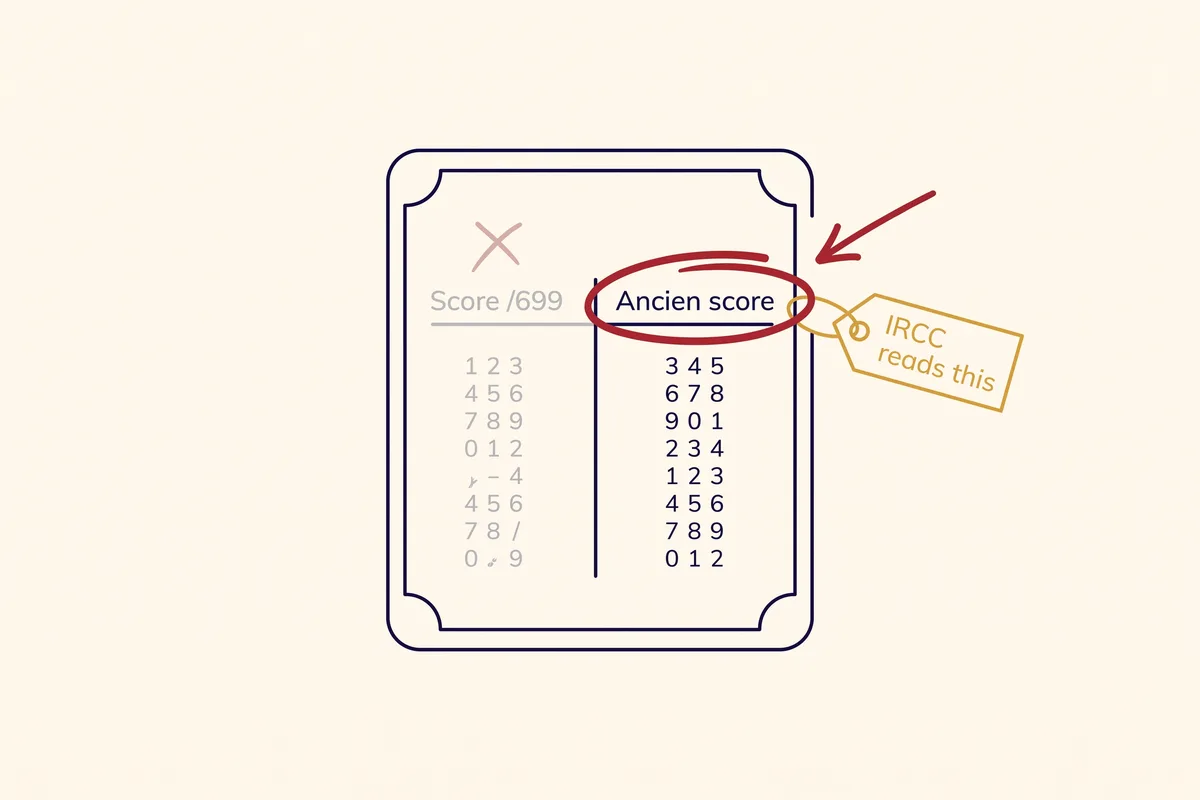
Your attestation shows two sets of numbers. IRCC’s chart is built on the “Équivalence ancien score” column — ignore the /699 column when converting.
The most common and costly mistake candidates make is entering the numbers from the “Score / 699” column. These figures appear prominent and look like standard results, but they are currently incompatible with the IRCC system. Instead, you must locate and use the column labeled “Équivalence ancien score” (previous score equivalency). Entering the wrong column is a frequent cause of application refusals, as it prevents the system from correctly processing your language proficiency level. Always double-check your data entry against the “Équivalence ancien score” column before submitting your application.
Sources: IRCC — Express Entry: language test results · Le français des affaires — TEF Canada results
What your TEF score is worth in Express Entry points
Achieving a high result on the TEF Canada score chart is one of the most effective ways to boost your Comprehensive Ranking System (CRS) score, as French proficiency is rewarded twice within the Express Entry system.
The two ways French earns you points
French language ability adds value to your profile through two distinct mechanisms:
- Core points (second official language): If you designate French as your second official language, you can earn up to 24 core CRS points based on your NCLC level in each of the four abilities (the combined cap is 22 points if you apply with a spouse or common-law partner). Scoring NCLC 9 or higher in all four skills earns you the maximum 6 points per ability.
- Bilingualism bonus: This is a separate “additional points” category. If you score NCLC 7 or higher in all four French skills, you unlock a bonus:
- +25 points: if you have NCLC 7+ in French and CLB 4 or lower in English (or no English test on file).
- +50 points: if you have NCLC 7+ in French and CLB 5 or higher in all four English skills.
The biggest advantage: French-language category draws
While CRS bonus points are valuable, the greatest benefit of achieving NCLC 7 or higher is eligibility for French-language category-based Express Entry draws. These specific rounds frequently invite candidates with CRS scores significantly lower than those required for general draws. In 2026, French-language draws have consistently cleared at CRS cutoffs in the high 300s to low 400s — the ten draws held up to August 19, 2026 cleared between 382 and 420 — providing a pathway to permanent residence that is often unavailable to candidates relying solely on general draws.
Sources: IRCC — Comprehensive Ranking System criteria · IRCC — Express Entry rounds of invitations
TEF score requirements by immigration program
Finding your required score depends on which Canadian immigration pathway you are pursuing. While NCLC 7 is the “golden ticket” for most Express Entry streams, other programs — particularly skilled trades and citizenship — have different benchmarks.
Minimum NCLC levels by program
| Program / pathway | Target level |
|---|---|
| Federal Skilled Worker / general Express Entry | NCLC 7 (in all 4 skills) |
| Canadian Experience Class — TEER 0 or 1 | NCLC 7 (in all 4 skills) |
| Canadian Experience Class — TEER 2 or 3 | NCLC 5 (in all 4 skills) |
| Federal Skilled Trades Program (FSTP) | NCLC 5 (speaking/listening) & NCLC 4 (reading/writing) |
| Canadian citizenship (ages 18–54) | NCLC 4 (speaking/listening only) |
| French-language category draws | NCLC 7 (in all 4 skills) |
Why these levels matter
- The “NCLC 7” standard: This is the baseline for most federal economic immigration (FSWP, CEC TEER 0/1, and category-based draws). Scoring NCLC 7 or higher across all four skills is required to unlock the valuable bilingualism bonus (25 or 50 points, depending on your English results).
- Skilled trades exception: If you are applying through the Federal Skilled Trades Program, the government recognizes that the language requirements for technical trades are distinct, allowing for a lower minimum threshold in writing and reading.
- Citizenship: If your goal is only Canadian citizenship, the requirement is significantly more attainable, focusing exclusively on basic oral communication (NCLC 4 in speaking and listening, for applicants aged 18–54).
Always verify your specific TEER classification using the official National Occupational Classification (NOC) website to ensure you are aiming for the correct benchmark.
Sources: IRCC — Express Entry: language test results · IRCC — Citizenship: proof of language skills
Reading real TEF results: three examples
The following scenarios illustrate how the TEF Canada score chart is applied to real-world results. These examples use the figures from the “Équivalence ancien score” column, which is the interpretation required for the Express Entry portal.
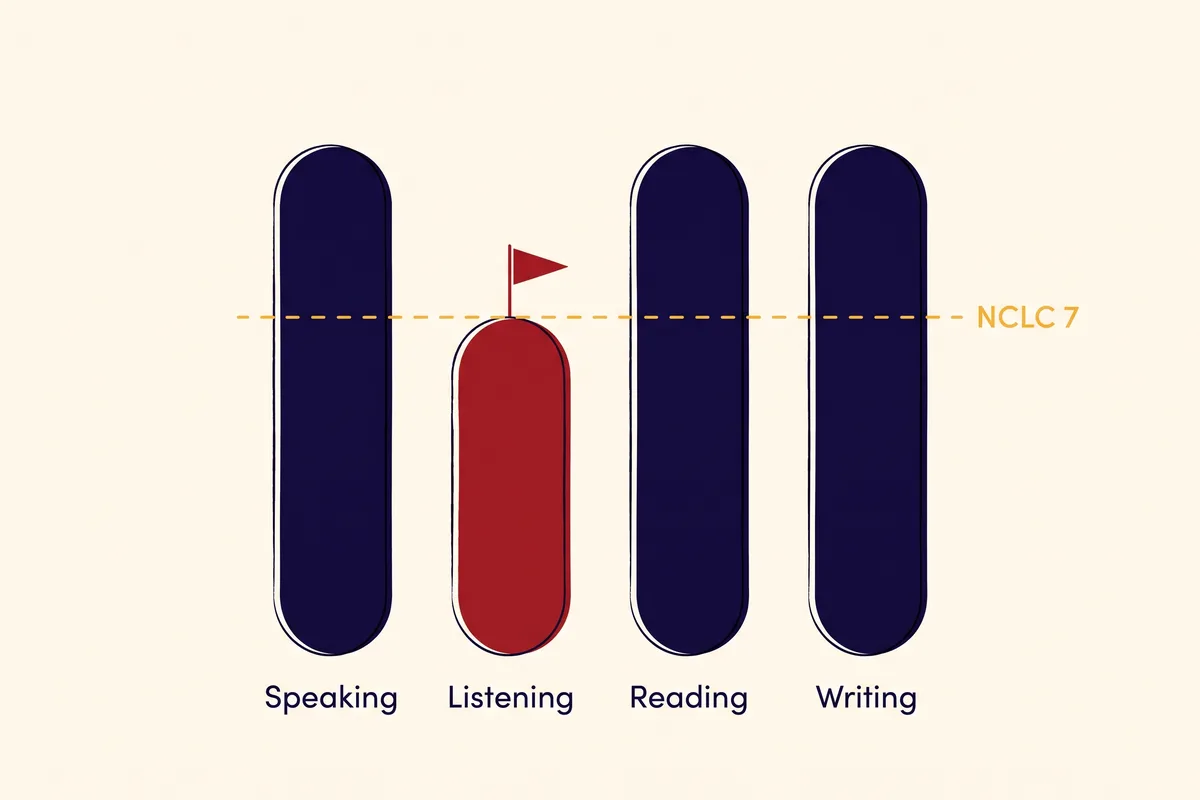
IRCC reads your four skills separately: the lowest one decides your French-bonus eligibility.
Scenario: the PR-ready candidate (NCLC 7)
Example results: Reading 210, Writing 320, Listening 255, Speaking 320.
This candidate has successfully hit NCLC 7 across all four skills. They qualify for French-language category draws and are eligible for the bilingualism bonus in Express Entry — 25 or 50 points, depending on their English results.
Scenario: the high-achiever (NCLC 9)
Example results: Reading 250, Writing 380, Listening 305, Speaking 380.
This candidate has reached NCLC 9. This score significantly maximizes their core CRS points for French and positions them exceptionally well for competitive category draws, often resulting in an Invitation to Apply (ITA) in the very next round of invitations.
Scenario: the “so close” candidate (below threshold)
Example results: Reading 220, Writing 320, Listening 240, Speaking 320.
This candidate has strong scores in three skills but their Listening (240) falls below the NCLC 7 requirement (249). Because IRCC requires NCLC 7 in all four skills, this candidate misses out on French-language draw eligibility and the bilingualism bonus, despite having high marks elsewhere.
If one skill falls short
If your results show that you hit your target level in three skills but fell short in one, it is natural to feel frustrated — especially because the TEF Canada does not allow you to retake individual sections. Because IRCC requires that all four module results come from the same test sitting, you must register for and complete the entire four-part exam again if you want to improve a single score.
Retake rules and timing
You can retake the TEF Canada as often as you like, as there is no limit on the number of attempts allowed. However, you are subject to a mandatory 20-day waiting period between sittings. While this minimum wait is the administrative rule, the real question is when you will be ready to perform better.
Deciding between a quick rewrite and more prep
Booking the next available date immediately is often a mistake unless you have truly addressed the root cause of your score. Use your previous results to guide your decision:
- The “near-miss” (missed by 1 level): If you were just one level away from your target in a single skill, a focused 4–6 week preparation period is often enough to bridge the gap. Use this time to drill specifically on the weak skill rather than repeating general practice — our TEF preparation guide breaks down how to train each section.
- The “major gap” (CLB 5 or below): If you are more than one level away from your target, jumping into a retake is likely to yield the same result. You should treat this as a signal that you need a structured foundation-building period of 3–6 months rather than quick test-prep.
- Identify the failure pattern: Before rebooking, analyze your result. Was it a lack of language proficiency, a struggle with exam timing, or simply test-day anxiety? If your score was held back by fluency (pauses, hesitation) rather than grammar, prioritize speaking or listening practice with real-time feedback over reading textbooks.
Sources: Alliance Française — TEF Canada exam rules
How TEF scores compare with TCF scores
While both the TEF Canada and TCF Canada are accepted by Immigration, Refugees and Citizenship Canada (IRCC) for your immigration application, they are fundamentally different exams with distinct scoring methods. You cannot simply look at a TCF score and expect it to work on a TEF Canada score chart, or vice-versa, because the raw scoring scales are entirely different.
The TEF Canada evaluates each skill using specific ranges: Reading (0–300), Listening (0–360), Writing (0–450), and Speaking (0–450). In contrast, the TCF Canada uses a completely different metric: it scores listening and reading on a 699-point scale, and writing and speaking on a 20-point scale. Because these numbers measure performance using different mathematical baselines, a “raw score” from one test cannot be applied to the other exam’s standards.
However, the reason both tests are valid for your application is that they are both calibrated to the same Canadian Language Benchmark (NCLC) levels. Regardless of which test you choose, IRCC converts your specific exam results into the standardized NCLC level used for Express Entry points and category-based draws. Ultimately, while the TEF Canada score chart and its TCF equivalent look different in their raw numbers, they lead to the same destination: an official NCLC level that determines your eligibility for Canadian permanent residence. Still choosing between the two exams? Our TEF vs TCF comparison goes format by format.
TEF Canada score chart FAQ
What is the minimum TEF Canada score required for Express Entry?
Most immigration streams require at least NCLC 7 in all four skills. This corresponds to 207+ in Reading, 249+ in Listening, 310+ in Writing, and 310+ in Speaking.
Why does my certificate show two different scores?
You will likely see a “Score / 699” and an “Équivalence ancien score” column. IRCC requires you to enter the numbers from the “Équivalence ancien score” column into your Express Entry profile, as the /699 scale is not currently compatible with their system.
Can I average my scores across the four skills?
No, you cannot average your results. IRCC evaluates each of the four language abilities independently, meaning if even one skill falls below the required threshold, you do not meet the minimum requirement.
How long are TEF Canada scores valid for immigration?
Your results must be less than two years old both when you complete your Express Entry profile and when you submit your application for permanent residence. If your results expire between those two steps, your application will be refused.
What is the difference between CLB and NCLC?
They are essentially the same standard but for different languages: CLB (Canadian Language Benchmarks) is used for English, while NCLC (Niveaux de compétence linguistique canadiens) is the French-language equivalent. Both frameworks share the same 12-level scale and immigration requirements.
Can I use a TCF Canada score instead of the TEF Canada?
Yes, both tests are accepted by IRCC for immigration purposes. However, they use different scoring scales, so you must convert your specific exam results into NCLC levels using the conversion table provided by the test provider.
How often can I retake the TEF Canada?
There is no limit to the number of times you can retake the TEF Canada exam. You must simply wait 20 days between test sittings before registering for a new attempt.
What should I do if only one of my four skills is below the threshold?
Because IRCC does not allow you to retake individual modules, you must register for and complete the entire four-part exam again. It is best to focus your preparation specifically on that weak skill before rebooking.
Does achieving NCLC 7 guarantee an invitation to apply (ITA)?
No, NCLC 7 is a minimum benchmark for eligibility and accessing bonus points, but it does not guarantee an ITA. You are still ranked in the Express Entry pool based on your CRS score, which includes other factors like age, education, and work experience.
Why is NCLC 7 often called the “golden ticket”?
NCLC 7 is the threshold that unlocks French-language category-based Express Entry draws and the bilingualism bonus points (up to 50 CRS points). These benefits can significantly improve your chances of receiving an invitation compared to relying only on general draws.
Is NCLC 5 ever enough for permanent residence?
Yes, depending on the program and your occupation. For example, the Canadian Experience Class may accept NCLC 5 for TEER 2 or 3 positions, though NCLC 7 remains the standard for maximizing CRS points.
How does the TEF Canada scoring work for reading and listening?
These sections consist of multiple-choice questions where you earn points for correct answers. Your raw score is then converted into a calibrated score that accounts for the specific difficulty of the questions you answered, rather than just a simple count.

Get to your target score with Toronto French Academy
Preparing for the TEF or TCF exam can feel overwhelming, but you don’t have to navigate it alone. At Toronto French Academy, we’ve been helping students reach their immigration goals since 2018. Every new student begins with a personalized demo class that includes a detailed level check to identify exactly where you stand. Whether you prefer our live online group classes starting from $249/month or focused private tutoring, we provide the structured support you need. Join a community with a 4.8-star rating from over 239 Google reviews and start your journey today.
Book a demo class