
The short answer
Quick answer: B1 is intermediate French and B2 is upper-intermediate. For Canadian PR the level that matters is CLB 7 (NCLC 7), the low end of B2 — it earns Express Entry’s French bonus and qualifies you for French-language draws.
| CEFR level | CLB / NCLC (approx.) | What it means for Canada PR |
|---|---|---|
| B1 — intermediate | CLB 5–6 | CEC minimum for TEER 2–3 jobs (CLB 5) |
| B2 — upper-intermediate | CLB 7–8 | CLB 7+ in all four skills = French bonus (25–50 CRS points) |
| C1 — advanced | CLB 9–10 | Top Express Entry language points |
CLB 7 on the TEF Canada: reading 207+, listening 249+, writing 310+, speaking 310+ (TEF score chart). On the TCF Canada: listening 458+, reading 453+, writing 10+, speaking 10+ (TCF score chart). Full CLB/NCLC breakdown: NCLC levels guide. Bands verified against IRCC (canada.ca), August 21, 2026.
When navigating Canadian immigration, having the CEFR levels explained in the context of official requirements is essential for any French learner aiming to move to Canada. While language schools and the international versions of tests like the TCF and TEF describe ability in Common European Framework of Reference (CEFR) levels, the Canadian government uses its own system: the Niveaux de compétence linguistique canadiens (NCLC). Understanding how these two frameworks interact is the first step toward building a successful Express Entry profile or provincial nomination application.
The CEFR scale ranges from A1 for beginners to C2 for near-native command. For Canadian permanent residence, though, the “Upper Intermediate” or B2 level is the milestone that matters most, because it typically aligns with NCLC 7 — the threshold for the most competitive immigration streams and for French-language bonus points. Below is a practical breakdown of what each level means in real life and for your immigration plans.
On this page
- What Is the CEFR?
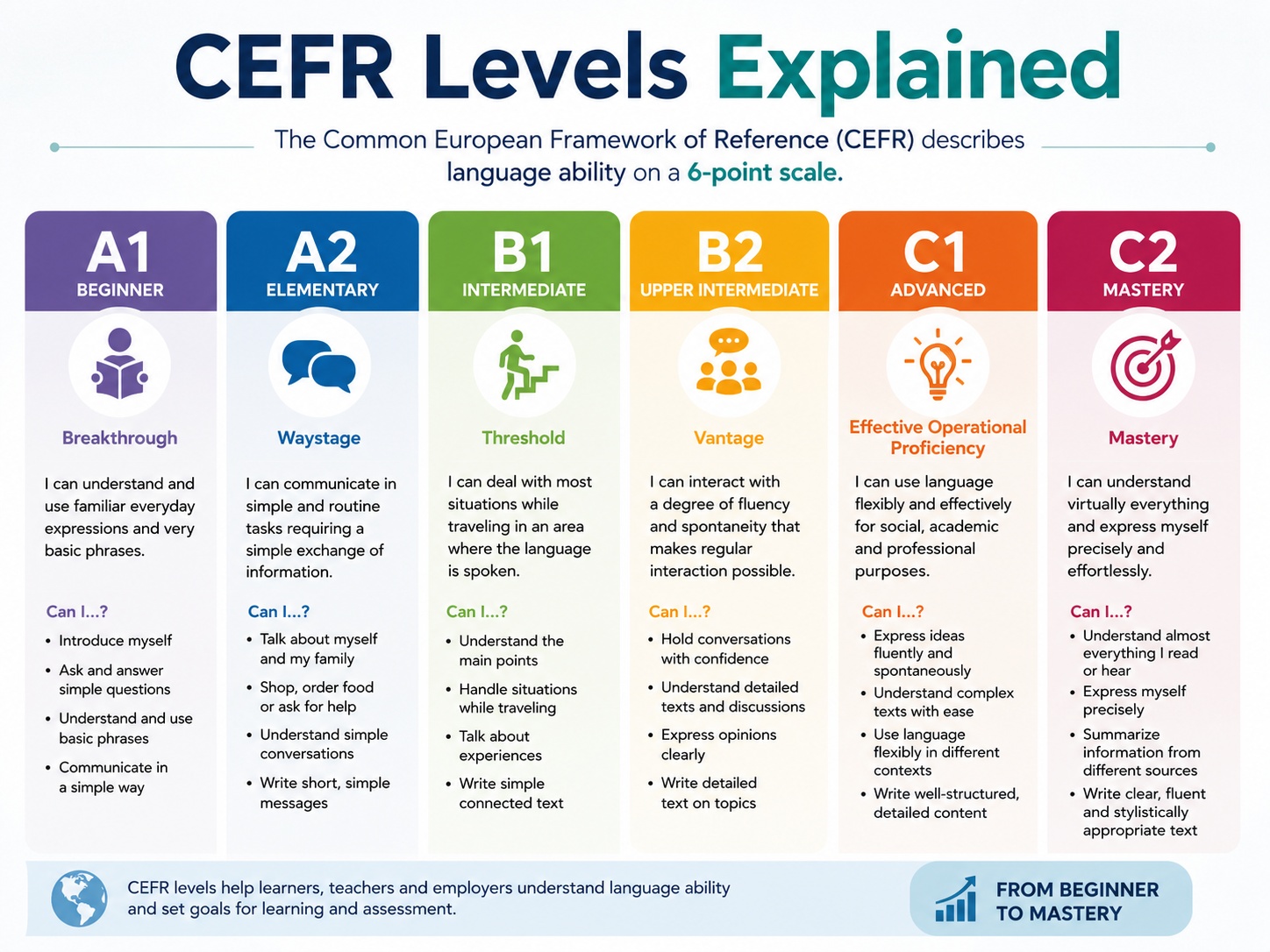
- The 6 CEFR Levels at a Glance
- What Is A1 Level in French? (Beginner)
- What Is A2 Level in French? (Elementary)
- What Is B1 Level in French? (Intermediate)
- What Is B2 Level in French? (Upper Intermediate)
- Is CLB 7 B1 or B2? CEFR to CLB for French Exams
- What Level of French Is Required for Canada PR?
- How You Prove Your Level: TEF Canada and TCF Canada
- How Long Does It Take to Progress Through CEFR Levels?
- CEFR Levels FAQ
What Is the CEFR?
The Common European Framework of Reference for Languages (CEFR) is an international standard developed by the Council of Europe. It was created to provide a consistent, transparent, and comprehensive way to describe language proficiency, making it easier for educational institutions, employers, and governments to evaluate a candidate’s language skills. Whether you are learning French in a language school in Europe or preparing for an official immigration exam, the CEFR serves as a universal yardstick — ranging from A1 for absolute beginners to C2 for near-native command.
For those pursuing Canadian immigration, navigating language levels can feel like juggling two different rulers. You will constantly encounter two distinct scales: the CEFR and the CLB (Canadian Language Benchmarks) or its French equivalent, the Niveaux de compétence linguistique canadiens (NCLC).
The confusion stems from their different origins and purposes:
- The CEFR is your international report card. When you take French exams, results are often described in CEFR levels because these tests are widely recognized in academic settings globally. It describes your general ability to communicate and interact in a foreign language.
- The CLB/NCLC is the Canadian government’s internal standard. Developed specifically for Canada’s immigration system, it focuses on your functional ability within the Canadian workplace and society. When you apply for permanent residence through Express Entry or provincial streams, the Canadian government requires your results in NCLC terms because that scale is calibrated to match Canada’s specific immigration, settlement, and labour market needs.
Understanding this distinction is key: while the CEFR tells you how “good” your French is by international standards, the NCLC tells you exactly where you stand in the eyes of Canadian immigration authorities.
The 6 CEFR Levels at a Glance
| Level | Description | User Type |
|---|---|---|
| A1 | Beginner | Basic User |
| A2 | Elementary | Basic User |
| B1 | Intermediate | Independent User |
| B2 | Upper Intermediate | Independent User |
| C1 | Advanced | Proficient User |
| C2 | Mastery | Proficient User |
While C1 and C2 are ideal long-term goals, A1 to B2 is where most learners — and nearly all Canadian PR candidates — spend their time. Here is each level in depth.
What Is A1 Level in French? (Beginner)
At this entry level, you can understand and use familiar, everyday expressions and very basic phrases aimed at satisfying concrete needs. You are able to introduce yourself and others, and you can ask and answer questions about personal details like where you live or the people you know.
What You Can Do at A1:
- Introduce yourself and others
- Ask and answer simple personal questions (e.g., age, nationality, job)
- Use everyday phrases like greetings and farewells
- Understand slow, clear speech with repetition
Example:
“Je m’appelle Marie. Je suis étudiante. J’habite à Brampton.”
Who This Level Is For:
- Complete beginners
- Learners just starting a French course
- Anyone preparing for DELF A1 or an immigration language requirement at the basic level
At A1, communication is limited, but it’s the essential foundation for your future progress.
What Is A2 Level in French? (Elementary)
At A2, you can understand sentences and frequently used expressions related to areas of most immediate relevance — basic personal and family information, shopping, local geography, and employment. You can communicate in simple, routine tasks that require a direct exchange of information.
What You Can Do at A2:
- Talk about your routine, work, shopping, or family
- Describe basic needs and immediate environments
- Understand frequently used expressions related to areas of immediate relevance
- Interact in simple conversations if the other person speaks slowly
Example:
“Je travaille dans un restaurant. Je commence à 9 heures et je finis à 17 heures.”
Who This Level Is For:
- Learners with some experience (3–6 months of study)
- Candidates preparing for the DELF A2 exam
- People who want to travel or live short-term in a French-speaking country
At this stage, you’re gaining the ability to survive in French — ordering food, asking for directions, and handling simple conversations.
What Is B1 Level in French? (Intermediate)
The B1 level, often called the “threshold” level, marks your transition into becoming an independent user of French. At this stage, you can handle the majority of situations you might encounter while travelling in a French-speaking region. You are comfortable expressing your personal interests, discussing familiar topics, and providing basic reasons or explanations for your opinions and plans.
B1 speakers still face hurdles with complexity, though. You may struggle to follow fast-paced, unscripted conversations, understand nuanced media, or engage in deep, abstract, or highly technical professional discussions. You can handle daily life with relative ease, but you are not yet fully autonomous in a professional or academic environment.
What You Can Do at B1:
- Understand the main points of spoken and written texts on familiar topics
- Deal with most travel situations without major issues
- Write short connected texts on personal interests or experiences
- Describe events, opinions, and plans
Example:
“L’année dernière, j’ai voyagé en France. C’était une expérience incroyable. J’ai parlé avec beaucoup de gens et j’ai amélioré mon français.”
Who This Level Is For:
- Learners who’ve studied French for about 1 year or more
- TEF or DELF B1 exam candidates
- Students or professionals preparing to live abroad
In the Canadian immigration context, B1 typically aligns with NCLC 5 or 6. It is a solid intermediate milestone, but it is rarely enough for permanent residence goals: most competitive pathways require a minimum of NCLC 7, which corresponds to the B2 level. While B1 is a valuable stepping stone for daily communication, your primary focus for Canadian immigration should be bridging the gap from B1 to B2.
What Is B2 Level in French? (Upper Intermediate)
At the B2 level, you can understand the main ideas of complex texts on both concrete and abstract topics, including technical discussions in your field of specialization. You can interact with a degree of fluency and spontaneity that makes regular interaction with native speakers quite possible without strain for either party.
B2 is the benchmark for academic, professional, and immigration-related use of French: CLB/NCLC 7–8 sits in this band, and NCLC 7 — the Express Entry French-bonus threshold — is its low end. For a deeper look at what the level demands skill by skill, see our guide to B2 level in French.
What You Can Do at B2:
- Understand the main ideas of complex texts, including technical discussions
- Interact with a degree of fluency and spontaneity
- Express opinions clearly in speech and writing
- Write essays or reports on various subjects
Example:
“À mon avis, parler plusieurs langues est un atout majeur dans le monde professionnel. Cela montre la capacité d’adaptation et favorise les opportunités.”
Who This Level Is For:
- Those applying for Canadian PR (CLB 7–8 = B2)
- Students pursuing higher education in French-speaking countries
- Professionals working in international or bilingual environments
B2 is where language learning starts to become a powerful career and immigration tool.
Is CLB 7 B1 or B2? CEFR to CLB for French Exams
CLB 7 corresponds to CEFR B2 — the lower half of upper-intermediate. CLB 5–6 maps to B1, and CLB 9 and above reaches into C1. CLB 7 in all four skills is the threshold for Express Entry’s French bonus.
Strictly speaking, CLB 7 sits right on the border between B1 and B2. The most rigorous study of the two frameworks — North and Piccardo’s 2019 alignment research for the Centre for Canadian Language Benchmarks — concluded that Benchmark 7 is best described as a strong B1+ with elements of B2, while Benchmark 8 is full B2. Interestingly, the same study’s French-language panel, and the median expert vote, placed Benchmark 7 at B2 — which is exactly where the practical “CLB 7 = B2” convention comes from, and it’s the convention used in the tables on this page: CLB 7 as the low end of the B2 band.
| CEFR Level | DELF / DALF Diploma | CLB / NCLC (approx.) |
|---|---|---|
| A1 | DELF A1 | CLB 1–2 |
| A2 | DELF A2 | CLB 3–4 |
| B1 | DELF B1 | CLB 5–6 |
| B2 | DELF B2 | CLB 7–8 |
TEF Canada and TCF Canada results are reported as score bands rather than diplomas — our TEF score chart and TCF score chart show exactly which scores equal CLB/NCLC 7 in each skill.
If your target is CLB 7 on the TEF Canada specifically, our step-by-step guide on how to get CLB 7 in TEF Canada covers the exact module scores, a 12-month study plan and realistic timelines by starting level.
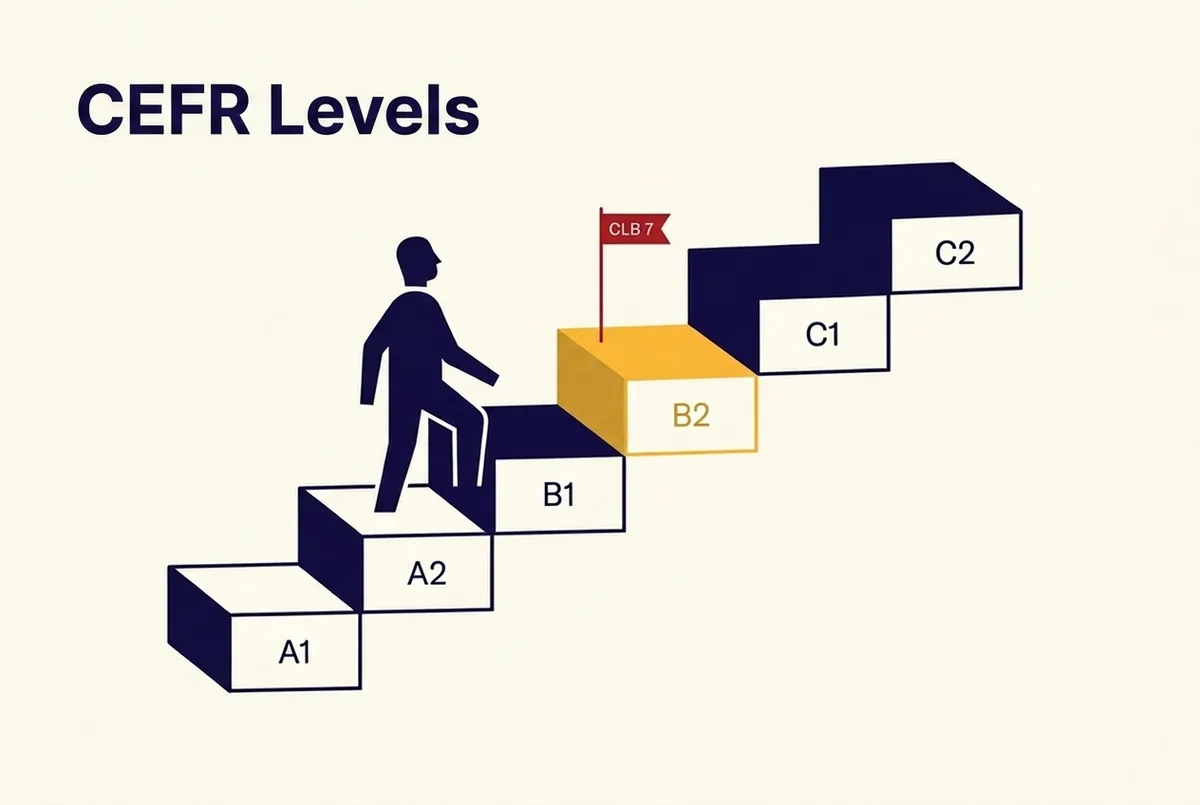
The reason these two scales don’t line up neatly is that they were built for fundamentally different purposes. The CEFR is a broad, international framework designed to describe general language ability for academic and professional contexts globally. In contrast, the CLB/NCLC was custom-built by the Canadian government specifically to measure your ability to integrate into the Canadian workplace and society.
Because they were developed by different institutions for different goals, there is no exact 1:1 mathematical conversion. A B1 level might mean you are “independent” in a European school context, but it doesn’t guarantee you have the specific functional vocabulary required to navigate a Canadian work environment as defined by CLB benchmarks.
If you are told you need CLB 7 for your immigration application, do not make the mistake of aiming for a standard “B1” level and stopping there. Because CLB 7 demands that higher-level “B1+” proficiency, you should prepare as if you are aiming for a solid B2. Treating CLB 7 as a low-level target can leave you short on your actual test scores; aiming for B2-level competency gives you the buffer needed to hit that critical CLB 7 threshold in all four skill areas.
What Level of French Is Required for Canada PR?
For most competitive federal immigration pathways, achieving a minimum of NCLC 7 is the primary goal. This level, which corresponds to B2 (Upper Intermediate) on the CEFR scale, is the critical threshold for several strategic advantages in the Express Entry system.
The French-language proficiency category-based draws require you to score NCLC 7 or higher in all four language skills: reading, writing, listening, and speaking. Qualifying for these targeted draws is a significant advantage, as they often feature Comprehensive Ranking System (CRS) cut-offs 100 or more points lower than general all-program draws. Additionally, reaching NCLC 7 in all four skills earns the French-language bonus: 50 CRS points if you also have English at CLB 5 or higher in all four skills, or 25 points if your English is below that.
While NCLC 7 is the standard for high-competition streams, requirements vary by program and occupation type:
- Federal Skilled Worker Program (FSWP) & CEC (TEER 0/1): NCLC 7 (CEFR B2).
- Canadian Experience Class (CEC) (TEER 2/3): NCLC 5 (CEFR B1).
- Federal Skilled Trades Program (FSTP): NCLC 5 (B1) for speaking and listening, and NCLC 4 (A2) for reading and writing.
- Canadian citizenship (ages 18–54): NCLC 4 (A2) in speaking and listening only.
How You Prove Your Level: TEF Canada and TCF Canada
When you are ready to prove your French proficiency for Canadian immigration — whether for Express Entry, provincial nomination, or citizenship — IRCC officially accepts only two French language tests: the TEF Canada (Test d’évaluation de français) and the TCF Canada (Test de connaissance du français). Both exams are rigorous and test the same four core skills: listening, reading, writing, and speaking.
While both tests lead to the same official NCLC levels required for your application, they use completely different scoring methodologies. The TEF Canada provides individual scores that map to specific bands, while the TCF Canada uses a mix of a 699-point scale for comprehension and a 20-point scale for production. Because these systems are so different, you cannot compare them numerically. Instead, focus entirely on the NCLC level they convert to, as that is the only metric the Canadian government uses to determine your eligibility and points.
Choosing between the two usually comes down to personal fit rather than objective difficulty. The TEF Canada often uses a more fixed, structured format that some find predictable, while the TCF Canada is frequently perceived as more adaptive and flexible, though it requires managing tasks across a different number of exercises. Before you book, consider factors like your test-taking style, how quickly you need a result, and which test centres are available near you. The “easier” test is simply the one that helps you reliably reach your target NCLC level, so the best way to decide is to try a mock version of both and see which format feels more natural.
Our TEF Canada score chart and TCF Canada score chart carry the full IRCC conversion tables, with every band from NCLC 4 to 10.
How Long Does It Take to Progress Through CEFR Levels?
“How long does it take to learn French?” is a question that depends entirely on what you want to achieve. If you are aiming for basic tourist survival, you need significantly fewer hours than someone aiming for professional fluency. French is one of the more accessible languages for English speakers — the two share a large stock of vocabulary, and French sits in the easiest category of the commonly used difficulty rankings for English speakers.
Progress is rarely linear, though. The early stages (A1–A2) involve learning the basics, while the transition to intermediate (B1) and upper-intermediate (B2) levels requires substantially more time to solidify grammar and listening comprehension.

Estimated Study Hours per Level
The following table provides cumulative estimates based on widely used guided-study benchmarks. These figures assume focused, active study rather than passive app usage.
| CEFR Level | Description | Estimated Cumulative Hours |
|---|---|---|
| A1 | Beginner | 80–100 hours |
| A2 | Elementary | 180–200 hours |
| B1 | Intermediate | 350–400 hours |
| B2 | Upper Intermediate | 500–600 hours |
| C1 | Advanced | 700–800 hours |
| C2 | Mastery | 1,000–1,200+ hours |
What Influences Your Speed?
Your progress is not set in stone. Several factors can accelerate or delay it:
- Consistency over intensity: 30 minutes of daily, focused practice builds skill more effectively than a 4-hour “marathon” session once a week.
- Prior language experience: If you already speak another Romance language (like Spanish, Italian, or Portuguese), you may progress 30–50% faster thanks to shared grammatical logic and vocabulary.
- Active vs. passive study: Tapping through gamified apps is passive. Active tasks — shadowing native speakers, transcribing audio (dictation), and speaking with tutors — are what actually move you from one level to the next.
- Immersion: Moving to a French-speaking environment, or creating a “French bath” at home with podcasts, news, and movies, forces your brain to adapt faster than classroom study alone.
The “B1 Plateau”
Many learners stall between B1 and B2. At B1, you can communicate your basic needs and opinions, but you often hit a wall when faced with fast-paced native speech, complex sentence structures, or specialized vocabulary.
The primary cause of this plateau is reliance on textbooks and apps that do not simulate real-world speed and ambiguity. To break through to B2, you must stop “studying French” and start “using French” — shifting your focus to listening to authentic content and pushing yourself into spontaneous conversation, even when it feels uncomfortable.
CEFR Levels FAQ
What is B1 level in French?
B1 is the CEFR's intermediate level — an independent user. You can handle travel situations, understand the main points of everyday conversation, and write short connected texts. On the Canadian scale, B1 corresponds roughly to CLB/NCLC 5–6.
What is B2 level in French?
B2 is upper-intermediate: you interact with fluency, follow complex texts and express opinions clearly. It is the benchmark for academic, professional and immigration use of French, and corresponds roughly to CLB/NCLC 7–8.
Is CLB 7 B1 or B2?
CLB 7 corresponds to CEFR B2 — the lower half of upper-intermediate. CLB 5–6 maps to B1, and CLB 9 and above reaches into C1. CLB 7 in all four skills is the threshold for Express Entry's French bonus.
What is the difference between B1 and B2?
B1 means you're conversational — travel, personal discussions and basic work topics. B2 is more academic or professional: you can debate, write formal texts, and interact fluently with native speakers.
Is B2 level fluent?
Not quite. B2 is often described as independent fluency: you function well in daily life and work but may still struggle with complex or abstract language. True fluency usually begins at C1.
Which CEFR level do you need for Canadian PR?
For TEF Canada, most Express Entry applicants aim for CLB 7 or higher — CLB 7 corresponds to B2-level proficiency in French. IRCC assesses each of the four skills separately.
Can you skip a CEFR level, like A2 to B2?
It's possible but not recommended. Each CEFR level builds important foundations; skipping levels can leave gaps in grammar, comprehension and fluency.
Do CEFR levels apply only to French?
No. The CEFR applies to all major languages — Spanish, German, English, Italian and more. It's a universal standard for measuring language ability.
Can I use DELF or DALF for Canadian immigration?
No. IRCC accepts only two French tests for Express Entry and citizenship: the TEF Canada and the TCF Canada. DELF and DALF are respected diplomas for study and work, but they cannot be used for a PR application.
Is B1 good enough for Canadian PR?
Generally no. Most competitive federal pathways need NCLC 7 — B2 territory — in all four skills. B1 (roughly NCLC 5–6) meets the CEC minimum for TEER 2–3 occupations, but it does not earn the French bonus or French-draw eligibility.
What happens if I score high in one skill but low in another?
IRCC assesses each skill separately, and the French bonus and French-language draws require NCLC 7 in all four. One skill below 7 means no bonus and no draw eligibility, so balanced preparation matters more than a high average.
Toronto French Academy
Where to Go From Here
Now that you have the CEFR levels explained in the context of your immigration goals, it is time to turn that knowledge into action. Since 2018, Toronto French Academy has taught 1,200+ students — most of them preparing for the TEF Canada or TCF Canada for permanent residence — and holds a 4.8-star average across 316+ Google reviews. Whether you choose group classes starting at $249/month or tailored private tutoring, the focus is practical preparation: check the score charts above to confirm your target, then book a demo class with a tutor-led level check.
Every level on this page, A1 through B2, is taught live in our online French classes, on Eastern-time schedules with TEF and TCF preparation included.
Book a Demo ClassTutor-led level check