
On this page
Most people spend months studying French, only to encounter the exam format for the first time on test day. We designed this course so that your first attempt is not the real one.
This page shows you exactly what we teach for each section, how long it takes, what it costs, and what to do next.
Who This TEF Preparation Course Is For
You are an Express Entry candidate who needs NCLC 7 in all four skills to qualify for the French-language category draws. This score also earns you up to 50 additional CRS points if your English is at CLB 5 or higher.
You are the spouse of an Express Entry applicant, and your French scores can add valuable points to a couple’s profile.
You are applying for Canadian citizenship and need to prove NCLC 4 in speaking and listening.
Your work permit is expiring and you urgently need CLB 5 (NCLC 5) in listening and speaking for a Francophone Mobility work permit. We will target these two sections on a deadline.
You are starting from a B1 level and want to target the exam, or you are starting from zero and need a full path to proficiency.
What You Get in the TEF Canada Preparation Course, Section by Section
Three things move TEF Canada scores:
- knowing the exact task formats,
- training under timed pressure with one-play audio,
- getting your writing and speaking corrected by someone who marks against the TEF’s own criteria.
A preparation course is not a French lesson with an exam at the end. It is a targeted training program built backwards from the four sections of the test. Every week, we train all four skills. And every week, the two you have to produce, your writing and your speaking, are corrected by a tutor.
TEF Canada Listening Preparation
Your target for NCLC 7 is a score between 249 and 279 out of 360. This section has 40 multiple-choice questions in 40 minutes. Each recording plays only once, the questions appear in order, and you cannot go back.
What we teach: We train you to read the four choices before the audio begins so you can predict what matters: the speaker’s purpose, their tone, a number, or the next action. You will learn to catch numbers, times, prices, and negations, which are common traps.
We work with the specific audio types the exam uses, from news reports and phone messages to public announcements with background noise, informal conversations, and formal interviews. We also focus on questions that ask what a speaker implied, not just what they said.
We drill two rules until they become reflexes.
- First, reset instantly after a missed question. Carrying a mistake into the next question costs more than the miss itself.
- Second, never leave a blank. A wrong answer scores zero, not negative, so a guess is always better than nothing.
How we teach it: In class, we run scored listening sets where the audio is never replayed before you answer. For homework, you will transcribe 15 to 30 second audio clips, writing down every word you hear before checking it against the transcript and shadowing the lost phrases aloud.
You will keep an error log classified by cause (e.g., missed vocabulary, lost number, negation, panic) instead of just thinking “my listening is bad.” As the exam approaches, we run full 40-question listening sections under real timing.
TEF Canada Reading Preparation
Your target for NCLC 7 is a score between 207 and 232 out of 300. This section has 40 multiple-choice questions in 60 minutes. You can move freely between questions. This is often the most learnable section on the paper.
What we teach: We teach a pacing strategy: bank the quick, factual questions first, then flag the slower inference questions and come back to them with your time reserve. Every answer must have evidence in the text; “it sounds French” is not evidence.
You will learn to spot the contrast words that can flip an answer, like pourtant, en revanche, and bien que. We focus on learning vocabulary in chunks (poser sa candidature, mettre en œuvre) so you recognize whole phrases, not just single words.
We insist on one distinction: understanding the article is not the task. Answering the question is the task.
How we teach it: We run timed sets twice a week, and every miss is classified by cause so you can see your pattern of error. You will have reading homework between classes and do specific pacing drills designed to get you through all 40 questions inside the 60-minute limit. Before your exam, you will complete full reading sections from our mock test bank.
TEF Canada Writing Preparation
Your target for NCLC 7 is a score between 310 and 348 out of 450. You have two tasks to complete in 60 minutes. This is the section where NCLC 7 is usually won or lost, and it is the most fixable.
What we teach for Section A (25 minutes, continue a news article, 80 words minimum): We give you the tense toolkit you need for journalistic writing: the passé composé for main events, the imparfait for background description, and the plus-que-parfait for events that happened earlier.
We teach a four-move plan:
- re-read the opening to identify who, where, and what;
- decide what happened next before you start typing;
- develop two or three events with one useful detail each;
- close like a journalist with the outcome or the next step.
Our practice target is 120 to 150 words, not just scraping by the 80-word minimum.
What we teach for Section B (35 minutes, argue a point of view, 200 words minimum): We teach a structure that works every time:
- state your position early,
- support it with two clear reasons backed by concrete examples,
- address one counterargument,
- provide a clean conclusion.
You will build an inventory of connectors (d’abord, ensuite, en effet, par exemple, en revanche, néanmoins, par conséquent, en conclusion) and learn to write in a neutral-formal register. We train you to avoid generic introductions like “De nos jours,” because assessors disregard opening paragraphs that could work for any subject.
We build three habits:
- plan for 3 to 5 minutes before you start typing;
- finish both tasks, because an elegant half-answer is still half an answer;
- keep the last few minutes for proofreading agreements, verb endings, and accents.
How we teach it: Every week, you will submit a writing task and receive it back with detailed, examiner-style feedback on task fulfilment, development, and language. You will then rewrite the corrected text from memory, because simply reading feedback changes nothing.
You will also keep a short log of your recurring errors. In the final weeks, we run timed 25-minute and 35-minute simulations in class.
TEF Canada Speaking Preparation
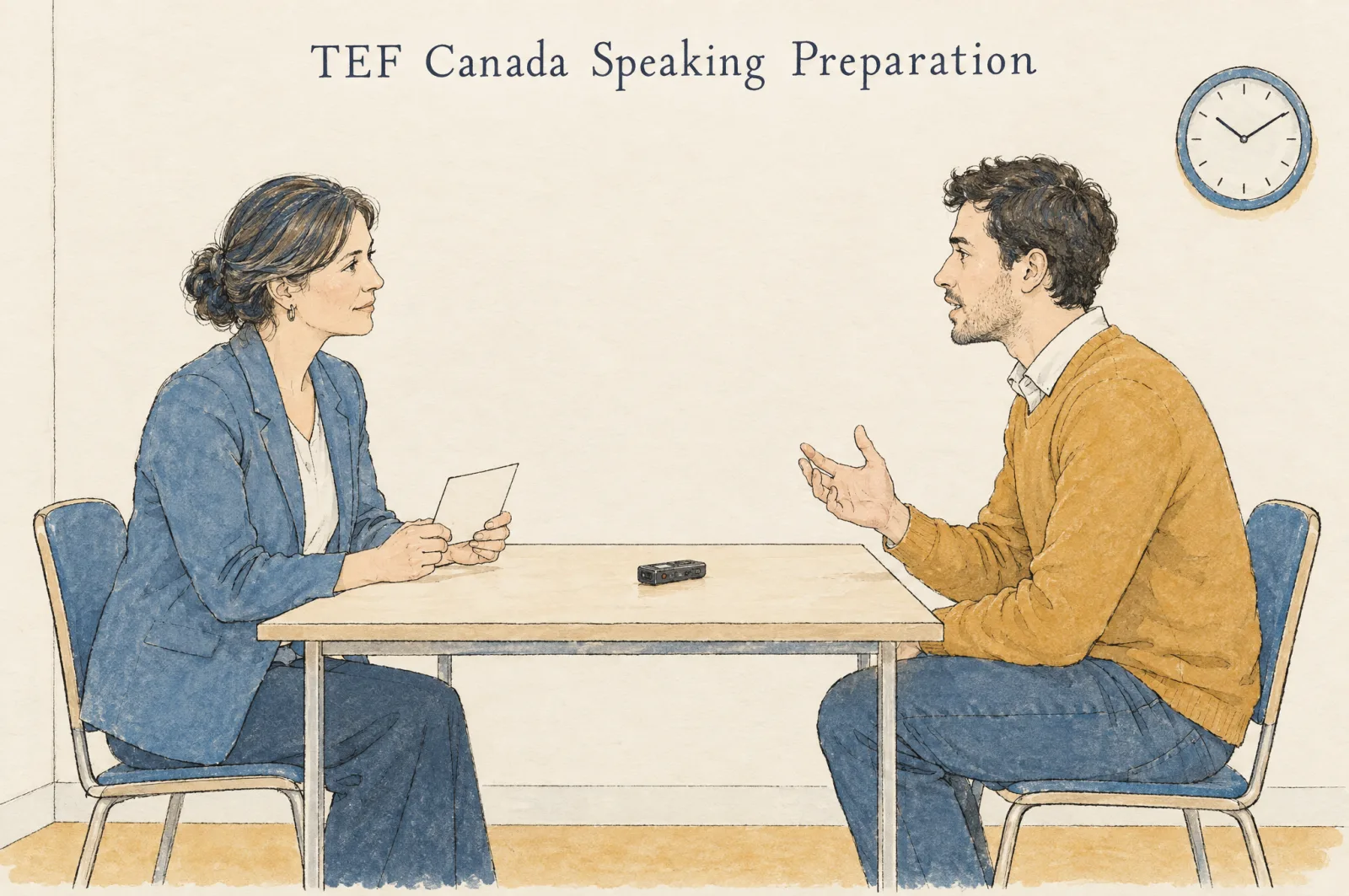
Your target for NCLC 7 is a score between 310 and 348 out of 450. You have two role-plays in 15 minutes, conducted face to face with an examiner and recorded. This is a conversation, not a speech.
What we teach for Section A (5 minutes, obtain information, about ten questions): We prepare you with the eight question families that cover most scenarios:
- price and fees,
- dates and schedule,
- location and access,
- conditions,
- what is included,
- registration,
- cancellation and refund,
- contact information.
You will practice using the polite vous form with the advertiser, opening with a proper greeting, and closing the call correctly. The key skill here is reacting to each answer you receive instead of just reading down a mental checklist of questions.
What we teach for Section B (10 minutes, convince a friend): We teach a simple persuasive structure: benefit, reason, example. The most important skill is hearing your friend’s objection and answering it directly. This means acknowledging their concern, answering it specifically, and then checking to see what concern remains.
You will learn the connectors that mark a B2-level speaker (d’abord, en plus, justement, cependant, au contraire, c’est vrai que… mais). You will use tu with your friend and practice closing the conversation on one manageable next step, even if your friend still resists.
We train you to avoid the most common mistakes:
- asking checklist questions without reacting to the answers,
- delivering a memorized speech that collapses at the first unexpected reply,
- falling silent after a “no,”
- speaking faster while thinking it makes you sound better.
How we teach it: You will have one corrected speaking task per week. You will also record two role-plays a week and listen back to them to identify fillers, flat answers, and moments where you failed to answer an objection.
You will practice with a partner who is trained to push back; if your partner agrees too quickly, there is no exam. As your test date nears, you will do full 15-minute mock interviews under real timing with a tutor.
Every course begins with a diagnostic test in the first session. This isn’t for a grade; it’s to place each of your four skills against its NCLC 7 band so we can set a realistic plan and target exam date.
Time and effort go to the weakest section, not equally to all four. We feed the bottleneck.
As your test date approaches, you will take mock exams under real timing, drawn from a bank of 220 TEF mock tests.
TEF Preparation Course Formats and Pricing
Our TEF preparation course formats start at $249 per month, with three options designed to match your schedule, starting level and timeline.
Group
$249 per month
- 20 classes per month
- 5 (Mon-Fri) days a week
- 1 hour per class, 6 to 8 students
- 10 to 12 months typical A1 to B2
- Best for: a structured routine on a budget
Individual
$369 per month
- 12 classes per month
- 3 days a week
- 1 hour per class, one to one
- 8 to 10 months typical A1 to B2
- Best for: a flexible schedule and faster progress
Fast-Track Individual
$549 per month
- 20 classes per month
- 5 days a week
- 1 hour per class, one to one
- 6 to 8 months typical A1 to B2
- Best for: the fastest path to exam readiness
Our Group classes run Monday to Friday in the mornings and evenings, with 6 to 8 students per class. Our Individual and Fast-Track Individual classes are one-to-one, with slots available in the mornings from 8 am to 12 pm and in the evenings from 8 pm to 12 am, Eastern Time.
All our TEF Canada prep courses are billed monthly. You can switch between formats from one month to the next if your schedule or goals change.
Book a demo classHow Our TEF Exam Preparation Works, Week by Week
Every student follows the same structured, week-by-week plan for TEF Canada exam preparation, in every format.
- Diagnostic Test: Your first session is a diagnostic test to pinpoint your current level in listening, reading, writing and speaking. This gives us a clear baseline and shows us exactly which skills need the most attention.
- Level Plan and Target Date: Based on your diagnostic, we create a personalized level plan. We work with you to set a realistic target exam date and map out the milestones you need to hit each month to be ready.
- The Weekly Cycle: Every week follows a consistent pattern: you attend your live classes, complete your homework, and submit one writing task and one speaking task. Your tutor corrects these tasks and gives you detailed feedback so you can improve week after week.
- Timed Mock Exams: As your exam date gets closer, we shift to timed mock exams under real conditions. You will practice with tests from our bank of 220 TEF mock tests to build stamina and master the question types for all four sections.
- Booking Your Exam: The final step is booking your official TEF Canada sitting. We guide you through the process to make sure you book the right test at a certified centre.
How Long TEF Canada Preparation Takes
The time it takes to reach CLB 7 (NCLC 7) in all four sections of the TEF Canada exam depends on your starting point and how many hours you can dedicate each week.
- From a B1 level: Most students need 3 to 6 months of structured TEF exam preparation to bridge the gap to a solid B2 and master the exam format.
- From zero (A1 level): A student starting from scratch typically needs 10 to 14 months to build the language from the ground up and then prepare for the exam.
- From a B2 level or higher: If you are already at a B2 level, you may only need 3 to 4 weeks to focus specifically on the TEF task formats, timing and strategy.
These are typical ranges, not promises. The exact time varies from person to person. Factors like the number of hours you study per week, your starting level, and your weakest section will determine whether you are on the shorter or longer end of these estimates.
TEF Preparation for Beginners: Starting From Zero
If you are starting your TEF preparation with little or no French, the first phase of your course will focus on building a strong foundation. You will work through the A1 and A2 levels, learning the core grammar, vocabulary, and sentence structures of the language.
During this foundational phase, we do not focus on TEF exam tasks. Once you have a solid base, we begin to layer in exam-specific strategies, task types, and timed practice, gradually preparing you for the demands of the test.
For a beginner, the Group format provides an affordable and consistent routine, while the Individual formats offer a faster, more flexible schedule that can be adjusted to your personal learning pace.
What TEF Score Is CLB 7, and How the Course Targets It
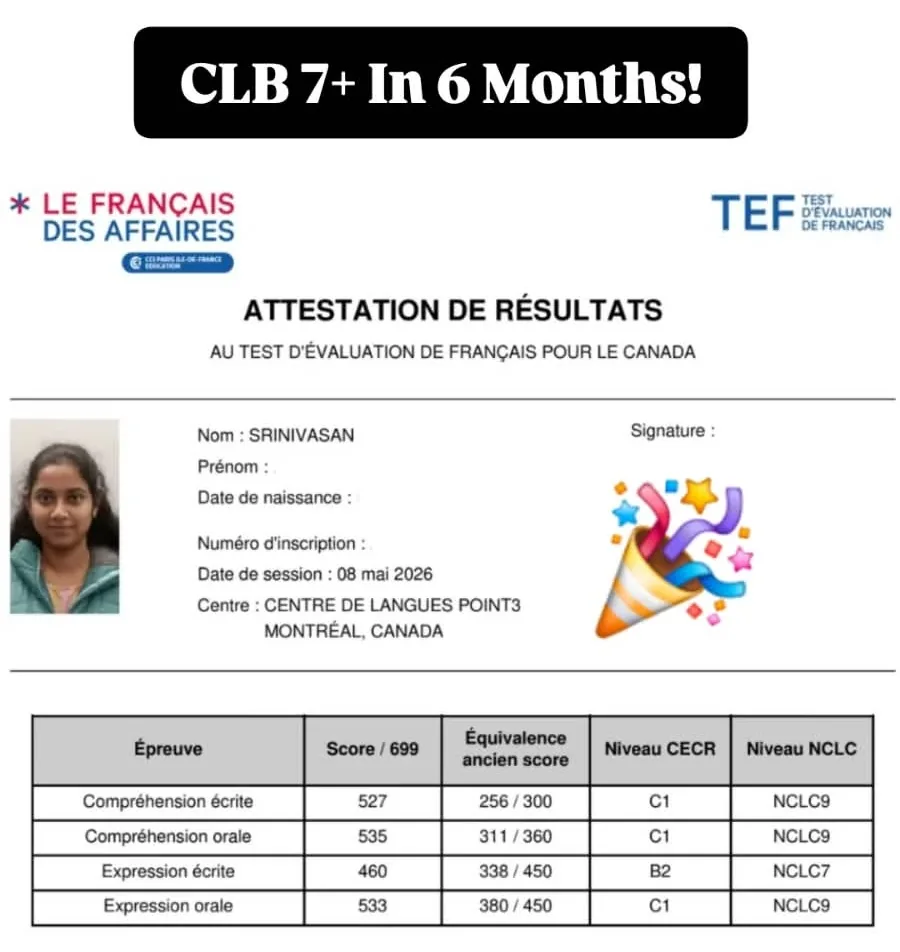
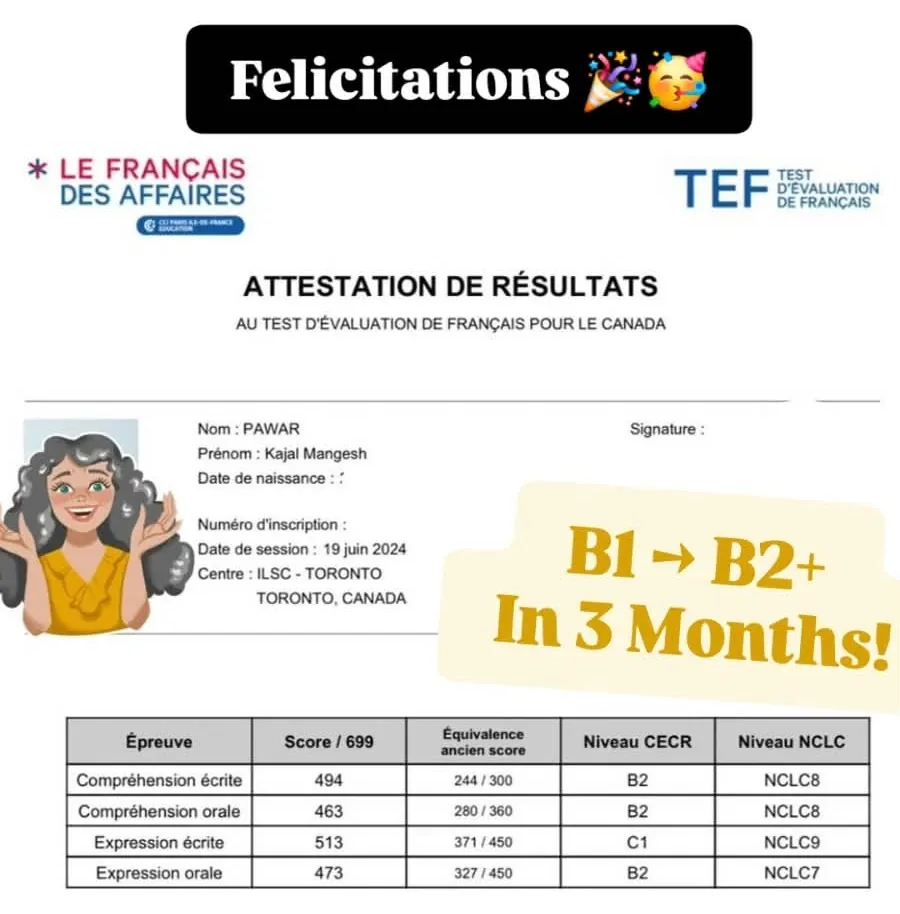
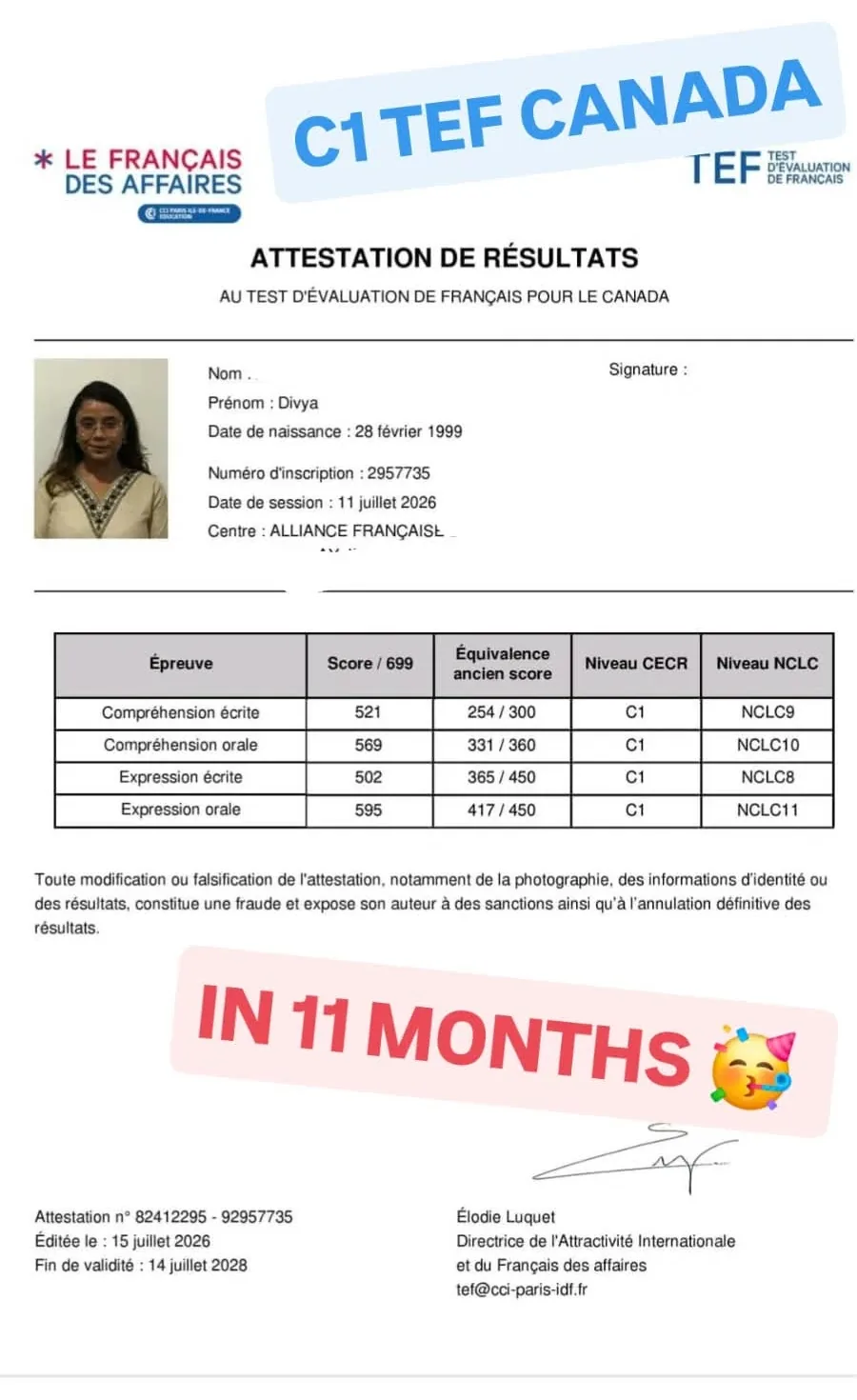
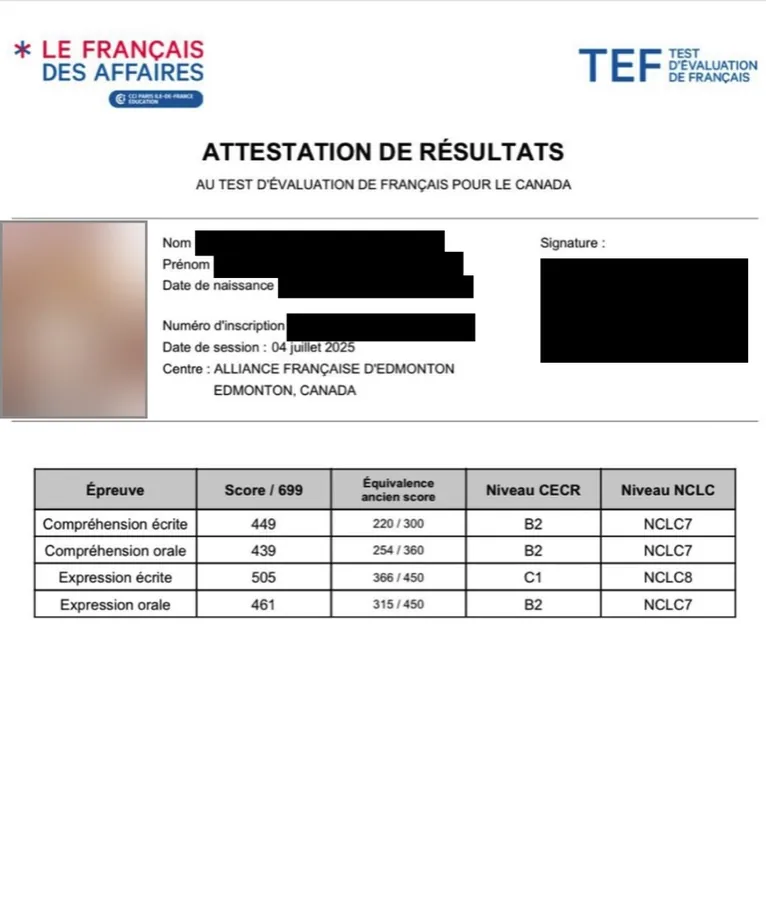
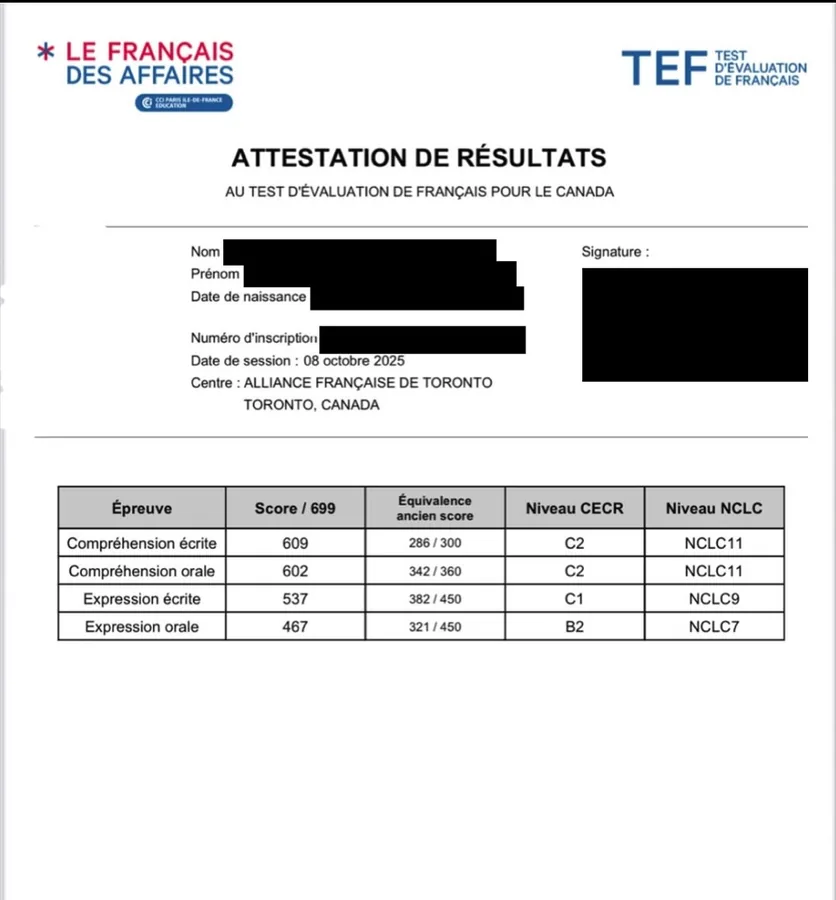
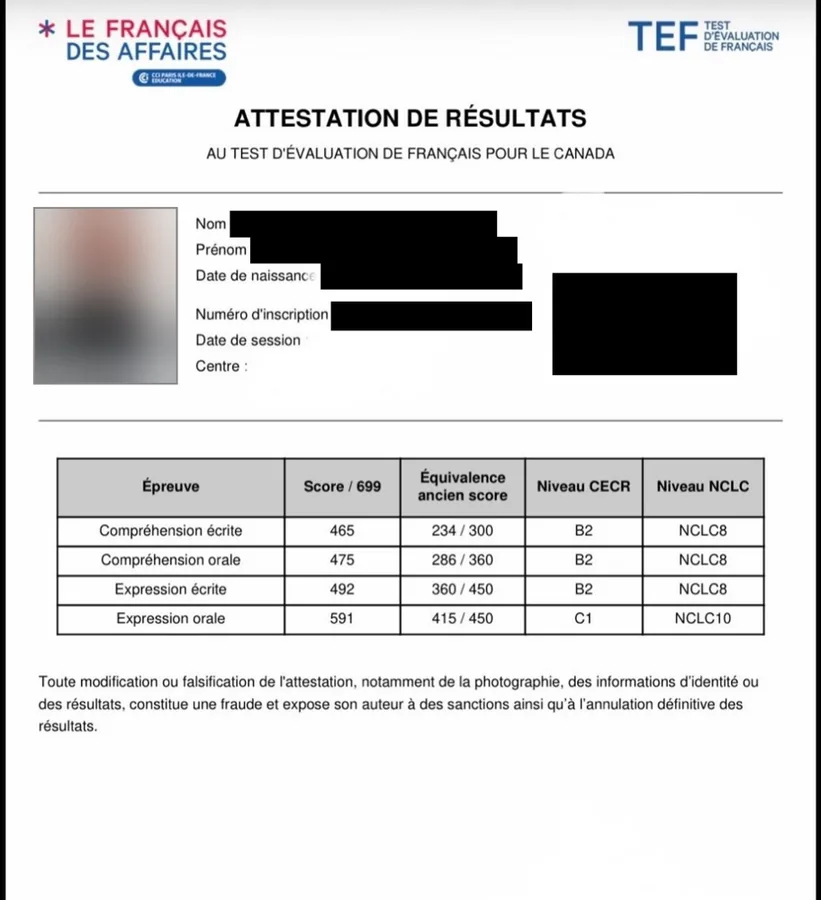
After you take the TEF Canada, your attestation will show two score columns: “Score /699” and “Équivalence ancien score”. For Express Entry, IRCC uses the “Équivalence ancien score” column. The target, CLB 7, is called NCLC 7 in French.
To achieve NCLC 7, your “ancien score” must fall within these specific bands:
- Reading: 207 to 232 out of 300
- Listening: 249 to 279 out of 360
- Writing: 310 to 348 out of 450
- Speaking: 310 to 348 out of 450
Our course is built around a weekly cycle designed to move each of your four skills into these target bands. It begins with a diagnostic to place your current abilities against the NCLC 7 standard. Each week, you complete writing and speaking tasks that are corrected by your tutor, providing direct feedback on your productive skills. For your receptive skills, you take mock reading and listening tests under timed conditions to track your progress and build stamina.
TEF or TCF: Which Exam Should You Prepare For?
IRCC accepts both TEF Canada and TCF Canada equally for Express Entry applications. The main differences between the two are practical. The TEF Canada speaking section consists of two role-play tasks in 15 minutes, while the writing section has two longer tasks. The TCF Canada speaking section has three tasks in about 12 minutes, and the writing section has three shorter tasks. We prepare candidates for both exams and can help you decide which one is a better fit for your test-taking style.
Online TEF Classes or In Person in Toronto and Brampton?
You can do your TEF Canada preparation online or in person. Both our online and in-person classes are taught by the same certified tutors using the exact same curriculum and weekly methodology.
Our live online TEF classes are available to students across Canada, giving you access to our top tutors from anywhere. We also offer in-person French classes for TEF at our academies in Toronto and Brampton. Our Toronto classes run at 3401 Dufferin St, North York, and our Brampton classes at 499 Main St S.
Online classes are the best fit if you live outside the GTA or if you have a fixed work schedule that makes commuting difficult. In-person classes are ideal for students in Toronto and Brampton who prefer learning in a physical classroom and benefit from a set time and place each week.
Why Prepare for TEF Canada With Toronto French Academy
We have been helping candidates prepare for French language exams since 2018. In that time, we have taught over 1,200 students, built a team of more than 200 C1/C2 certified tutors, and earned a 4.8-star rating on Google. Our TEF Canada preparation course is structured for results: it starts with a diagnostic, includes weekly corrected writing and speaking assignments, features mock exams under real timing, and gives you access to a bank of 220 TEF mock tests.
For those who prefer a more personalized approach, we also offer one-to-one TEF coaching. With this option, you work exclusively with a private TEF tutor who can tailor the curriculum to your specific strengths and weaknesses. This is an ideal format if you have a tight deadline or want intensive focus on particular skills.
Real TEF Canada Results From Our Students
These are TEF Canada attestations our students have shared with us, as published on our results page. Names are withheld; the scores are theirs.
What Students Say About Our TEF Preparation
Three of the Google reviews students have left for Toronto French Academy, quoted as written. More are on our reviews page.
★★★★★I’ve been taking French lessons with Love Bhatia Sir at TFA for the past two months, and it has been an amazing experience so far. I was a complete novice when I started, but thanks to Love’s easy to grasp explanations, kind approach and structured lessons, I’ve made noticeable progress in a short time. He is smart and very skilled at what he does. Each lesson is engaging, supportive, and tailored to my pace. If you’re new to French, preparing for TEF or looking to build a solid foundation, I highly recommend Love Sir and TF Academy.
★★★★★I started my journey french with TFA and I must say their one to one sessions are best for anyone who wants to learn french quickly and working on tight timelines. Special thanks to Divya Ahuja my trainer for being flexible, innovative and supportive. I would recommend them.
★★★★★She is one of the best and experienced teacher that will make you understand even difficult topics of french in simple ways. Her way of teaching is very unique and polite so i would like to give her more than 5 stars but there is no option for that.
TEF Canada Preparation Course: Frequently Asked Questions
Our TEF Canada preparation course starts with your level and your target, then sets the work and the format around them. These answers cover the practical questions to settle before enrolling.
How long does it take to prepare for TEF Canada?
The time required depends on your starting level. From a B1 level, preparation typically takes 3 to 6 months. From zero, it can take 10 to 14 months. If you are already at a B2 level or higher, you may be ready in 3 to 4 weeks. These are typical timeframes and not guarantees.
Can I prepare for TEF Canada in 3 months?
If you are already at a B1 level, yes. The typical preparation time from B1 is 3 to 6 months, so 3 months is possible but requires more hours per week. If you are at a B2 level or higher, 3 to 4 weeks of task-specific practice is often sufficient. Starting from zero French, you should plan for 10 to 14 months. These are typical ranges, not promises; the diagnostic test we use at the start of our course will clarify your personal timeline.
Can I get CLB 5 in French in 3 months?
To achieve CLB 5 (NCLC 5) in listening and speaking for the Francophone Mobility work permit in 3 months from zero, you must study 4 to 6 hours daily. We train these two sections from the start. If you have less time, plan for a longer period. These are typical ranges, not promises; the diagnostic in your first session will provide a personal estimate.
Can I prepare for TEF Canada online?
Yes. We offer live online TEF preparation classes that are accessible to students across Canada. This format provides the same interactive instruction and support as our in-person classes, which are available at our locations in Toronto and Brampton.
Can I prepare for TEF Canada by self-study?
For listening and reading, yes. You can make good progress with timed practice tests and an error log. Writing and speaking improve fastest when someone who marks against the TEF’s own criteria corrects your work every week. This is what our course adds: weekly corrected writing and speaking, plus mock exams under real timing.
How much does a TEF preparation course cost?
We offer several formats. Our Group TEF exam preparation course is $249 per month for 20 classes. For one-to-one coaching, the Individual course is $369 per month for 12 classes, and the Fast-Track Individual course is $549 per month for 20 classes. All classes are one hour long and billing is monthly.
Do you help book the TEF exam?
Yes, we do. As part of our service, we help students through the process and book their real TEF Canada sitting at an official test centre. This ensures you have a confirmed test date that aligns with your preparation timeline.
What level do I need to start?
There is no minimum level required to start our TEF Canada preparation. Beginners will start from zero, learning the fundamentals of French. Students with existing knowledge will take a diagnostic test, and we will place you in a class that matches your current B1 or B2 level.
When does the next TEF preparation course start?
There is no waiting for a batch to begin. You can start your course as soon as you enrol, with your first session being a diagnostic. Our group classes run Monday to Friday in the mornings or evenings. For individual and fast-track students, we offer slots in the mornings from 8 am to 12 pm and evenings from 8 pm to 12 am Eastern.
Is TEF or TCF easier to prepare for?
Neither exam is inherently easier; they are just different. The TEF has two longer speaking and writing tasks, while the TCF has three shorter tasks in each section. Your choice may depend on whether you prefer developing a topic in depth or responding quickly to multiple prompts. We prepare students for both exams.
Is the TEF Canada exam hard to pass?
There is no pass or fail. The TEF Canada places each of your four skills on a level, and Express Entry requires NCLC 7 in all four. The two places candidates lose the most points are the listening section (40 questions in 40 minutes, each recording plays once, no going back) and Section B of the writing test (35 minutes, 200 words minimum, argue a point of view). Both are trainable.
Do you offer TEF classes in Brampton?
Yes, we offer in-person TEF preparation classes in Brampton. We also have a location in Toronto and provide live online classes for students who prefer to learn from home or live elsewhere in Canada.
Are there TEF mock tests in the course?
Yes. Mock tests are a core component of our preparation. The course includes mock exams conducted under real timing to simulate the test-day experience. You will also get access to our extensive bank of 220 TEF mock tests and 140 TCF mock tests for practice.
Do you provide TEF preparation materials?
In the course, we provide a bank of 220 TEF mock tests. On our site, we provide 40 TEF speaking topics with two model dialogues (in our TEF Canada expression orale guide) and 40 TEF writing topics with three full sample answers (in our TEF Canada expression écrite guide). Both are downloadable as PDFs.
What TEF score is CLB 7?
To get CLB 7, you need to reach NCLC 7 on the “Équivalence ancien score” scale in all four sections. The required score ranges are: reading 207-232, listening 249-279, writing 310-348, and speaking 310-348.
Do you offer TEF preparation for beginners?
Yes, our program is designed to accommodate students at all levels, including complete beginners. If you are starting from zero, the course will guide you through the foundational grammar, vocabulary, and skills needed to begin preparing for the exam format.
Are beginner classes taught in English?
Yes, our beginner French classes are taught in English. This ensures a student starting from zero understands every explanation from the first class. As your French level improves, the language of instruction gradually shifts from English to French, ensuring a smooth and effective learning transition.
Book a Demo Class
The next step is to see the TEF Canada preparation course for yourself. In a demo class, we will conduct a level check, outline a personalized plan for you to reach CLB 7, and answer all your questions about the schedule and enrolment process.
Ready when you are
Tell us your exam date and your current level. We will map the sections, pick the format and start the weekly cycle.

Program lead
Simar Dua, French Program Lead
Simar leads the TEF Canada and TCF Canada programs at Toronto French Academy and has guided hundreds of Express Entry candidates from their first French lesson to the NCLC 7 result. She runs the diagnostics described on this page and hosts the academy’s free monthly French for Canada PR info session.