

CRS Points for French: How to Get 50+ Points for Canada PR in 2026
CRS points for French — if you’re applying through Express Entry, this is the question that could determine whether you receive an Invitation to Apply (ITA) or wait months for the next draw. In 2026, French proficiency has become one of the most powerful levers in the Comprehensive Ranking System, offering up to 50 additional points and access to category-based draws with significantly lower cutoffs.
With IRCC’s removal of CRS points for arranged employment offers in March 2025, the remaining controllable factors — like language ability — have become more valuable than ever. This guide breaks down exactly how many CRS points for French you can earn, what NCLC level you need, how the bilingual bonus works, and how to achieve the scores that unlock these points through TEF Canada or TCF Canada.
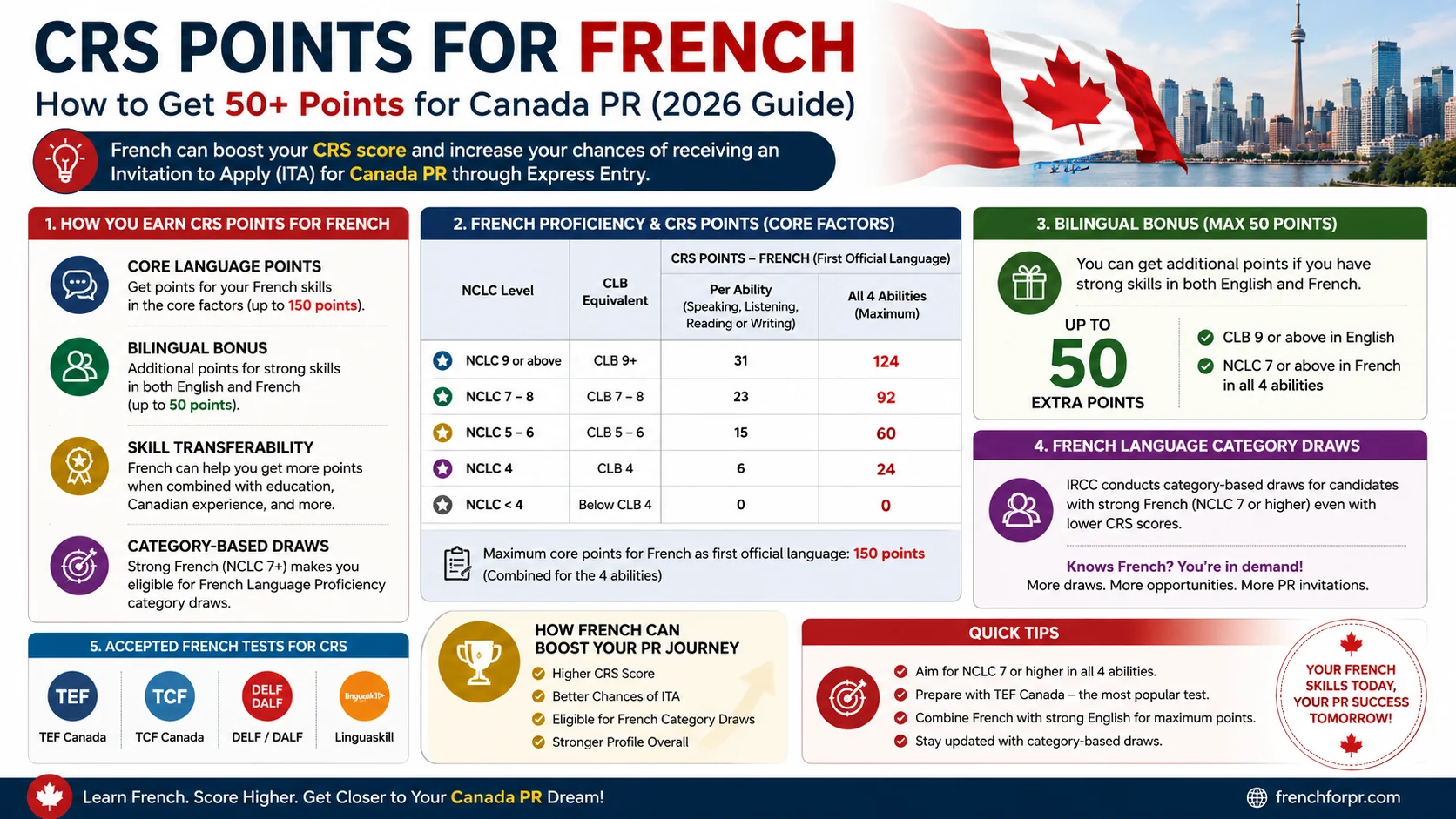
CRS points for French in Express Entry can add up to 50 points to your score. You need NCLC 7 in all four French abilities (reading, writing, listening, speaking) and CLB 5+ in all four English abilities to unlock the full 50-point bilingual bonus. Without English, you qualify for 25 points. French-language category draws have historically used cutoffs as low as 336 — well below general draws.
Table of Contents
- 01How Many CRS Points for French Can You Get?
- 02The Bilingual Bonus: 25 vs 50 Points Explained
- 03NCLC 7: The All-or-Nothing Threshold
- 04TEF Canada & TCF Canada Score Requirements
- 05French-Language Category Draws: Lower Cutoffs
- 06Real CRS Example: Before and After French
- 07French-Friendly Provincial Nominee Programs
- 08How to Achieve NCLC 7
- 09Frequently Asked Questions
How Many CRS Points for French Can You Get in Express Entry?
French can add points to your CRS score in two distinct ways, and confusing them is a common mistake. The first is through core second-language points, worth up to 24 points. The second is the bilingual bonus, worth up to 50 additional points. Both can stack together.
Second Language Core Points
- Up to 6 points per ability
- Based on your NCLC level
- Available below NCLC 7
Bilingual Bonus
- 25 points: NCLC 7+ French, CLB 4 or lower English
- 50 points: NCLC 7+ French, CLB 5+ English
This means a candidate with strong English (CLB 9+) who adds French at NCLC 7 can collect both: the core second-language points (up to 24) plus the 50-point bilingual bonus — a total uplift of up to 74 points on top of their core language score.
As of August 15, 2026, IRCC has issued 45,500 invitations across nine French-language category draws this year, with CRS cutoffs between 391 and 420. The most recent draw, on August 6, 2026, invited 5,000 candidates at a cutoff of just 391 — while general draws have required scores in the 500s. If you are starting from scratch, our full guide to French for Canada PR walks through the exams, levels, and timelines.
The Bilingual Bonus: CRS Points for French — 25 vs 50 Explained
The bilingual bonus is a separate “additional points” award in the CRS. It works like this:
- 25 points: You score NCLC 7 or higher in all four French abilities, combined with CLB 4 or lower in English (or no English test on file).
- 50 points: You score NCLC 7 or higher in all four French abilities, combined with CLB 5 or higher in all four English abilities.
The detail most people miss is in level two. To unlock the full 50 points, strong French alone is not enough. You also need at least moderate English (CLB 5 across the board). A candidate with excellent French and no English test on file caps out at 25 points, not 50.
If you already have CLB 5+ in English, adding French at NCLC 7 unlocks the full 50-point bilingual bonus. If you don’t have an English test yet, take one — moving from 25 to 50 points is often faster than improving your French.
NCLC 7: The All-or-Nothing Threshold for CRS Points for French
Here is the part of the French bonus that causes the most anxiety, and rightly so: it is all or nothing. To unlock the bilingual bonus, IRCC requires a minimum of NCLC 7 in all four French abilities — reading, writing, listening, and speaking.
Score below NCLC 7 on even one of those four, and your bonus is not reduced. It is eliminated. Zero points, not a partial award.
Picture a hypothetical applicant who spends a full year in French classes and finally sits TEF Canada. Her reading, writing, and listening scores all land at NCLC 7 or higher. Her speaking score comes back at NCLC 6, just one band short. Under this rule, she receives zero French CRS points, the same as someone who never took a single class.
Your French CRS points are awarded based on the weakest of your four section scores, not the average. If three sections are at NCLC 8 and one is at NCLC 6, the bonus tier is closed and you get partial CRS points based on NCLC 6. The gap between NCLC 6 and NCLC 7 is the single highest-leverage improvement in French exam prep.
TEF Canada & TCF Canada Score Requirements for CRS Points for French
To earn the maximum CRS points for French, you need NCLC 7 in all four skills. Here is what that score threshold looks like on each exam:
| Skill | TEF Canada (NCLC 7) | TCF Canada (NCLC 7) |
|---|---|---|
| Reading | 207 – 232 | 453 – 498 |
| Listening | 249 – 279 | 458 – 502 |
| Writing | 310 – 348 | 10 – 11 |
| Speaking | 310 – 348 | 10 – 11 |
The small TCF Canada numbers for writing and speaking are not a typo: TCF Canada grades those two skills on a 20-point scale, while its listening and reading sections are scored in the hundreds. A 10 – 11 in speaking or writing really is NCLC 7.
For most English-speaking professionals with some French background, achieving B2 across all four skills requires approximately 600–800 total hours of structured study from a zero base — or significantly less if you already have a B1 foundation. Complete beginners typically need 800 to 1,200 hours of structured learning to reach CLB 7.
The difference between CLB 6 and CLB 7 isn’t just a few points on a test — it’s 50+ points on your Express Entry profile. Focus your preparation on your weakest skill, because that weakest skill, not your average, determines whether you collect the bonus at all.
French-Language Category Draws: Beyond CRS Points for French
Beyond the points, NCLC 7+ in all four French abilities also qualifies candidates for French-language category-based Express Entry draws. These draws have historically used significantly lower CRS cutoffs than general draws.
45,500 invitations issued across nine French-language draws in 2026, as of August 15, 2026
CRS cutoff range: 391 – 420 (vs general draws in the 500s)
Latest draw: August 6, 2026 — 5,000 invitations at a CRS cutoff of 391
This means CRS points for French work in two ways: they raise your score, and they place you in a smaller, often more accessible pool on your path to permanent residence. French is no longer just a “nice to have” point booster — for many applicants, it is the most direct path to an ITA.
Real CRS Example: CRS Points for French Before and After
Let’s walk through a concrete example from a real Toronto French Academy student:
Priya’s Profile: CLB 9 English, master’s degree, 3 years of work experience
CRS without French: 441 (below general draw cutoffs)
French score achieved: NCLC 7 on TEF Canada after 9 months
CRS with French: 491 (+50 bonus points)
Result: Received Invitation to Apply (ITA) within 2 weeks
As this example shows, the 50-point boost from CRS points for French can move a profile from “waiting indefinitely” to “ITA received” — often within weeks of scoring NCLC 7.
French-Friendly Provincial Nominee Programs (PNPs)
Beyond Express Entry, several provinces offer dedicated immigration streams that prioritize French-speaking candidates. These programs can add 600 CRS points through a provincial nomination — effectively guaranteeing an ITA.
| Province | Stream Name | French Advantage |
|---|---|---|
| Ontario | French-Speaking Skilled Worker Stream | Lower CRS threshold, dedicated draws |
| New Brunswick | Strategic Initiative for Francophones | Community-driven preference |
| Manitoba | Francophone Stream (MPNP) | Dedicated French-only stream |
| Nova Scotia | Express Entry – Labour Market Priorities | Targeted draws for francophones |
| Alberta | Alberta Advantage Immigration Program | Actively prioritizes bilingual applicants |
How to Achieve NCLC 7 and Unlock CRS Points for French
Reaching NCLC 7 in all four French abilities is achievable with a structured, exam-focused approach. Here is what works:
- Focus on your weakest skill: Since the bonus is all-or-nothing, your weakest skill determines your success.
- Take a diagnostic test early: Book a practice test or early diagnostic to identify which ability is your weakest.
- Work with a TEF-specific tutor: General French classes build fluency, but exam-specific preparation is what unlocks the score.
- Practice under timed conditions: Full mock exams under real exam conditions help you prepare for test-day pressure.
- Track your progress: Use official TEF Canada and TCF Canada score tables to know exactly where you stand.
At Toronto French Academy, we specialize in TEF Canada preparation with structured curricula, certified tutors, and timed mock exams designed to get you to NCLC 7. Book a free consultation to get a personalized plan for your CRS points for French journey.
Ready to Unlock CRS Points for French?
Toronto French Academy has helped 1,200+ students achieve NCLC 7 and earn their 50 bonus points. Book a free consultation and get a personalized plan for your French goals.
Book a Free Consultation →Authority Resources
For official information on language requirements and CRS scoring, refer to the IRCC official language requirements page and the IRCC rounds of invitations page for current draw cutoffs. These authoritative resources validate the standards we teach at Toronto French Academy.
Frequently Asked Questions About CRS Points for French
How many CRS points do you get for French in Express Entry?
You can earn up to 50 additional CRS points through the bilingual bonus if you score NCLC 7 in all four French abilities and CLB 5+ in all four English abilities. Without English, you qualify for 25 points. You can also earn up to 24 core points for French as a second official language.
What NCLC level do I need for French CRS points?
You need NCLC 7 in all four abilities (reading, writing, listening, speaking) to qualify for the bilingual bonus. Scoring below NCLC 7 in even one ability means zero bonus points.
Can I get CRS points for French without English?
Yes, but only 25 points instead of 50. You score NCLC 7+ in all four French abilities and either score CLB 4 or lower in English or do not take an English test. To unlock the full 50 points, you need CLB 5+ in all four English abilities.
What French test is accepted for CRS points?
IRCC accepts two French tests: TEF Canada (administered by CCI Paris IdF) and TCF Canada (administered by France Education International). Both are equally valid and map to the same NCLC scale. Choose based on format preference and test-centre availability.
How long does it take to get NCLC 7 in French?
For complete beginners, reaching NCLC 7 typically takes 800 to 1,200 hours of structured learning. For candidates with some French background (B1 level), it takes approximately 4 to 8 months of focused preparation. A structured, exam-focused approach is more efficient than general fluency classes.
Do French classes alone earn CRS points?
No. IRCC only awards the French-language bonus once you submit results from an approved test (TEF Canada or TCF Canada). A class builds your ability, but it does not put a single point on your Express Entry profile. You must take the official test and score NCLC 7 in all four abilities.
What are the French-language draw cutoffs in 2026?
French-language draws in 2026 have had CRS cutoffs between 391 and 420, compared to general draws requiring scores in the 500s. As of August 15, 2026, IRCC has issued 45,500 invitations across nine French-language draws this year — most recently 5,000 invitations at a cutoff of 391 on August 6, 2026. Cutoff scores vary every round and are set by IRCC at the time of each draw.
The Verdict: CRS Points for French Are Within Your Reach
The CRS points for French are one of the most powerful levers in Express Entry. With up to 50 bonus points and access to category-based draws with significantly lower cutoffs, French proficiency can transform your profile from “waiting” to “invited.”
The key is understanding the all-or-nothing nature of NCLC 7, focusing on your weakest skill, and preparing strategically with exam-specific training. Whether you choose TEF Canada or TCF Canada, the path to NCLC 7 is achievable with consistent, focused effort.
Don’t leave your Canadian future to chance — invest in your French proficiency and unlock the CRS points for French that could make all the difference.
Ready to Earn Your CRS Points for French?
Toronto French Academy has helped 1,200+ students achieve NCLC 7 and unlock their 50 bonus points. Book a free consultation and get a personalized plan for your French goals.
Book a Free Consultation →
Explore our professional B2 and TEF classes or join our WhatsApp community for daily French practice tips.