
On this page

TEF Writing Format: What the Expression Écrite Actually Tests
The TEF writing format tests whether you can deliver clear information and developed arguments in French.
The TEF Canada writing test has two different jobs. Section A tests narrative continuity, mostly through past tenses; Section B tests a position you can defend. Correct sentences about the wrong subject still miss the task — that is where most points quietly leave.
Practise within the official 25- and 35-minute sections, including proofreading time, and don’t build a strategy around borrowing minutes from one task for the other. The official pages describe two separate timed sections and say nothing about moving between them.
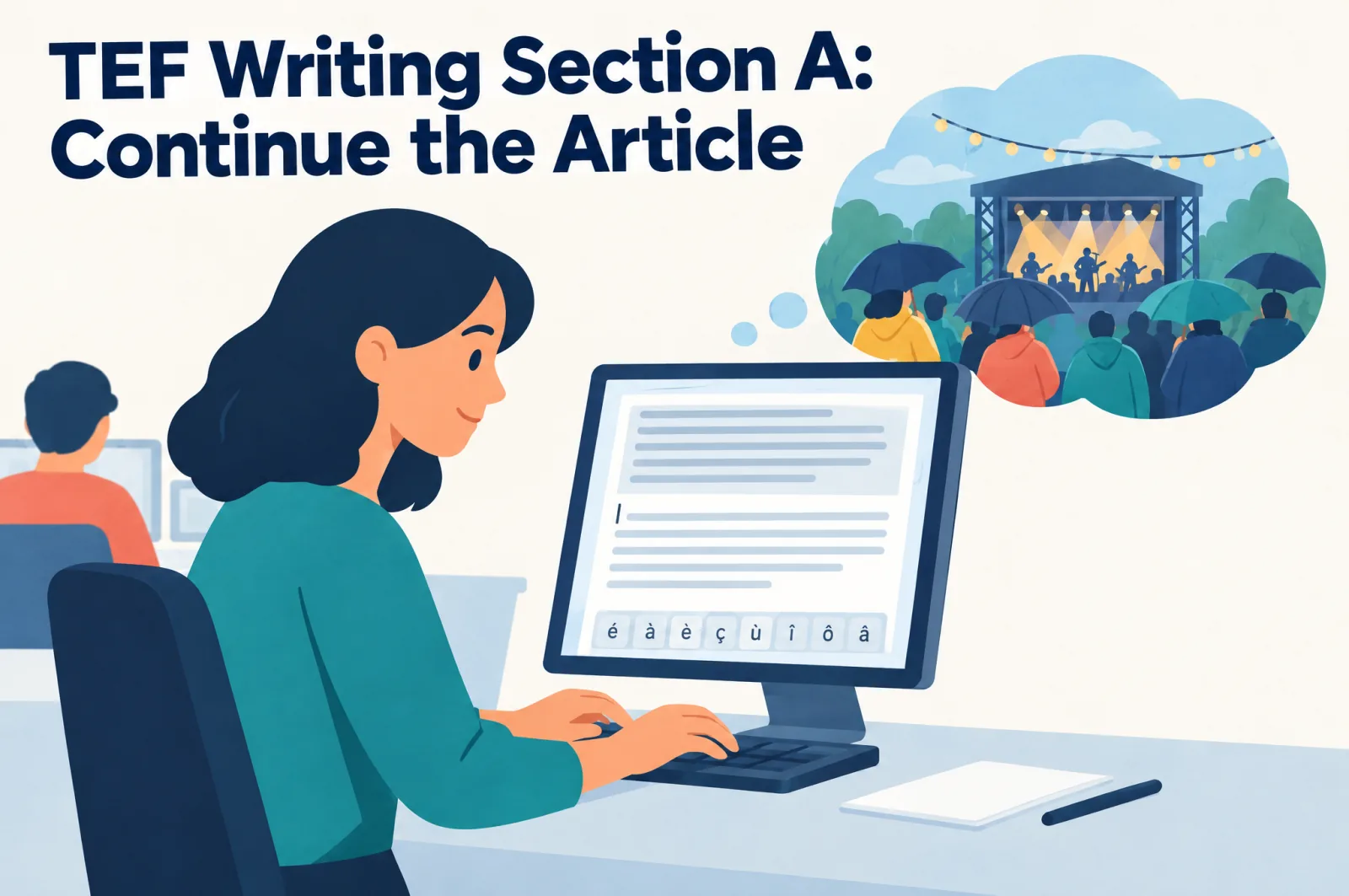
The test runs on a computer: the French characters é, è, ê, ç and à are available on an on-screen virtual keyboard. Practise inserting them under time pressure. For immigration, all four TEF Canada tests are taken the same day (Le français des affaires, test structure).
The other three sections are covered in the TEF Canada exam guide; the speaking section has its own TEF Canada expression orale guide.
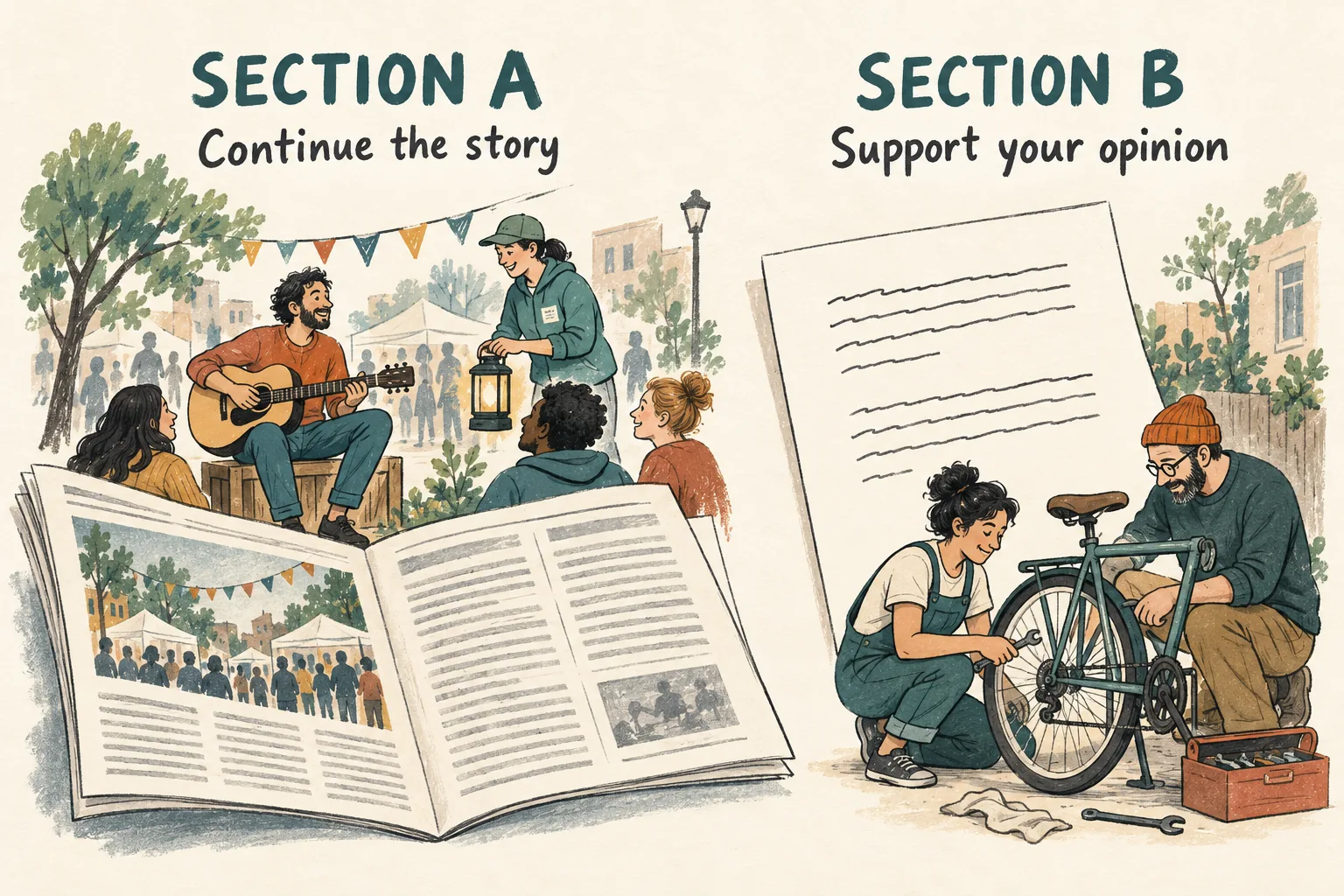
| Section | Time | Minimum | Your task |
|---|---|---|---|
| A · Continue the article | 25 min | 80 words | You read the opening of a short news item and write its logical continuation. |
| B · Defend a point of view | 35 min | 200 words | You react to a statement: state a clear position and justify it. |
| On a computer · special French characters on an on-screen virtual keyboard · all four TEF Canada tests on the same day. | |||
Source: Le français des affaires — TEF Canada test structure, checked September 10, 2026.
Section A — Continue the Article (25 Minutes, 80 Words Minimum)
TEF writing Section A, sometimes called TEF writing task 1, asks you to continue a short news article with relevant events and details.
Keep the same people, place and event. If the opening is a disrupted festival, continue with the response to the disruption — not your favourite holiday memory. The official Section A guidance also says not to recopy the opening: it costs time and earns nothing.
The tense toolkit for Section A
- Passé composé — eventsLes bénévoles ont installé une nouvelle scène.
The volunteers set up a new stage. - Imparfait — backgroundLe public attendait sous la pluie.
The audience was waiting in the rain. - Plus-que-parfait — earlier eventsL’orage avait endommagé les câbles.
The storm had damaged the cables. - Time and cause connectorsPeu après, le concert a repris grâce à un groupe électrogène.
Shortly after, the concert resumed thanks to a generator.
I want each tense to explain when something happened. A random plus-que-parfait is just an expensive mistake.
A simple 4-move plan
- Re-read the opening; identify who, where and what.
- Decide what happened next before typing.
- Develop two or three events, with one useful detail each.
- Close like a journalist: give the outcome or the next step.
Aim usefully above the minimum — 120–150 words is our practice target. Don’t triple the minimum with weather descriptions.
Section B — Defend Your Point of View (35 Minutes, 200 Words Minimum)
TEF writing Section B asks you to react to a statement and justify your position with arguments and examples.
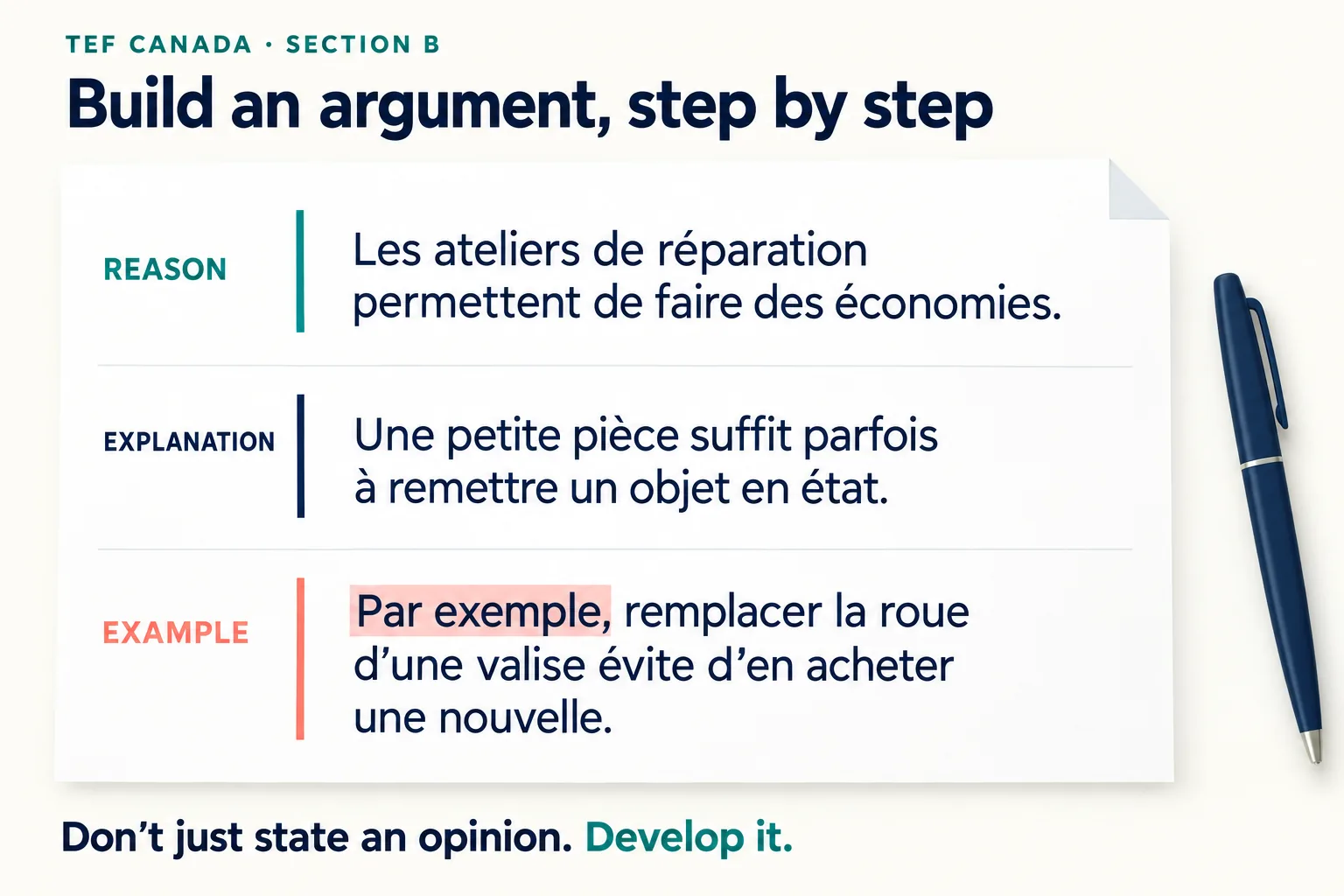
Despite its nickname, a formal letter is not compulsory — the official Section B guidance says an official letterhead earns no points; follow whatever your particular instructions ask for. State your position immediately. Develop two or three reasons on the pattern reason → explanation → concrete example. If the instructions ask for three arguments, give three. Handle one concession with c’est vrai que… mais, then finish with a recommendation. This is a planning method, not a marking formula.
“Repairs save money” is a claim, not an argument. Explain that a new battery extends a phone’s life; illustrate with someone who cannot afford a replacement. That is where your 200 words go.
The connector inventory
- First reasonD’abord
- Next reasonEnsuite
- Explanation or supporting detailEn effet
- IllustrationPar exemple
- ContrastEn revanche
- Qualification despite an obstacleNéanmoins
- ConsequencePar conséquent
- Closing judgmentEn conclusion
Connectors cannot rescue an undeveloped idea. Eight signposts pointing nowhere are still nowhere.
Register: written, neutral-formal French
Use complete sentences and precise vocabulary. Replace spoken fillers such as bof or ben with explanations. A nuanced position is fine as long as you keep it consistent: “I support repairs when parts are available.”
TEF Writing Topics: 40 Practice Prompts (Section A and Section B)
These 40 original TEF writing topics — TEF expression écrite sujets — give you 15 article openings and 25 Section B statements for practice.
All of them are newly written; none is presented as a recalled exam question. Candidate discussions mention unexpected discoveries, animal incidents and community events on the A side, and debates about consumption, screens and education on the B side — treat those as broad practice themes, not predictions.
For each A prompt, continue from the final sentence. For each B statement, choose your position before you start typing.
| # | Section | Theme | The prompt | Your task |
|---|---|---|---|---|
| 01 | A | Daily life | Une boulangère a trouvé une enveloppe dans sa livraison quotidienne. À l’intérieur, un message demandait son aide.A baker finds an envelope in her daily delivery containing a request for help. | Continue the article (80 words minimum). |
| 02 | A | Daily life | Une cliente a acheté un manteau d’occasion. Dans une poche, elle a découvert un billet de loterie gagnant.A customer discovers a winning lottery ticket inside a second-hand coat. | Continue the article (80 words minimum). |
| 03 | A | Daily life | Samedi, les caisses d’un supermarché ont cessé de fonctionner. Un client a alors proposé une solution inattendue.A supermarket’s tills stop working on Saturday; a customer proposes an unexpected solution. | Continue the article (80 words minimum). |
| 04 | B | Daily life | Les fabricants devraient fournir gratuitement les pièces nécessaires aux petites réparations.Manufacturers should provide parts for minor repairs free of charge. | State and justify your point of view (200 words minimum). |
| 05 | B | Daily life | Les supermarchés devraient réserver une journée par semaine aux produits locaux.Supermarkets should reserve one day a week for local products. | State and justify your point of view (200 words minimum). |
| 06 | B | Daily life | Les clients devraient payer davantage pour recevoir leurs achats le jour même.Customers should pay more for same-day delivery. | State and justify your point of view (200 words minimum). |
| 07 | B | Daily life | Les magasins devraient proposer la location de vêtements pour les grandes occasions.Shops should offer clothing rentals for special occasions. | State and justify your point of view (200 words minimum). |
| 08 | A | Work and study | Une entreprise a organisé une collecte de vêtements. Parmi les dons, les employés ont découvert une étrange valise.Employees discover a strange suitcase among donations to a workplace clothing collection. | Continue the article (80 words minimum). |
| 09 | A | Work and study | Des lycéens ont réparé un vieux projecteur pour leur exposition. La première image projetée a surpris leur professeur.Students repair an old projector for an exhibition; its first image surprises their teacher. | Continue the article (80 words minimum). |
| 10 | B | Work and study | Les entreprises devraient consacrer une heure par semaine à la formation de leurs employés.Companies should devote an hour weekly to employee training. | State and justify your point of view (200 words minimum). |
| 11 | B | Work and study | Chaque élève devrait découvrir un métier manuel avant de quitter le secondaire.Every student should explore a manual trade before leaving secondary school. | State and justify your point of view (200 words minimum). |
| 12 | B | Work and study | Les réunions professionnelles devraient toujours se terminer après trente minutes.Workplace meetings should always end after thirty minutes. | State and justify your point of view (200 words minimum). |
| 13 | B | Work and study | Les universités devraient proposer davantage de cours le soir aux adultes qui travaillent.Universities should offer more evening courses for working adults. | State and justify your point of view (200 words minimum). |
| 14 | B | Work and study | Les employeurs devraient laisser leurs salariés choisir leurs jours de télétravail.Employers should let employees choose their remote-working days. | State and justify your point of view (200 words minimum). |
| 15 | A | Technology and media | Une station météo locale a annoncé cinquante degrés en pleine neige. Une technicienne est partie vérifier les capteurs.A weather station reports fifty degrees during snowfall; a technician investigates. | Continue the article (80 words minimum). |
| 16 | A | Technology and media | Une radio a diffusé des chants d’oiseaux pendant son journal. L’équipe technique a aussitôt cherché l’origine du problème.Birdsong interrupts a radio news bulletin; technicians investigate the cause. | Continue the article (80 words minimum). |
| 17 | B | Technology and media | Les groupes de messagerie entre collègues devraient rester silencieux après les heures de travail.Work messaging groups should stay silent outside working hours. | State and justify your point of view (200 words minimum). |
| 18 | B | Technology and media | Les journaux devraient publier leurs corrections aussi visiblement que leurs titres.Newspapers should display corrections as prominently as headlines. | State and justify your point of view (200 words minimum). |
| 19 | B | Technology and media | Les parents devraient demander l’accord de leurs enfants avant de publier leurs photos.Parents should ask their children before posting their photos. | State and justify your point of view (200 words minimum). |
| 20 | B | Technology and media | Les services publics devraient toujours proposer une solution sans application mobile.Public services should always offer an option without a mobile app. | State and justify your point of view (200 words minimum). |
| 21 | A | City and environment | Un camion a perdu des pots de peinture sur une place. Les commerçants ont commencé à protéger leurs vitrines.A truck spills paint pots in a square; shopkeepers protect their windows. | Continue the article (80 words minimum). |
| 22 | A | City and environment | Des passants ont aperçu un hérisson coincé dans une grille. Une agente municipale est arrivée avec un équipement inhabituel.A hedgehog is trapped in a grate; a municipal worker arrives with unusual equipment. | Continue the article (80 words minimum). |
| 23 | A | City and environment | Des habitants ont découvert des arbres plantés pendant la nuit. La mairie a lancé un appel pour identifier les jardiniers.Residents discover trees planted overnight; the town seeks the gardeners. | Continue the article (80 words minimum). |
| 24 | B | City and environment | Chaque quartier devrait disposer d’un atelier public de réparation.Every neighbourhood should have a public repair workshop. | State and justify your point of view (200 words minimum). |
| 25 | B | City and environment | Les villes devraient transformer certains stationnements en jardins partagés.Cities should turn some parking areas into community gardens. | State and justify your point of view (200 words minimum). |
| 26 | B | City and environment | Les transports publics devraient être moins chers en dehors des heures de pointe.Public transport should cost less outside rush hour. | State and justify your point of view (200 words minimum). |
| 27 | B | City and environment | Les propriétaires devraient récupérer l’eau de pluie pour arroser leurs jardins.Homeowners should collect rainwater to water their gardens. | State and justify your point of view (200 words minimum). |
| 28 | B | City and environment | Les commerces devraient livrer à vélo dans les centres-villes.Shops should make city-centre deliveries by bicycle. | State and justify your point of view (200 words minimum). |
| 29 | A | Health and lifestyle | Un nageur a entendu un bruit inhabituel dans la piscine municipale. Le personnel a immédiatement évacué le bassin.A swimmer hears an unusual noise; staff evacuate the municipal pool. | Continue the article (80 words minimum). |
| 30 | A | Health and lifestyle | Une course caritative a attiré deux fois plus de participants que prévu. Les organisateurs ont dû modifier le départ.A charity run attracts twice the expected turnout; organisers change the start. | Continue the article (80 words minimum). |
| 31 | B | Health and lifestyle | Les restaurants devraient proposer une petite portion de chaque plat.Restaurants should offer a small portion of every dish. | State and justify your point of view (200 words minimum). |
| 32 | B | Health and lifestyle | Les municipalités devraient financer des activités sportives sans compétition.Municipalities should fund non-competitive sports activities. | State and justify your point of view (200 words minimum). |
| 33 | B | Health and lifestyle | Les employeurs devraient encourager une véritable pause déjeuner sans écran.Employers should encourage a proper lunch break without screens. | State and justify your point of view (200 words minimum). |
| 34 | A | Culture and community | Une médiathèque a reçu plusieurs livres accompagnés de bouquets. Aucun des paquets ne portait le nom de l’expéditeur.A library receives books with bouquets, but none identifies the sender. | Continue the article (80 words minimum). |
| 35 | A | Culture and community | Samedi soir, une panne d’électricité a interrompu le festival du quartier. Les organisateurs ont aussitôt lancé un appel aux habitants.A power cut interrupts a neighbourhood festival; organisers appeal to residents. | Continue the article (80 words minimum). |
| 36 | A | Culture and community | Une vieille horloge de musée a sonné après quarante ans de silence. La gardienne a remarqué un visiteur près du mécanisme.A museum clock rings after forty silent years; the attendant notices a visitor nearby. | Continue the article (80 words minimum). |
| 37 | B | Culture and community | Les musées devraient organiser davantage de visites conçues par les habitants.Museums should offer more tours designed by local residents. | State and justify your point of view (200 words minimum). |
| 38 | B | Culture and community | Les festivals devraient réserver une partie de leur programme aux artistes débutants.Festivals should reserve part of their programme for emerging artists. | State and justify your point of view (200 words minimum). |
| 39 | B | Culture and community | Les bibliothèques devraient prêter des instruments de musique en plus des livres.Libraries should lend musical instruments as well as books. | State and justify your point of view (200 words minimum). |
| 40 | B | Culture and community | Les quartiers devraient organiser un repas collectif à chaque changement de saison.Neighbourhoods should hold a shared meal at each change of season. | State and justify your point of view (200 words minimum). |
Download the 40 topics as a PDF
Two pages: the full prompt table, plus the Section A tense toolkit and the Section B connector inventory. Enter your name and email and the link arrives in your inbox.
Your details stay with Toronto French Academy. No spam, ever.
TEF Writing Samples: Full Section A and Section B Answers, Including a Formal Letter
A useful TEF writing sample makes every paragraph earn its place.
Each original TEF expression écrite sample below is written at a solid B2 practice level — an instructional judgment, not an examiner-issued result. Prompt details are fictional.
Section A sample: the festival power cut
Samedi soir, une panne d’électricité a interrompu le festival du quartier. Les organisateurs ont aussitôt lancé un appel aux habitants. Task: continue the article (80 words minimum).
Plusieurs voisins ont apporté des lampes à piles, tandis qu’un restaurateur a proposé d’accueillir les musiciens sur sa terrasse. La pluie avait cessé et une centaine de spectateurs attendaient encore devant la scène.
Après une courte discussion, les artistes ont décidé de jouer sans matériel électrique. Les bénévoles ont déplacé les chaises pour permettre au public de s’installer près d’eux. Une habitante, qui avait préparé des boissons chaudes chez elle, les a distribuées aux familles.
Le concert a finalement repris dans une ambiance chaleureuse. Selon les organisateurs, aucun incident n’a été signalé et la plupart des visiteurs sont restés jusqu’à la dernière chanson. L’électricité a été rétablie peu avant minuit. La prochaine édition du festival devrait prévoir un éclairage de secours afin de mieux faire face à une panne similaire.

Section B sample: public repair workshops
Chaque quartier devrait disposer d’un atelier public de réparation. Task: state and justify your point of view (200 words minimum); this practice response develops three arguments.
Je suis favorable à la création d’ateliers publics de réparation dans les quartiers, à condition que leur fonctionnement reste simple et accessible.
D’abord, ces ateliers permettraient aux habitants de faire des économies. Un appareil en panne ne doit pas forcément être remplacé : parfois, une petite pièce suffit. Par exemple, une personne pourrait apprendre à changer la roue de sa valise au lieu d’en acheter une autre avant son départ en vacances.
Ensuite, réparer aiderait à réduire les déchets. Lorsqu’on ignore comment démonter un objet, on le jette souvent trop vite. Un bénévole pourrait montrer comment remplacer le câble d’une lampe, puis expliquer les précautions à prendre. L’objet retrouverait ainsi sa place dans la maison plutôt que de finir à la poubelle.
Enfin, un atelier serait aussi un lieu de rencontre. Des personnes qui vivent dans le même immeuble sans se connaître pourraient travailler ensemble. Un étudiant sachant réparer un vélo pourrait, par exemple, aider un voisin qui lui apprendrait ensuite à recoudre un vêtement.
C’est vrai que ces espaces demanderaient du matériel et des personnes compétentes, mais chaque atelier pourrait commencer modestement, avec quelques outils et des rendez-vous mensuels. Les réparations dangereuses devraient rester réservées aux professionnels.
Je recommande donc aux municipalités de tester ce service dans un local existant, puis de demander aux usagers quelles réparations leur sont réellement utiles. Cette étape permettrait d’adapter les ateliers aux besoins du quartier avant de multiplier les dépenses.
Section B sample as a formal letter: community gardens instead of parking
Some Section B instructions ask for a letter to a newspaper, an official or an organisation. This third TEF writing sample shows the same argument skeleton inside letter conventions — greeting, position, reasons, concession, request, closing formula. The formula itself earns no points; keep it to one sentence.
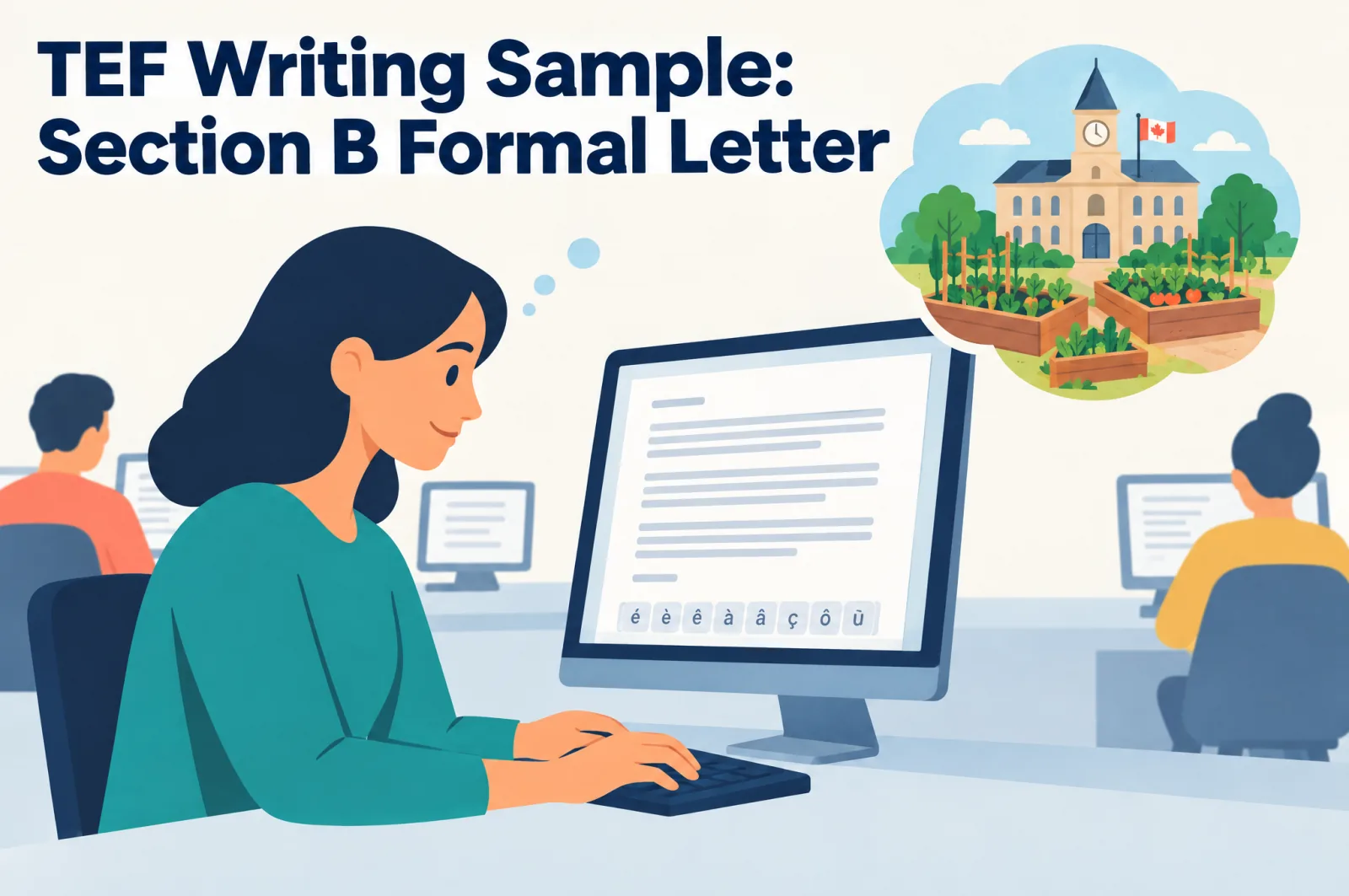
Les villes devraient transformer certains stationnements en jardins partagés. Task: state and justify your point of view (200 words minimum); this practice version asks for a letter to the mayor.
Madame la Maire,
J’ai lu avec intérêt la proposition de transformer certains stationnements de notre ville en jardins partagés, et je souhaite vous faire part de mon soutien à ce projet.
D’abord, ces jardins offriraient un espace de verdure aux habitants qui n’ont ni balcon ni cour. En effet, dans mon quartier, la plupart des familles vivent en appartement. Un jardin partagé leur permettrait de cultiver quelques légumes et de passer du temps dehors sans quitter la ville.
Ensuite, un tel projet renforcerait les liens entre voisins. Par exemple, une retraitée qui connaît bien le jardinage pourrait guider de jeunes parents, qui l’aideraient à leur tour à porter le terreau ou les outils. Ces échanges sont rares aujourd’hui, et un lieu commun les rendrait naturels.
Certes, la suppression de places de stationnement gênerait certains automobilistes. Néanmoins, la ville pourrait commencer par les parkings les moins utilisés, notamment ceux qui restent vides le week-end, et conserver des places réservées aux personnes à mobilité réduite.
Par conséquent, je vous invite à lancer une première expérience dans deux ou trois quartiers, puis à consulter les habitants après une saison de culture. Leurs remarques permettraient d’ajuster le projet avant de l’étendre.
Je vous remercie de l’attention que vous porterez à cette lettre et vous prie d’agréer, Madame la Maire, l’expression de mes salutations distinguées.
Check your own TEF writing sample answers against these TEF writing examples: does each paragraph add something?
How the Expression Écrite Is Scored
Your TEF writing score reflects task completion, coherence and cohesion, vocabulary range, grammatical control, spelling and punctuation.
The written expression test is assessed by two independent, trained and experienced assessors using standardised evaluation grids; their assessments are converted into a calibrated score (Le français des affaires, how the test is evaluated).
Candidates often say “TEF writing CLB 7”; French uses NCLC 7. Your certificate shows two figures for each skill: the score out of 699 (for tests taken on or after December 11, 2023) and an équivalence ancien score on the old scale, which for writing runs to 450. The table below gives both.
Express Entry asks for the “Équivalence ancien score” column. Enter that column’s scores in your profile, not “Score /699” (IRCC language-testing instructions; IRCC equivalency charts).
For reading, listening and speaking, use the TEF score chart. For what to work on first, see how to get CLB 7 in TEF Canada.
| NCLC level | Writing, old scale /450 (what Express Entry asks for) | Writing, certificate scale /699 |
|---|---|---|
| NCLC 4 | 181–225 | 268–329 |
| NCLC 5 | 226–270 | 330–378 |
| NCLC 6 | 271–309 | 379–427 |
| NCLC 7 · PR target | 310–348 | 428–471 |
| NCLC 8 | 349–370 | 472–511 |
| NCLC 9 | 371–392 | 512–557 |
| NCLC 10 | 393–450 | 558–699 |
Sources: IRCC language-test equivalency charts (both scales; /699 = tests from December 11, 2023 — IRCC’s level-10 row groups 558–699, which the test maker’s own chart splits into NCLC 10, 11 and 12). Full converter: TEF Canada score chart.
Mistakes That Cost Your TEF Writing Score
The most damaging TEF writing mistakes weaken relevance or development, even when individual sentences look polished.
A candidate reported meeting both word minimums and using advanced tenses, yet receiving a disappointing writing result — without the script, nobody can diagnose it, but it is a useful warning: grammar trophies are not the task.
- Starting another story. Keep the opening’s people and problem; add the next event.
- Repeating an opinion. Give each reason an explanation and an example.
- Connector confetti. Delete the connector; check whether the ideas actually connect.
- Universal introductions. Cut the generic De nos jours… paragraph. The official guidance says assessors disregard long introductions and conclusions that work for every subject.
- Counting grammar trophies. Use a tense because it expresses your meaning, not to impress.
- Padding or stopping short. Check length, then add substance or cut repetition.
- No review time. Reserve minutes in each section for endings, agreements and accents.
- Accent-typing panic. Rehearse on a computer; phone autocorrect is a different skill.
A 4-Week TEF Writing Practice Plan
Effective TEF writing practice combines focused drafts, targeted correction and timed attempts.
- W1Continuity — Write three Section A continuations. Count your added words; underline the verbs and check the event timeline. Get one corrected by a teacher.
- W2Development — Write three Section B responses. Label each reason, explanation and example. Audit your connectors. Have a teacher identify your least convincing paragraph.
- W3Repair — Rewrite both corrected pieces, then tackle one new prompt per section. Track recurring errors, and recheck old drafts after two days without looking at the corrections.
- W4Timing — Complete two full 25/35-minute simulations. Check word count, tenses and connectors, then have a teacher review one complete attempt, including task fulfilment.
Weekly corrected writing speeds up revision by showing you what to change next; keep a short correction log. Four weeks is a practice cycle, not a score promise. The full study schedule is in the TEF Canada preparation guide.
TEF Canada Expression Écrite: Frequently Asked Questions
What is the TEF Canada expression écrite?
TEF Canada expression écrite is the written-expression component of TEF Canada. It requires two texts: a continuation of an article and a justified opinion. The test lasts 60 minutes on a computer. Preparation should cover both narrative organisation and argument development.
How many words do I need for Section A and Section B?
Section A requires at least 80 words; Section B requires at least 200. For practice, approximately 120–150 and 230–260 words give room for useful development and checking. Those ranges are coaching targets, not official upper limits. Check the instructions on your own test before you start.
What topics come up in TEF writing?
TEF writing practice should cover everyday events and social questions: consumption, work, education, technology, transport, health and community life. Candidate accounts describe varied subjects, but recalled topics are not a forecast. Train yourself to explain an unfamiliar situation using vocabulary you already control.
Is the TEF writing test on a computer, and can I type accents?
Yes. TEF Canada writing is computer-based, and French special characters are available through an on-screen virtual keyboard. Practise typing accented sentences under time pressure. Ask your centre about its physical keyboard layout beforehand; don’t assume your familiar home shortcuts will be available.
How is TEF writing scored?
TEF writing is evaluated by two independent, trained assessors using standardised criteria. Relevant content, organisation, vocabulary and grammatical control all contribute; spelling and punctuation matter too. The assessments become a calibrated score. A practice checklist helps you revise, but counting connectors or advanced tenses cannot calculate an official score.
Is it hard to get CLB 7 in TEF writing?
The difficulty depends on your current writing, especially how clearly you develop information and control grammar under time pressure. For French, the benchmark is NCLC 7: writing 310–348 out of 450 on the old-equivalence scale. Have a teacher assess timed work before deciding what preparation you need.
How should I split the 60 minutes?
Use the official 25 minutes for Section A and 35 for Section B. A practical rehearsal budget is Section A: 3 minutes planning, 18 writing, 4 checking; Section B: 5 planning, 25 writing, 5 checking. These subdivisions are coaching advice. Don’t rely on transferring time or revisiting a completed section.
Can I use a dictionary?
Plan for a supervised, timed exam with nothing open but the test itself: no dictionary, no notes, no reference tools. Practise timed drafts without lookups, then study the gaps afterwards. During the test, a clear paraphrase is a better choice than hunting your memory for one impressive noun. Confirm test-day rules with your centre.
What happens if I write fewer than 80 or 200 words?
You have not met the stated minimum for that task, which puts task fulfilment at risk and leaves less language to assess. The official sources we reviewed do not give a fixed deduction per missing word or an automatic-zero rule. Practise finishing above the minimum without adding repetition.
Can I give a mixed opinion in Section B?
Yes: a qualified position can work when you explain its limits consistently. State what you support, under what conditions, and why. Develop your reasons and address an objection without reversing your position accidentally. The task is to justify your view; no universal paragraph order earns a particular score.
The Takeaway
Strong TEF Canada expression écrite keeps the story moving and gives every argument enough explanation to stand up. Start with one timed draft, then improve it with feedback.
Dates, centres and fees are on the TEF Canada booking page; the speaking role-plays have their own expression orale guide.

Written and checked by
Simar Dua, French Program Lead
Simar leads the TEF Canada and TCF Canada programs at Toronto French Academy and has guided hundreds of Express Entry candidates from their first French lesson to the NCLC 7 result. She reviewed the French prompts and sample answers on this page and hosts the academy’s free monthly French for Canada PR info session.
Get your writing corrected every week
Our TEF preparation at Toronto French Academy includes weekly corrected writing practice, so the drafts that drift off-task in a mock get fixed before test day.