
On this page
TEF Speaking Format: What the Expression Orale Actually Tests
The TEF Canada speaking format tests whether you can keep a purposeful conversation going in French.
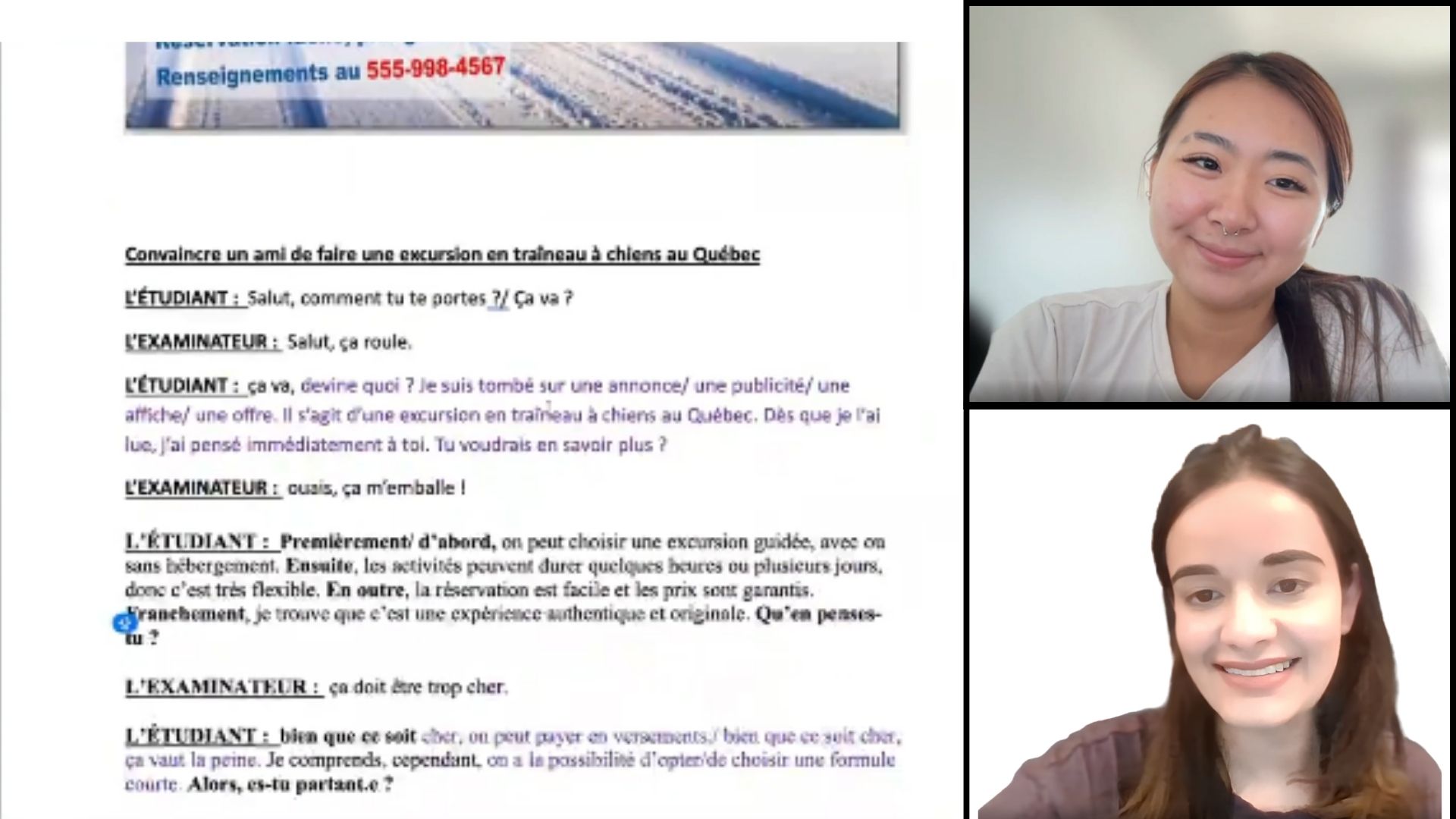
The TEF speaking format is two role-plays, not a presentation. You ask, listen, clarify and persuade. An elegant introduction reveals little about how you handle an unexpected answer. That next exchange matters.
For immigration, all four TEF Canada tests must be taken on the same day. During speaking, notes and scrap paper are prohibited; dictionaries and other reference materials are also forbidden (Le français des affaires, test-day rules).
The other three sections are covered in the TEF Canada exam guide; dates, centres and fees are on the booking page.
| Section | Time | Your role | Examiner’s role |
|---|---|---|---|
| A · Obtaining information | 5 min | You have read an ad. You call for more information and ask about ten questions. | Plays the person on the phone and answers. |
| B · Expressing an argument to convince | 10 min | You have read an ad. You present it to a friend and persuade them to take part. | Plays the friend and does not agree with you. |
| Face-to-face with one examiner · recorded for a double assessment · no notes, dictionary or scrap paper · all four TEF Canada tests on the same day. | |||
Source: Le français des affaires — TEF Canada test structure and oral-expression guidance, checked September 7, 2026.
TEF Section A — Obtaining Information (5 Minutes)
In Section A of the TEF expression orale, you read an advertisement and make a simulated call to obtain information from the examiner.
The official instruction asks for about ten questions. Use polite vous with the advertiser.
Open simply: Bonjour, votre annonce m’intéresse. Est-ce que je peux vous poser quelques questions ?
Close when the exchange reaches its end: Merci pour ces renseignements. Je vais consulter les disponibilités. Bonne journée !
The 8 question families you must be able to ask
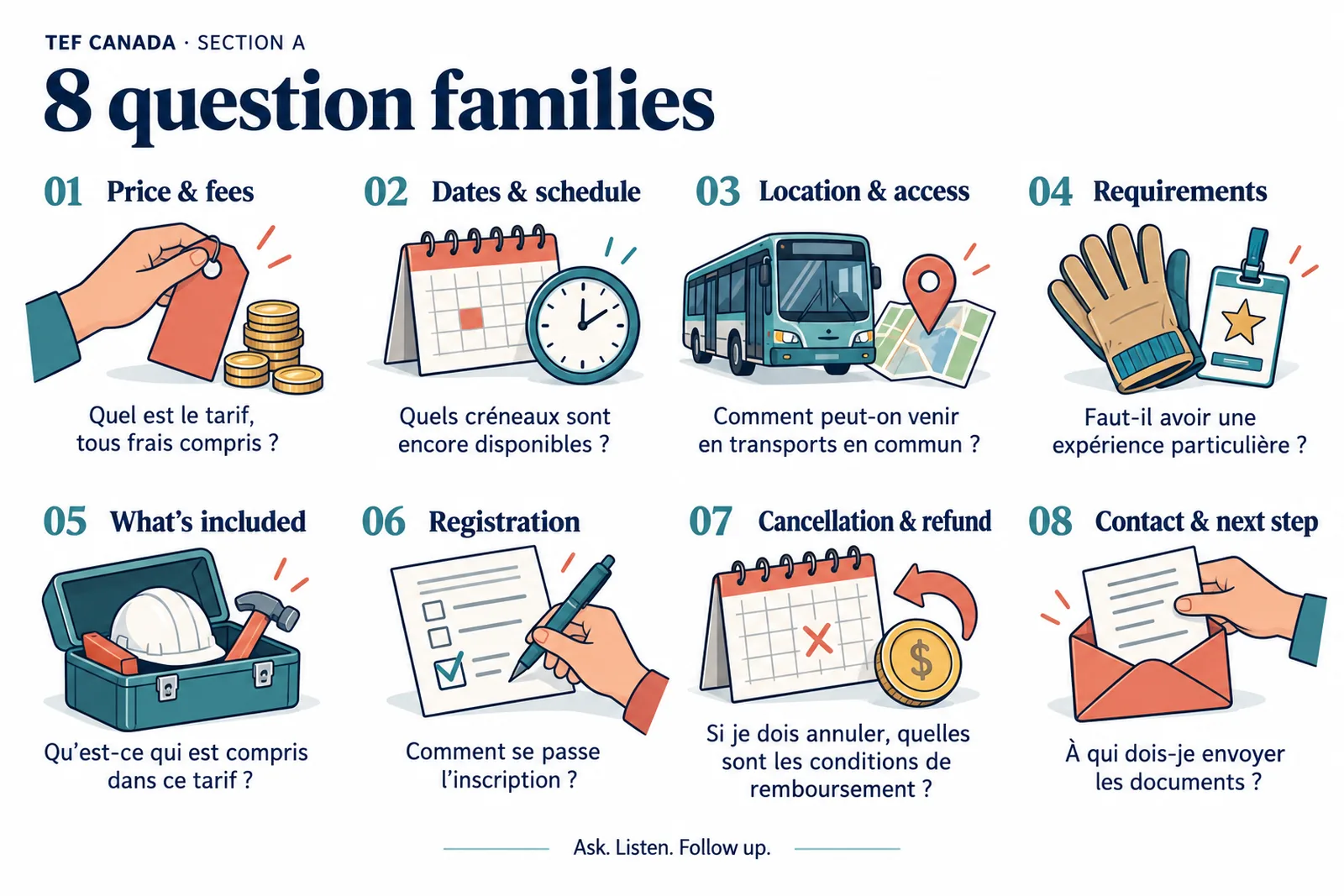
- Price/feesQuel est le tarif, tous frais compris ?
What is the price, including all fees? - Dates and scheduleQuels créneaux sont encore disponibles ?
Which time slots are still available? - Location and accessComment peut-on venir en transports en commun ?
How can we get there by public transport? - Conditions and requirementsFaut-il avoir une expérience particulière ?
Is any particular experience required? - What is includedQu’est-ce qui est compris dans ce tarif ?
What does this price include? - RegistrationComment se passe l’inscription ?
How does registration work? - Cancellation/refundSi je dois annuler, quelles sont les conditions de remboursement ?
If I cancel, what are the refund conditions? - Contact/next stepÀ qui dois-je envoyer les documents ?
Who should I send the documents to?
What to do when you run dry
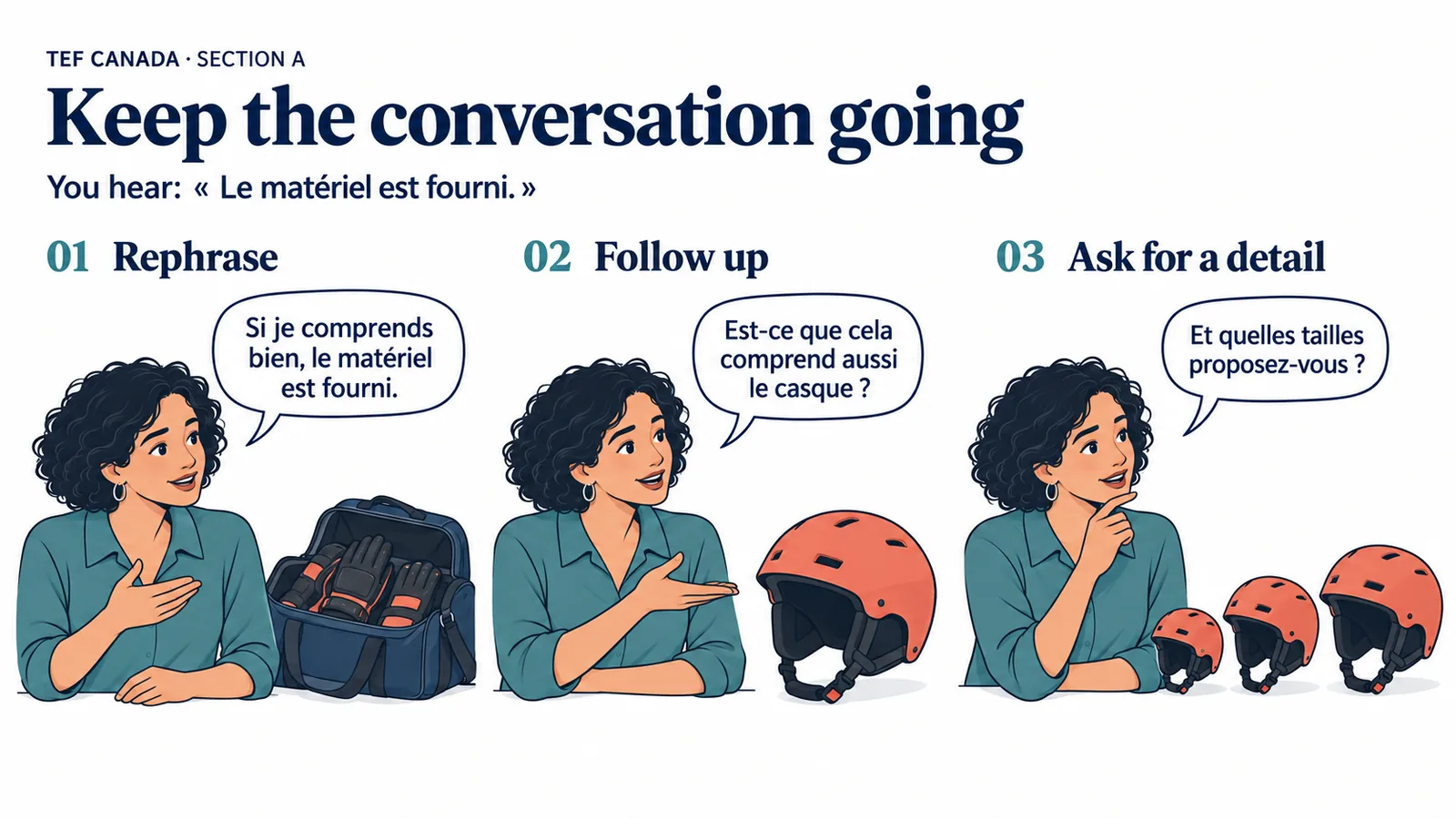
Use the examiner’s last answer in every TEF speaking practice session: reformulate it, follow it up, then request a detail.
Si je comprends bien, le matériel est fourni. Est-ce que cela comprend aussi le casque ? Et quelles tailles proposez-vous ?
One candidate reported asking 11–12 questions, then falling silent until the examiner asked whether they had more. Ten questions do not automatically finish the conversation.
TEF Section B — Convincing a Friend (10 Minutes)
In TEF Section B, you present an advertisement to a friend and argue for taking part while the examiner challenges your proposal.
Use tu. Present the offer, develop three benefits tied to your friend, handle objections, then propose a next step. Three benefits are my practice framework, not an official quota.
The examiner is instructed to disagree. This is not personal (official guidance).
How to handle the examiner’s objections
Acknowledge the concern, answer it specifically and check what remains unresolved. Adapt these patterns to the advertisement:
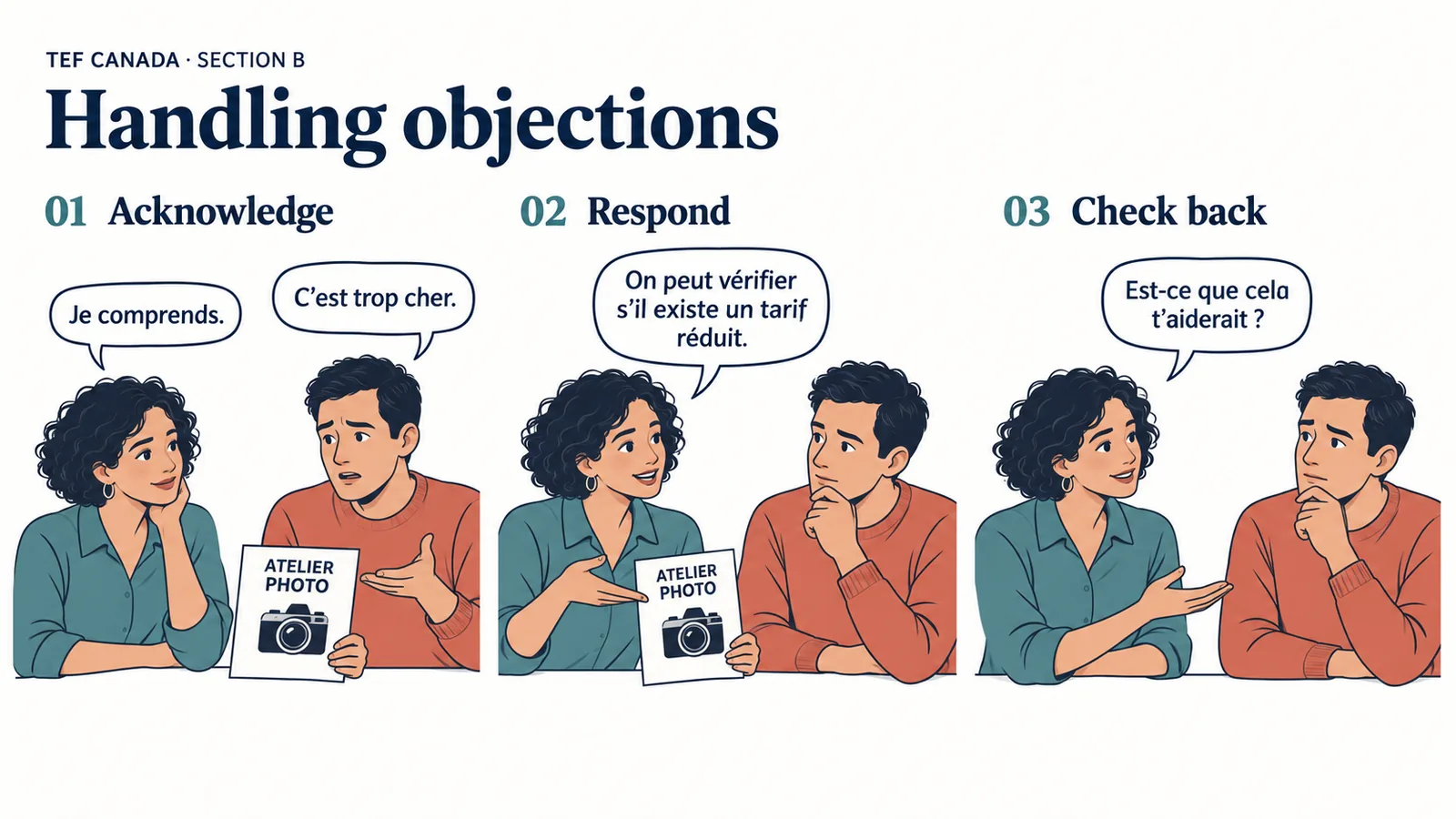
- PriceJe comprends, c’est une dépense. On peut vérifier s’il existe un tarif réduit.
I understand, it is an expense. We can check whether there is a reduced rate. - TimeTu n’as qu’une heure ? Regardons si une participation plus courte est possible.
You only have an hour? Let us see whether a shorter slot is possible. - DistanceC’est un peu loin. Si on partageait le trajet, ce serait plus simple.
It is a bit far. If we shared the trip, it would be simpler. - Not interestedQu’est-ce qui te déplaît exactement ? Je pensais surtout à ton envie de rencontrer du monde.
What exactly puts you off? I was mostly thinking of how much you want to meet people. - Too hardTu crains de ne pas y arriver ? On pourrait demander comment les débutants sont accompagnés.
Worried you will not manage? We could ask how beginners are supported. - Already busyTu as déjà beaucoup d’engagements. On pourrait choisir une seule date, sans s’engager davantage.
You already have a lot on. We could pick a single date, with no further commitment.
The connectors that mark B2
Use d’abord to introduce a benefit; en plus to add one; justement to answer a concern; cependant to qualify; au contraire to challenge an assumption; and c’est vrai que… mais to concede before responding.
These help listeners follow your reasoning. They are not B2 passwords. Cependant cannot rescue an irrelevant answer.
TEF Speaking Topics: 40 Practice Prompts (Section A and Section B)
These 40 original TEF speaking topics give you 20 Section A enquiries and 20 Section B persuasion tasks across everyday themes.
These TEF Canada speaking topics develop adaptability. Candidates report pet-care and environmental-volunteering themes; those accounts are self-reported. Every advertisement below is newly written.
For each A prompt, build relevant Section A questions. For each B prompt, have your partner resist.
| # | Section | Theme | The advertisement | Your task |
|---|---|---|---|---|
| 01 | A | Housing | Studio meublé disponible pour trois mois, près du tramway.Furnished studio, three months, near tram. | You call for more information. |
| 02 | A | Housing | Colocation calme : une chambre se libère en octobre.Quiet shared home: room available in October. | You call for more information. |
| 03 | A | Housing | Petit espace de rangement à louer au sous-sol.Small basement storage space for rent. | You call for more information. |
| 04 | B | Housing | Résidence partagée : chambres privées et cuisine commune.Shared residence: private rooms, communal kitchen. | Convince your friend to consider moving there. |
| 05 | B | Housing | Atelier du quartier : réparez vos meubles avec un bénévole.Neighbourhood workshop: repair furniture with a volunteer. | Convince your friend to repair an old table. |
| 06 | A | Work and training | Formation du soir : découvrez les bases du tableur.Evening course: learn spreadsheet basics. | You call for more information. |
| 07 | A | Work and training | Boulangerie cherche une aide pour les marchés du dimanche.Bakery seeks help at Sunday markets. | You call for more information. |
| 08 | A | Work and training | Bureaux partagés : postes disponibles à la journée.Shared offices: desks available by the day. | You call for more information. |
| 09 | B | Work and training | Atelier CV : échangez avec des recruteurs locaux.CV workshop with local recruiters. | Convince your friend to attend the workshop. |
| 10 | B | Work and training | Initiation à la photo de produits pour petits commerces.Product photography introduction for small businesses. | Convince your friend to join the course. |
| 11 | A | Leisure and sport | Initiation au badminton : adultes débutants bienvenus.Beginner badminton sessions for adults. | You call for more information. |
| 12 | A | Leisure and sport | Club de lecture : romans courts, discussions mensuelles.Book club: short novels, monthly discussions. | You call for more information. |
| 13 | B | Leisure and sport | Balade photo : découvrez les ruelles avec votre téléphone.Explore local lanes through phone photography. | Convince your friend to join the walk. |
| 14 | B | Leisure and sport | Piscine municipale : séances de découverte pour adultes.Municipal pool: introductory adult sessions. | Convince your friend to try a session. |
| 15 | B | Leisure and sport | Chorale de quartier : aucune audition nécessaire.Neighbourhood choir: no audition required. | Convince your friend to join the choir. |
| 16 | A | Services | Visites à domicile pour chats pendant vos déplacements.Home visits for cats while you travel. | You call for more information. |
| 17 | A | Services | Couturière : retouches de manteaux sur rendez-vous.Coat alterations by appointment. | You call for more information. |
| 18 | A | Services | Location d’outils : perceuses et ponceuses disponibles.Tool rental: drills and sanders available. | You call for more information. |
| 19 | B | Services | Réparation de petits appareils : diagnostic au centre communautaire.Small-appliance assessments at the community centre. | Convince your friend to bring a broken toaster. |
| 20 | B | Services | Échange de services entre voisins : proposez votre savoir-faire.Neighbours exchange practical skills. | Convince your friend to offer gardening help. |
| 21 | A | Community and volunteering | Banque alimentaire : bénévoles recherchés pour trier les dons.Food bank seeks donation-sorting volunteers. | You call for more information. |
| 22 | A | Community and volunteering | Jardin collectif : nouvelles parcelles ouvertes aux habitants.Community garden plots available to residents. | You call for more information. |
| 23 | B | Community and volunteering | Sentier propre : matinée de ramassage, équipement fourni.Morning trail cleanup; equipment provided. | Convince your friend to volunteer that morning. |
| 24 | B | Community and volunteering | Café d’échange linguistique : discussions en petits groupes.Language café with small-group conversations. | Convince your friend to attend a meeting. |
| 25 | B | Community and volunteering | Bibliothèque : aidez les habitants à utiliser leur tablette.Library volunteers help residents use tablets. | Convince your friend to become a volunteer. |
| 26 | A | Travel and transport | Vélo urbain d’occasion, panier inclus, à essayer sur place.Used city bike; basket included; test available. | You call for more information. |
| 27 | A | Travel and transport | Minibus pour le festival : départs depuis la gare.Festival minibus departures from the station. | You call for more information. |
| 28 | A | Travel and transport | Location de canots sur le lac, réservation conseillée.Lake canoe rentals; booking recommended. | You call for more information. |
| 29 | B | Travel and transport | Escapade ferroviaire : découvrez une ville voisine samedi.Saturday train outing to a nearby town. | Convince your friend to take the trip. |
| 30 | B | Travel and transport | Covoiturage local : trouvez des voisins au même horaire.Match with neighbours for shared commutes. | Convince your friend to try carpooling. |
| 31 | A | Health and wellbeing | Marche douce encadrée : parcours accessibles aux débutants.Guided gentle walks for beginners. | You call for more information. |
| 32 | A | Health and wellbeing | Atelier cuisine : préparez des repas pour la semaine.Workshop on preparing the week’s meals. | You call for more information. |
| 33 | B | Health and wellbeing | Pause détente au parc : étirements et respiration guidée.Park relaxation with stretching and guided breathing. | Convince your friend to join a session. |
| 34 | B | Health and wellbeing | Défi quartier : une promenade quotidienne pendant une semaine.Neighbourhood challenge: daily walks for a week. | Convince your friend to try the challenge. |
| 35 | B | Health and wellbeing | Atelier cuisine collective : partagez recettes et préparation.Group cooking: share recipes and preparation. | Convince your friend to cook with the group. |
| 36 | A | Family and education | Club scientifique du mercredi pour enfants de huit à douze ans.Wednesday science club for ages eight to twelve. | You call for more information. |
| 37 | A | Family and education | Soutien scolaire : petits groupes après les cours.After-school tutoring in small groups. | You call for more information. |
| 38 | B | Family and education | Sortie au musée : parcours interactif pour les familles.Museum visit with an interactive family route. | Convince your friend to bring their family. |
| 39 | B | Family and education | Bourse aux jouets : échangez les jeux devenus inutilisés.Swap toys your family no longer uses. | Convince your friend to participate in the swap. |
| 40 | B | Family and education | Atelier parents-enfants : construisez un nichoir ensemble.Parent-child workshop: build a birdhouse together. | Convince your friend to attend with their child. |
Download the 40 topics as a PDF
Two pages: the full topic table, plus the Section A question families and the Section B objection patterns. Enter your name and email and the link arrives in your inbox.
Your details stay with Toronto French Academy. No spam, ever.
Model Answers: One Full Section A Call and One Full Section B Dialogue
A useful TEF expression orale sample shows how each reply changes what the candidate says next.
These original B2 dialogues follow the TEF speaking format as complete exchanges. They are not timed transcripts; Section B needs more development in a full mock. C means candidate; E means examiner. Offer details are fictional.
Section A model dialogue
CBonjour, j’ai vu votre annonce pour la location d’outils. Je voudrais refaire une petite étagère chez moi et j’aurais besoin de quelques renseignements. Est-ce que vous avez un moment ?
EBonjour, oui, je vous écoute. Vous cherchez quel type d’outil ?
CUne ponceuse, surtout. Je n’en ai jamais utilisé. Quel modèle me conseilleriez-vous pour un meuble en bois ?
ENous avons un petit modèle assez simple. Il convient bien pour ce genre de travail.
CTrès bien. Est-ce que vous montrez comment s’en servir avant de le louer ? Je préfère éviter d’abîmer le meuble.
EOui, on vous fait une démonstration au comptoir. Cela prend une dizaine de minutes.
CD’accord. Et combien coûte la location pour un week-end ?
ETrente dollars, du samedi matin au lundi matin. Il faut aussi laisser une caution de quatre-vingts dollars.
CDonc, si j’ai bien compris, les quatre-vingts dollars me sont rendus lorsque je rapporte l’appareil en bon état ?
EExactement. Ce n’est pas un supplément sur le prix de location.
CMerci, c’est plus clair. Qu’est-ce qui est fourni avec la ponceuse ?
EUn sac de transport. Le papier abrasif est vendu séparément.
CAh, je vois. Dans ce cas, pourriez-vous m’aider à choisir le papier adapté quand je viendrai ?
EBien sûr. Apportez une photo de votre étagère, ce sera plus facile.
CBonne idée. À quelle heure ouvrez-vous le samedi ?
EÀ neuf heures, mais il y a parfois un peu d’attente.
CJe pourrais venir vers dix heures. Comment peut-on réserver l’appareil ?
EPar téléphone. Il nous faut votre nom et la date souhaitée.
CEt quels documents faut-il présenter au moment du retrait ?
EUne pièce d’identité et une carte bancaire pour la caution.
CDernière chose : si mes travaux prennent du retard, est-ce que je peux prolonger la location ?
EAppelez-nous avant lundi matin. Ce sera possible si personne n’a réservé l’appareil après vous.
CSinon, je le rapporte à l’heure prévue, c’est bien ça ?
EOui, pour ne pas bloquer la réservation suivante.
CTrès bien. Je vais vérifier mes disponibilités et je vous rappellerai pour réserver. Merci pour votre aide, bonne journée !
EAvec plaisir. Bonne journée !
Section B model dialogue
CTu te souviens du sentier où on s’est promenés le mois dernier ? L’association du quartier organise une matinée de nettoyage samedi. J’ai vu l’annonce et j’ai pensé qu’on pourrait y aller ensemble.
EFranchement, ramasser les déchets des autres, ça ne me tente pas.
CJe comprends. D’abord, ce serait l’occasion de retrouver ce coin que tu avais aimé. En plus, on rencontrerait des habitants du quartier ; tu me disais que tu connaissais encore peu de monde. Et on ferait quelque chose de concret pour garder le sentier agréable.
EPeut-être, mais je suis déjà débordé. Je ne vais pas sacrifier tout mon samedi.
CJustement, l’annonce parle d’une matinée, de neuf heures à midi. Ce n’est pas toute la journée. Si tu dois partir plus tôt, on peut demander aux organisateurs si une participation de deux heures leur serait utile.
EMême deux heures, ça reste du temps. J’ai besoin de me reposer.
CC’est vrai que tu as eu une grosse semaine. On pourrait choisir un secteur facile et avancer tranquillement. Ce qui te gêne surtout, c’est l’effort physique ou le fait d’avoir encore un rendez-vous ?
EUn peu les deux. Et je n’ai aucun matériel.
CPour ça, l’annonce est claire : ils fournissent les gants et les sacs. On apporterait simplement de l’eau et des chaussures adaptées. Pour le rythme, en revanche, je préfère vérifier comment les équipes sont organisées.
EEt comment on y va ? Je n’ai pas envie de payer un taxi.
COn pourrait regarder les bus. Si les horaires ne conviennent pas, je demanderai s’il y a du covoiturage. Je ne vais pas te promettre un trajet gratuit sans avoir vérifié.
ETu vois, il y a beaucoup de choses à organiser pour ramasser trois papiers.
CÀ deux, notre contribution restera modeste. Cependant, si plusieurs groupes s’occupent chacun d’une portion, le résultat peut être visible. Ce serait aussi une façon de voir comment fonctionne l’association, sans devenir bénévoles toutes les semaines.
EJe ne suis toujours pas convaincu. J’ai peur qu’on nous demande de revenir tout le temps.
CAlors, on pose clairement la question : est-ce une participation ponctuelle, sans engagement ? Si la réponse est non, on laisse tomber. Je t’envoie l’annonce ce soir et je demande des précisions sur le transport et les horaires. On en reparle demain, quand on aura les réponses ?
How the Expression Orale Is Scored
Your TEF speaking score reflects task completion, interaction and language control across both role-plays of the TEF expression orale.
Examiners assess whether you obtain information and persuade effectively, organise connected ideas, use varied vocabulary and accurate grammar, and speak intelligibly with workable fluency. Pronunciation should make you easy to understand. Two independent examiners assess the performance: the test leader, and a second examiner working from the recording (Le français des affaires, how the test is evaluated).
For TEF speaking, candidates often say “CLB 7”; French uses NCLC 7. Your certificate shows two figures for each skill: the score out of 699 (for tests taken since December 10, 2023) and an équivalence ancien score on the old scale, which for speaking runs to 450. The table below gives both.
Express Entry asks for the “Équivalence ancien score” column. Enter that column’s scores in your profile, not “Score /699” (Le français des affaires results guidance; IRCC conversion tables).
For reading, writing and listening, use the TEF score chart. For what to work on first, see how to get CLB 7 in TEF Canada.
| NCLC level | Speaking, old scale /450 (what Express Entry asks for) | Speaking, certificate scale /699 |
|---|---|---|
| NCLC 4 (citizenship minimum) | 181–225 | 328–386 |
| NCLC 5 | 226–270 | 387–421 |
| NCLC 6 | 271–309 | 422–455 |
| NCLC 7 · PR target | 310–348 | 456–493 |
| NCLC 8 | 349–370 | 494–517 |
| NCLC 9 | 371–392 | 518–555 |
| NCLC 10 | 393–450 | 556–699 |
Sources: IRCC language-test equivalency table (old scale); Le français des affaires certificate scale. Full converter: TEF Canada score chart.
Mistakes That Cost Your TEF Speaking Score
Speaking mistakes become expensive when they stop you completing the task or responding to the person opposite you.
A candidate reported NCLC 6 in speaking despite NCLC 11 elsewhere. They suspected anxiety and examiner rapport; their account cannot establish the scoring reasons.
- Checklist questions. React to the answer before changing subjects.
- Monologues. Develop one benefit, then leave room for a response.
- Memorised speeches. Practise the same scenario with different objections.
- Silence after “no”. Acknowledge the concern and ask what specifically worries your friend.
- Tu in Section A. Default to polite vous with the advertiser.
- Abandoning the close. Suggest one manageable next step, even if the friend still resists.
- One unknown word. Ask what it means or describe the idea another way. Avoid turning a vocabulary gap into a full shutdown.
A 4-Week TEF Speaking Practice Plan
Effective TEF speaking practice combines daily recordings, targeted correction and timed conversations with a live partner.
- W120 minutes daily — Build questions across the eight families. Record two openings and five questions. Correct one repeated grammar problem.
- W225 minutes daily — Practise Section A with unpredictable answers. Record follow-ups. Finish the week with a live five-minute mock.
- W330 minutes daily — Practise benefits and objections. Record short exchanges, then a live ten-minute Section B mock at week’s end.
- W430 minutes daily — Alternate unfamiliar topics. Record two complete 15-minute mocks with a live partner on separate days. Redo the weakest exchanges after feedback.
For TEF expression orale practice, teacher feedback can catch what solo practice misses. Four weeks is a practice cycle, not a score promise. The full study schedule is in the TEF Canada preparation guide.
TEF Canada Expression Orale: Frequently Asked Questions
What is the TEF oral expression exam?
TEF Canada oral expression is a speaking assessment built around two role-plays: obtaining information and persuading a friend. You interact face-to-face with an examiner for 15 minutes in total. The session is recorded for double assessment, so practise listening and responding as well as speaking.
How many questions do I ask in Section A?
The official target is about ten questions. Treat that as guidance for a developed conversation, not a signal to stop at question ten. Listen to each answer, follow up where useful and continue responding if the examiner keeps the exchange open. Relevance matters throughout.
What if I run out of questions before time is up?
Return to something the examiner has already mentioned. Confirm what you understood, ask about a condition, or request a practical example. If the price covers equipment, ask which equipment. If cancellation is possible, ask how much notice is required. Keep the question connected to the advertisement.
Why does the examiner keep disagreeing in Section B?
Resistance is part of the task: the official guidance says the interlocutor will disagree so you can demonstrate persuasion. Acknowledge the objection, give a relevant response and keep listening. You are demonstrating how you argue and adapt; the examiner’s agreement is not the goal to chase.
Is it hard to get CLB 7 in TEF speaking?
NCLC 7, often called CLB 7 by candidates, requires a speaking performance within the relevant score band. Difficulty depends on your current French and ability to interact under pressure. Fluent rehearsed answers can hide weak listening or follow-up skills. A corrected live mock helps identify what needs work.
Can I take notes during the speaking test?
No. Official TEF Canada instructions prohibit notes, scrap paper and documents used as drafts during speaking. Dictionaries and reference materials are also prohibited. Practise using the prompt and your memory, with no written answer plan beside you. Notes made while studying belong outside the assessed conversation.
What if I don’t understand the examiner?
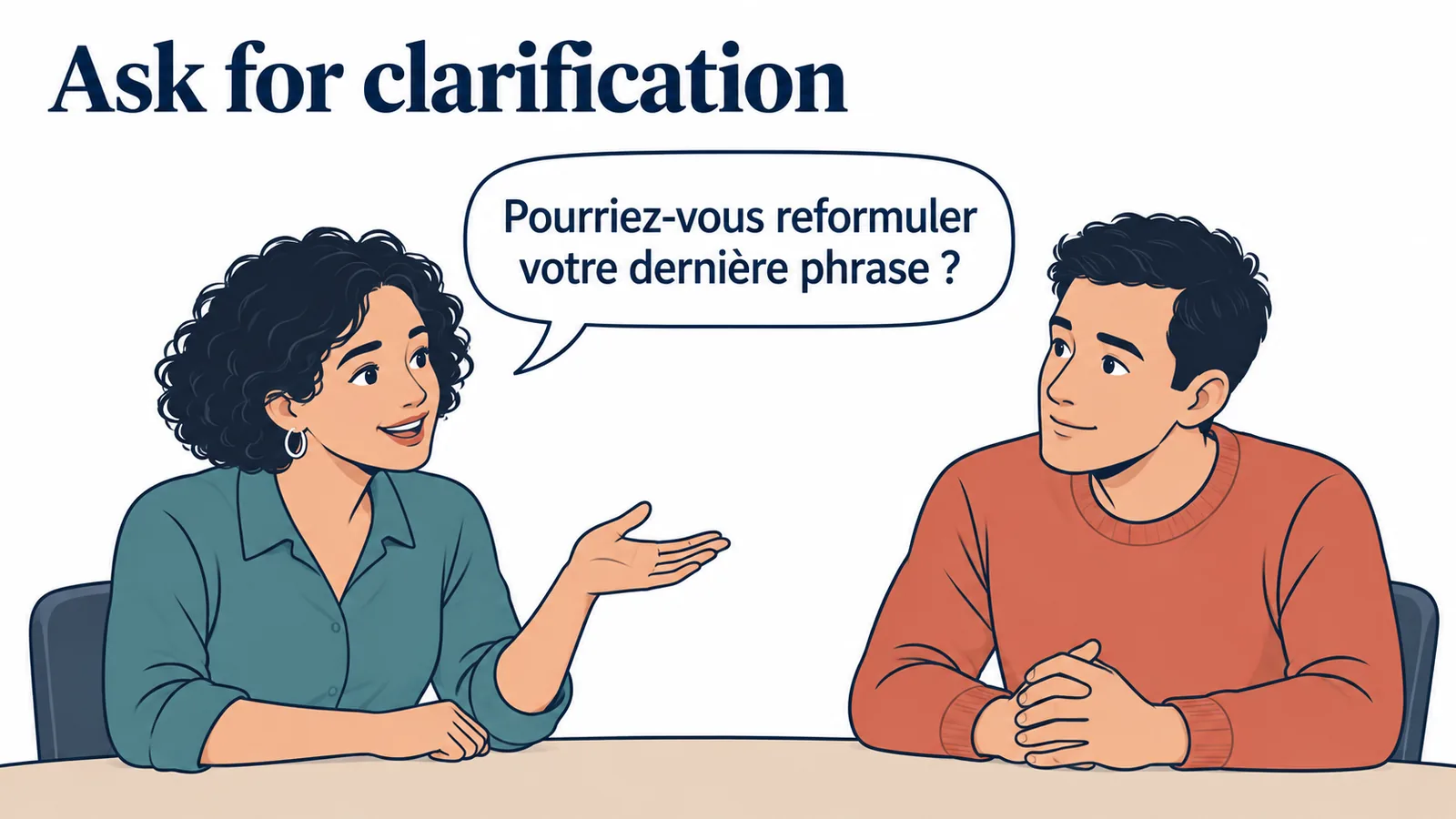
Ask for clarification in French: Pourriez-vous reformuler votre dernière phrase ? You can also check a specific meaning: Vous voulez dire que le transport n’est pas compris ? Then respond to the clarified point. Guessing and answering an unrelated question creates a bigger communication problem than briefly checking your understanding.
Do I get preparation time?
The official pages reviewed specify five minutes for Section A and ten for Section B, but do not state a separate preparation allowance before each section. Ask your centre to clarify the procedure before test day. Practise identifying the offer, your role and missing information quickly.
Which TEF speaking topics should I practise?
Practise everyday offers involving housing, services, work, leisure, transport, volunteering, wellbeing and family activities. Rotate through the 40 original prompts above, changing the details and objections. Candidate reports are useful for identifying broad themes, but they cannot establish which advertisement you will receive on your test day.
The Takeaway
Practise TEF Canada expression orale by asking relevant follow-ups and answering objections. Use the topics to build those habits; let your wording change.
Deciding between the two exams? The TEF vs TCF comparison covers how the speaking formats differ.

Written and checked by
Simer Dua, French Program Lead
Simer leads the TEF Canada and TCF Canada programs at Toronto French Academy and has guided hundreds of Express Entry candidates from their first French lesson to the NCLC 7 result. She reviewed the French prompts and dialogues on this page and hosts the academy’s free monthly French for Canada PR info session.
Get your speaking corrected every week
Our TEF preparation at Toronto French Academy includes weekly corrected speaking practice, so the exchanges that break down in a mock get fixed before test day.