
On this page
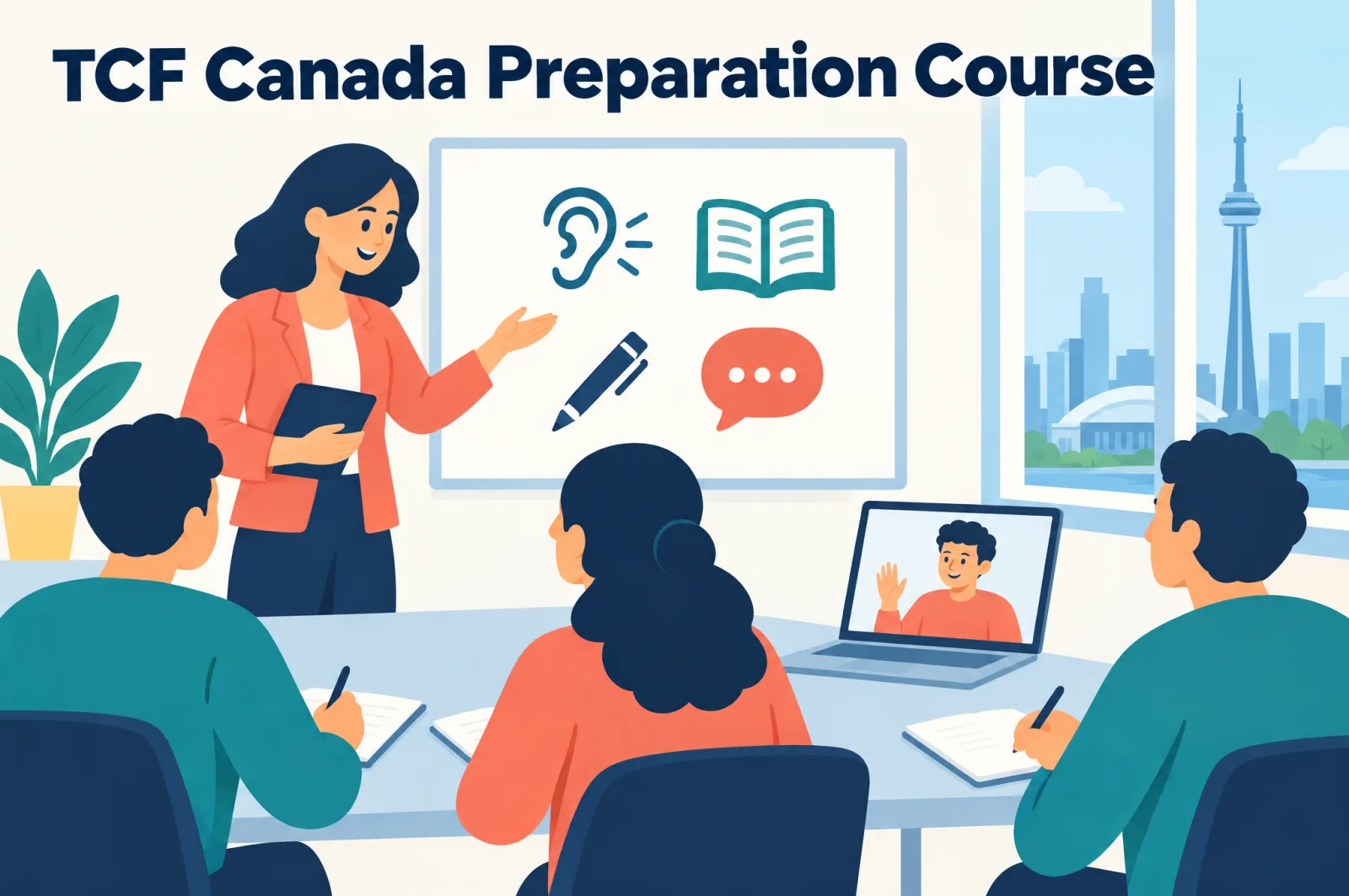
Who This TCF Preparation Course Is For
This TCF preparation course is for you if you are an Express Entry candidate who needs NCLC 7 in all four skills for the French-language draws. French can also add up to 50 CRS points when you have NCLC 7 or higher in every French skill and CLB 5 or higher in every English skill, so your preparation has to cover each section, not just the ones you like (IRCC, CRS criteria).
If you are a spouse adding French points to a household application, bring that goal to the diagnostic. We build your plan around the skills you need to improve, without assuming your target matches the principal applicant’s.
If you need French for citizenship, your target is NCLC 4 in speaking and listening. Tell us at the start so the plan reflects that requirement rather than the full NCLC 7 programme (IRCC, proof of language for citizenship).
If you are starting at B1, you already have French to work with. We look for the gap between understanding a lesson and producing an answer under pressure, especially when the listening moves faster than you can translate.
If you are starting from zero, you can begin here too. Your first stage builds usable French; exam practice comes in as soon as you have the language to attempt the tasks.
What You Get in the TCF Canada Preparation Course, Section by Section
Our TCF Canada preparation course teaches you how to handle each of the four sections, with weekly corrected writing and speaking. These French classes for TCF connect the language work to the decisions you have to make during the test.
The exam has four mandatory sections in one sitting of about 2 hours 47 minutes; the full format is in the TCF Canada exam guide. For the scores that match your target in each skill, use the TCF score chart.
TCF Listening Preparation: 39 Questions in 35 Minutes, Audio Played Once
Listening gives you 39 questions in 35 minutes, and each recording plays once. We use speed drills and listening practice with Canadian accents so you learn to recognise meaning without translating every word.
You listen for the situation, the speaker’s intention and the one detail that changes the answer. A familiar word can tempt you into choosing too early, especially when the speaker corrects themselves afterwards. We review what made the answer right, then practise deciding under once-only audio.
TCF Reading Preparation: 39 Questions in 60 Minutes
Reading gives you 39 questions in 60 minutes, with a difficulty ramp that makes pacing matter. We teach you to scan for evidence, recognise paraphrases and pin down what the question actually asks.
A notice might list several opening times while the question asks about the exception. You practise locating that exception instead of translating the whole notice. Timed work also shows where you are spending too long on one answer while harder texts still wait.
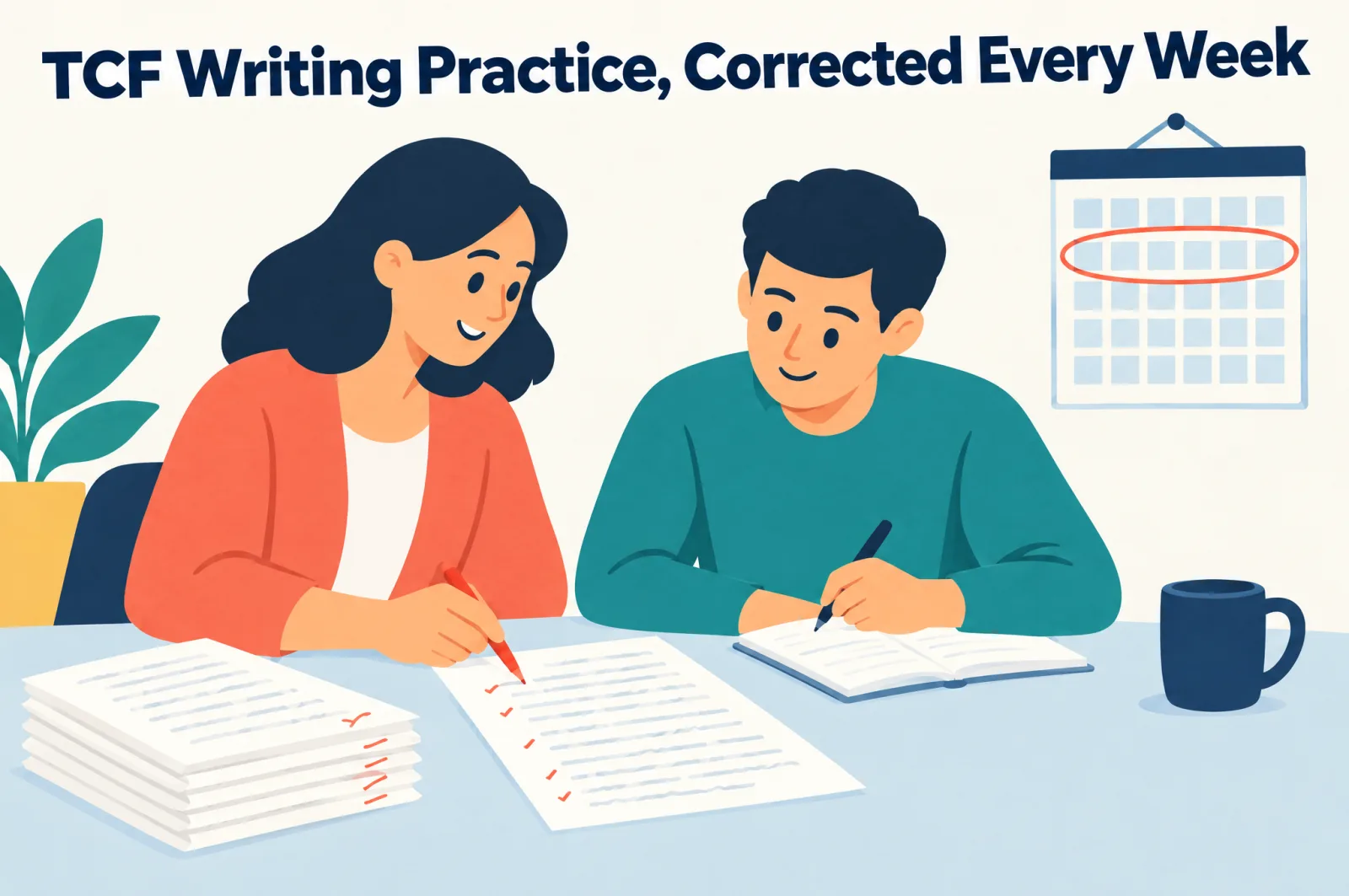
TCF Writing Preparation: The Three Tasks, Corrected Every Week
Writing is three tasks in 60 minutes: a short message of 60–120 words, an article or account of an experience of 120–150 words, and a synthesis of two opposing documents with your own position, 120–180 words. We practise choosing the right tone, organising the answer and staying inside each word range.
Task 3 needs particular care: you have to restate what each document says before you add what you think, and keep the two apart. We drill that separation, then the joining sentence that makes your position clear.
Your weekly writing comes back with examiner-style feedback on task completion, organisation and language, so you can see where an instruction went unanswered or an argument lost its thread. The next piece is built on those corrections, and we check whether the same errors come back.
TCF Speaking Preparation: Tasks 1, 2 and 3 With Mock Interviews
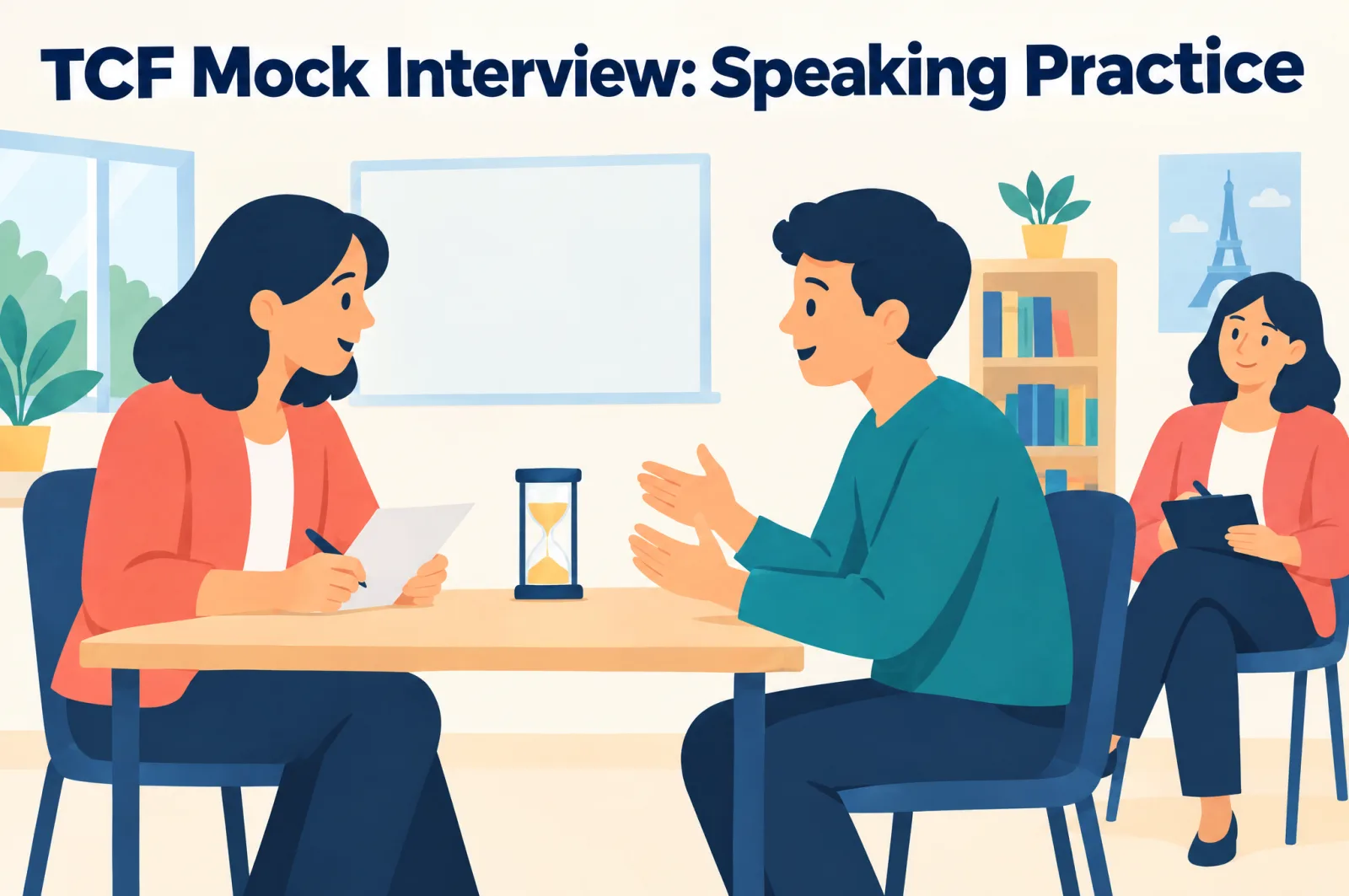
Speaking is three tasks in about 12 minutes, face to face with an examiner who records the interview. We practise all three through timed mock interviews and weekly speaking correction.
Task 1 is a guided interview about you: two minutes, no preparation. We practise answering naturally and adding relevant detail, so a follow-up question does not derail a memorised introduction. Task 2 is a role-play to obtain information: 5.5 minutes, including two minutes of preparation, and you ask the questions. We practise opening the exchange, following up on answers and keeping the conversation moving when a reply changes what you need to ask next. Task 3 asks you to defend an opinion for 4.5 minutes without preparation. We work on stating a position, developing reasons and supporting them with examples you can explain aloud. The full walkthrough, with 40 practice topics and model answers, is in our TCF Canada expression orale guide.
Every course starts with a diagnostic across the four skills, so the work goes where your gaps are. Mock exams under real timing then test whether that work holds up when you have to keep going without a teacher’s prompt.
TCF Preparation Course Formats and Pricing
Our TCF course costs $249, $369 or $549 per month, depending on the format. Choose your TCF Canada course by how often you want to be taught and how much individual attention you need.
Group
$249 per month
- 20 classes per month
- Monday to Friday, mornings or evenings
- 1 hour per class, 6–8 students
- 10 to 12 months typical A1 to B2
- Best for a weekday routine and a group to practise with
Individual
$369 per month
- 12 classes per month
- 3 days a week
- 1 hour per class, one to one
- 8 to 10 months typical A1 to B2
- Best for focused work on your own gaps
Fast-Track Individual
$549 per month
- 20 classes per month
- 5 days a week
- 1 hour per class, one to one
- 6 to 8 months typical A1 to B2
- Best for a fixed exam date and daily contact
Group TCF classes run in the mornings or evenings. Individual slots are in the mornings, 8 am to 12 pm, and evenings, 8 pm to 12 am Eastern. Billing is monthly. If you want to switch formats, ask us to confirm the arrangements before changing your schedule, and be honest with yourself about the homework time you can give as well as the class hours.
How Our TCF Exam Preparation Works, Week by Week
Our TCF exam preparation follows a diagnostic, a level plan, weekly correction and timed mocks. TCF Canada test preparation becomes more task-specific as your language and your exam date allow.
- Take the diagnostic in your first session. We check the four skills separately and find where the work needs to begin. A strong reading result can sit next to hesitant speaking.
- Set your level plan and target exam date. We weigh your starting point against the study time you actually have. The date gives the work direction; your progress tells us whether it stays realistic.
- Follow the weekly cycle. Class, homework, one corrected writing task and one corrected speaking task. You practise the lesson, get the feedback and apply it to the next attempt. Keep the corrections beside you when you revise.
- Sit mock exams under real timing as the date approaches. We review unfinished answers, comprehension gaps and recurring errors, then use those findings to decide what gets attention next.
- Arrange the real sitting when you are ready. The centre sets its own fee, typically $300–$450 CAD; the steps are on our TCF Canada booking page.
How Long TCF Canada Preparation Takes
TCF Canada preparation typically takes 3 to 6 months from B1, 10 to 14 months from zero, or 3 to 4 weeks from B2 or above. These TCF test preparation ranges are typical, not promises.
From B1, structured TCF prep combines language development with task practice. Listening at speed or sustaining an opinion may need more work than your reading suggests, and the diagnostic finds that difference early.
From B2 or above, the shorter range is for task-specific practice. You already have the underlying language; the focus is on instructions, timing and the habits that interfere with your answers.
The A1-to-B2 durations in the pricing cards describe each format’s typical language progression. Reaching B2 and being ready for your target scores are different milestones, so those durations are not interchangeable with the preparation ranges above.
TCF Preparation for Beginners: Starting From Zero
TCF preparation for beginners starts with everyday French: understanding short exchanges, asking questions and building sentences you can actually use. In the first months we work on pronunciation and grammar through speaking, listening and short written answers.
Group classes suit you if a weekday routine keeps you studying. Individual classes give more room to work through your particular gaps. Either way, leave time between lessons to listen again, revise corrected sentences and practise speaking.
TCF or TEF: Which Exam Should You Prepare For?
You can prepare for either TCF Canada or TEF Canada, because IRCC accepts both as French-language tests for Express Entry (IRCC, language testing). TCF has three speaking tasks in about 12 minutes and three writing tasks. TEF has two speaking role-plays in 15 minutes and two longer writing tasks. Compare how you handle those tasks in TEF vs TCF. We prepare students for both; see our TEF Canada preparation course.
Online TCF Classes or In Person in Toronto and Brampton?
Online TCF classes and our in-person options use the same teachers and the same method. You can take a TCF course online, live, from anywhere in Canada, or attend in Toronto or Brampton.
Choose online if removing the commute makes regular attendance more realistic. Choose in person if a classroom helps you concentrate and speak up. In either setting you will have to participate aloud and hand in the corrected work.
If you are searching for “TCF classes near me”, compare the actual schedule with your working week before you decide. Our TCF Canada classes include both local and online options; see online French classes for how the live classes run. For Toronto-specific exam information, use TCF Toronto.
Why Prepare for TCF Canada With Toronto French Academy
You prepare for TCF Canada with a diagnostic first, weekly corrected writing and speaking, and mock exams under real timing. Toronto French Academy has been teaching since 2018, with 1,200+ students, 200+ tutors and a 4.8-star Google rating.
Our TCF French classes draw on a bank of 140 TCF mock tests, used under real timing as your exam date approaches. The practical value is being able to attempt the work, review your mistakes and go back to the skills that need attention before the next attempt.
One-to-one TCF coaching suits you if you want a private TCF tutor to focus on your gaps, whether that is question formation for the role-play or organising your writing. See private tutoring and bring those priorities to your diagnostic.
What Students Say About Our TCF Preparation
Three of the Google reviews students have left for Toronto French Academy, quoted as written. More are on our reviews page.
★★★★★I’ve been taking French lessons with Love Bhatia Sir at TFA for the past two months, and it has been an amazing experience so far. I was a complete novice when I started, but thanks to Love’s easy to grasp explanations, kind approach and structured lessons, I’ve made noticeable progress in a short time. If you’re new to French, preparing for TEF or looking to build a solid foundation, I highly recommend Love Sir and TF Academy.
★★★★★I’ve had a fantastic experience learning French here! My teacher Priya is excellent—very clear, patient, and engaging, which makes the classes both enjoyable and effective. The institute is also great at accommodating my schedule, ensuring classes fit perfectly with my availability. Highly recommend for anyone looking to learn French with quality instruction and flexible timing!
★★★★★I have been studying French with Mr. Naveen from last 2 months. My experience has been fabulous thanks to the teaching methods and a smart learning tools that I have been able to understand and speak the language. The teaching skills are remarkable and would definitely recommend to all my friends as well. I have made significant improvements in such a short time.
TCF Canada Preparation Course: Frequently Asked Questions
Our TCF Canada preparation course starts with your level and your target, then sets the work and the format around them. These answers cover the practical questions to settle before enrolling.
How long does it take to prepare for TCF Canada?
Typical preparation takes 3 to 6 months from B1, 10 to 14 months from zero, and 3 to 4 weeks from B2 or above. These are ranges, not guarantees. We start with a diagnostic because you may need substantially more work in speaking or listening than in reading.
Can I prepare for TCF Canada online?
Yes. Our online TCF classes are live across Canada, with the same teachers and method as our in-person options. You complete weekly corrected writing and speaking and practise mock exams under real timing. Choose online if you can attend consistently and have a space where you can speak aloud without interruption.
How much does a TCF preparation course cost?
Toronto French Academy’s Group course costs $249 per month for 20 classes. Individual costs $369 per month for 12 classes, and Fast-Track Individual costs $549 per month for 20 classes. Billing is monthly. Compare the formats by teaching frequency and the amount of individual work you want, alongside your budget.
Do you help book the TCF exam?
Our booking guide explains the steps for arranging your TCF Canada sitting, including centres, dates and fees. Ask us what booking support is available when you discuss your target date. Your preparation plan should be built around that date, and mock exams help identify the work still needed before the sitting.
What level do I need to start?
You can start from zero, B1, or B2 and above. Every course begins with a diagnostic. Beginners first build usable French, while more advanced learners spend more time on task-specific practice. Your starting level changes the plan and the likely duration, so bring any previous study or test results to that discussion.
Is TCF or TEF easier to prepare for?
Neither is automatically easier for you. TCF uses three speaking tasks and three writing tasks; TEF uses two speaking role-plays and two longer writing tasks. Your comfort with those demands matters more than another candidate’s preference. We prepare students for both and can discuss the differences after checking your French.
Do you offer TCF classes in Brampton?
Yes. Toronto French Academy offers in-person TCF classes in Brampton and Toronto, plus live online classes across Canada. Start with a diagnostic to establish your level, then discuss your plan in a demo class. Ask about the schedule for your preferred location when choosing between Group, Individual and Fast-Track Individual.
Are there TCF mock tests in the course?
Yes. We use mock exams under real timing and have a bank of 140 TCF mock tests. Practice sits alongside weekly corrected writing and speaking. The point is to identify what went wrong and work on it before another attempt, including pacing, missed instructions and answers you couldn’t finish.
Can I switch from group to individual classes?
Ask us to confirm the switching arrangements before changing formats. Group is $249 per month, Individual is $369 per month, and Fast-Track Individual is $549 per month, with monthly billing. Tell us the reason for the change, such as needing more focused speaking practice, so the proposed format addresses it.
What if I only need NCLC 4 for citizenship?
Tell us that citizenship is your goal when you start. The French language requirement is NCLC 4 in speaking and listening, so your preparation plan should reflect that target. TCF Canada itself still has four mandatory sections. We begin with a diagnostic to establish the language work you need.
Book a Demo Class
A demo class gives you a level check, a plan and answers to your questions. Start your TCF preparation with a diagnostic, then use the demo to talk through your target date and which format fits your week.
Ready when you are
Tell us your exam date and your current level. We will map the sections, pick the format and start the weekly cycle.
Program lead
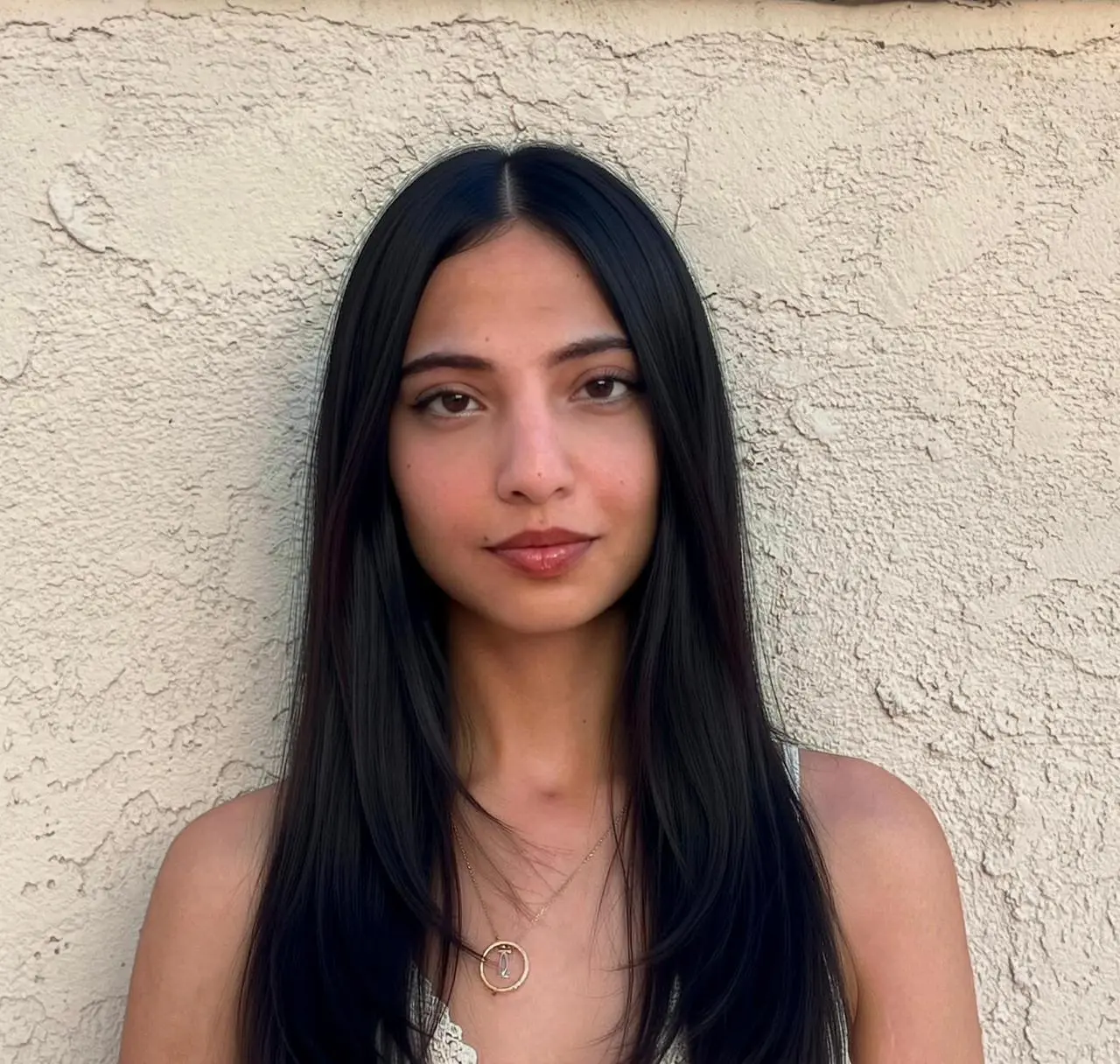
Simar Dua, French Program Lead
Simar leads the TEF Canada and TCF Canada programs at Toronto French Academy and has guided hundreds of Express Entry candidates from their first French lesson to the NCLC 7 result. She runs the diagnostics described on this page and hosts the academy’s free monthly French for Canada PR info session.