

TCF Canada Score Chart
Summary
The TCF Canada test is essential for Canadian immigration, translating raw scores into NCLC levels used by IRCC to determine Express Entry eligibility and Comprehensive Ranking System (CRS) points.
Key scoring principles:
- Independent assessment: IRCC evaluates Listening, Reading, Writing, and Speaking separately. You cannot average scores; failure to meet the minimum NCLC level in any one skill disqualifies you from specific benefits, regardless of performance in other areas.
- Dual scales: Listening and Reading use a 0–699 scale (machine-scored), while Writing and Speaking use a 0–20 scale (human-rated). Both map to the same NCLC levels (1–12).
- Validity: Results are valid for two years — they must still be valid both when you complete your Express Entry profile and when you submit your application for permanent residence.
The NCLC 7 benchmark. Achieving at least NCLC 7 in all four skills is the critical threshold for economic programs like FSWP and CEC. This level unlocks:
- French-language category draws: pathways often featuring lower CRS cut-offs than general draws.
- Bilingual bonus: up to 50 additional CRS points if combined with English proficiency.
- Required scores for NCLC 7: Listening 458–502 · Reading 453–498 · Writing 10–11 · Speaking 10–11.
Retake policy. The exam is not modular; you must retake all four sections if you fall short in one. Wait period: minimum 20 days between sittings. Costs: fees are set per centre, typically $300–$450 CAD. Strategy: avoid immediate rewrites without a targeted preparation strategy to diagnose and address specific weak sections.
Understanding the TCF Canada score chart is the first critical step for anyone looking to immigrate to Canada through Express Entry or other provincial pathways. This chart serves as a bridge, translating your raw numerical test results into the Niveaux de compétence linguistique canadiens (NCLC) levels that IRCC uses to determine your eligibility and CRS points. Every band on this page was checked against IRCC’s published chart on August 19, 2026.
TCF Canada score converter
The official TCF Canada score chart (all four skills)
To qualify for most economic immigration programs, you must achieve a specific NCLC level in each of the four mandatory abilities: listening, reading, writing, and speaking. Unlike some other exams, IRCC evaluates each skill independently, meaning you cannot average your scores to meet a requirement.
The table below outlines the current official conversion ranges used by Immigration, Refugees and Citizenship Canada (IRCC).
| NCLC level | Listening (/699) | Reading (/699) | Writing (/20) | Speaking (/20) |
|---|---|---|---|---|
| 10+ | 549–699 | 549–699 | 16–20 | 16–20 |
| 9 | 523–548 | 524–548 | 14–15 | 14–15 |
| 8 | 503–522 | 499–523 | 12–13 | 12–13 |
| 7 | 458–502 | 453–498 | 10–11 | 10–11 |
| 6 | 398–457 | 406–452 | 7–9 | 7–9 |
| 5 | 369–397 | 375–405 | 6 | 6 |
| 4 | 331–368 | 342–374 | 4–5 | 4–5 |
Please note that for Express Entry, achieving at least NCLC 7 in all four skills is often the minimum threshold to qualify for the French-language proficiency category and claim significant bonus CRS points. Results are valid for two years, and they must still be valid both when you submit your Express Entry profile and when you apply for permanent residence.
For the exam’s format, fees and booking, see our TCF Canada guide. Taking the other accepted test instead? Use the TEF Canada score chart.
Type all four scores into our TEF and TCF score calculator to see the NCLC level per skill and how far the weakest one is from NCLC 7. The French draw tracker shows the latest cut-off that level competes against, and the French CRS points calculator shows what it is worth in points.
What TCF score do you need for CLB 7?
To achieve the coveted CLB 7 (or NCLC 7) in TCF Canada, you must score at least 458 in Listening, 453 in Reading, 10 in Writing, and 10 in Speaking. It is vital to understand that IRCC evaluates these four skills independently; you cannot average high scores in one area to compensate for a lower result in another.
Reaching this level is widely considered the “key to the door” for Canadian permanent residence, as it serves as the minimum requirement for many federal programs, including the Federal Skilled Worker Program. Beyond basic eligibility, NCLC 7 unlocks two major advantages:
- French-language category draws: qualifying for these specific Express Entry rounds gives you access to selection pathways that often feature significantly lower CRS cutoffs compared to general draws.
- Bilingual bonus points: achieving NCLC 7 in all four skills is the mandatory “all-or-nothing” threshold to claim up to 50 additional CRS points if you also possess English proficiency.
Because the scoring system for TCF Canada (which uses 0–699 for comprehension and 0–20 for production) differs from other language tests, hitting these specific targets is the most strategic step to maximize your competitiveness in the Express Entry pool.
How TCF Canada scoring works
Understanding the TCF Canada score chart requires looking beyond a single total number. Because the test measures four distinct skills, it utilizes two separate scoring scales to reflect how each skill is evaluated. This dual-scale system often confuses candidates when they compare their own results to advice found on immigration forums.
Two different scales
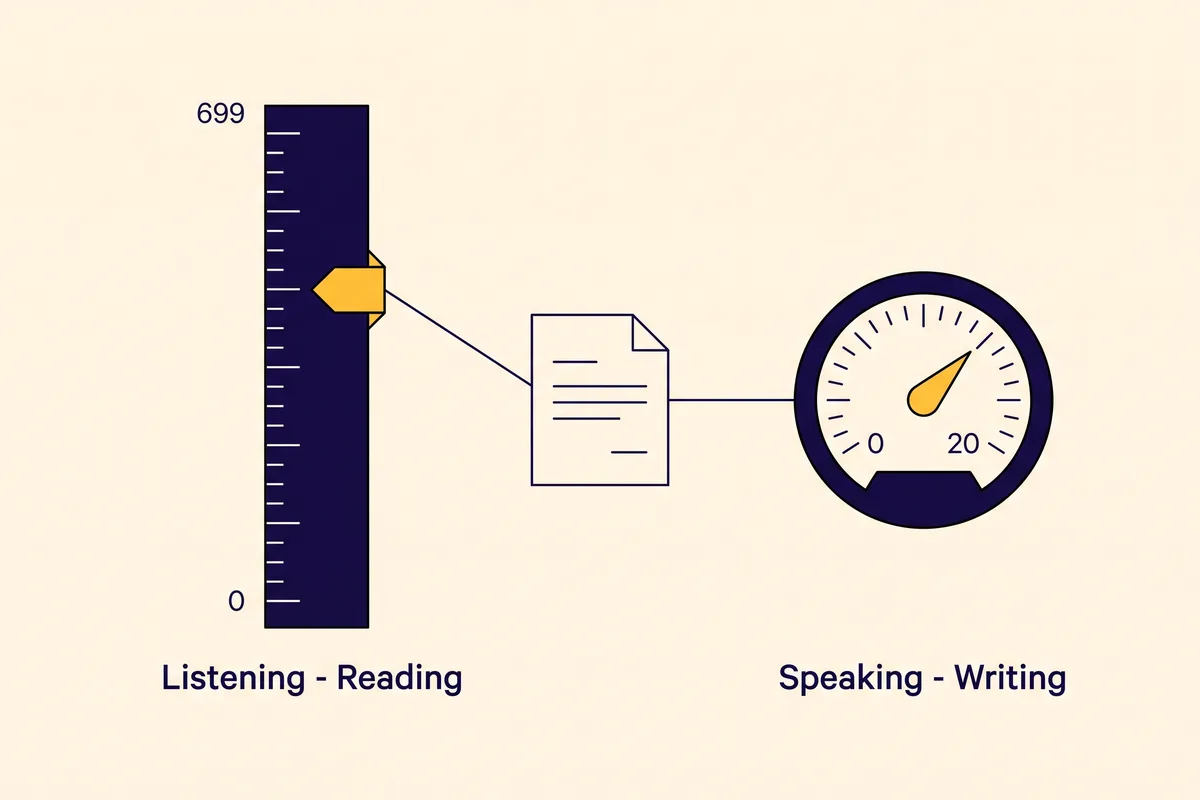
One exam, two rulers: listening and reading report on a 0–699 scale, writing and speaking on a 0–20 scale — both convert to the same NCLC levels.
The TCF Canada evaluates your proficiency using two methodologies.
- The 0–699 scale: used for Listening and Reading. These sections are objective, right-or-wrong assessments that allow the system to measure ability across a wide range of points.
- The 0–20 scale: used for Writing and Speaking. Because these are production-based skills, they are assessed using broader bands rather than raw point totals.
While the numbers look radically different, both scales ultimately map to the same NCLC levels used by IRCC for immigration. A score of 458 in Listening (0–699 scale) and a score of 10 in Writing (0–20 scale) both translate to the same NCLC 7 requirement.
Who marks what
The source of this scoring discrepancy lies in how the tests are graded.
- Machine-scored: Listening and Reading comprehension are multiple-choice, computer-graded exams. Because they can be evaluated objectively by software, they report on the more granular 0–699 scale.
- Human-rated: Writing and Speaking require evaluation by trained examiners. These experts score your performance based on standardized criteria — assessing clarity, vocabulary, grammar, and structure — which is why these skills use the more compact 0–20 scale.
This split often trips up new candidates who assume all sections should have similar numerical values. When you see forum advice suggesting a “high score” in one area but a “low score” in another, it is frequently just a misunderstanding of these two different scales. Always check which scale your target score refers to, or you may inadvertently aim for the wrong objective.
Sources: France Éducation International — TCF Canada · IRCC — Express Entry: language test results
What your TCF score is worth in Express Entry points
Your French proficiency is not just a language skill; it is a primary driver of your CRS score, acting as a crucial “lever” to boost your ranking, especially since the removal of arranged employment points. The TCF Canada score chart serves as your roadmap to maximizing your competitiveness in the Express Entry pool through three distinct mechanisms:
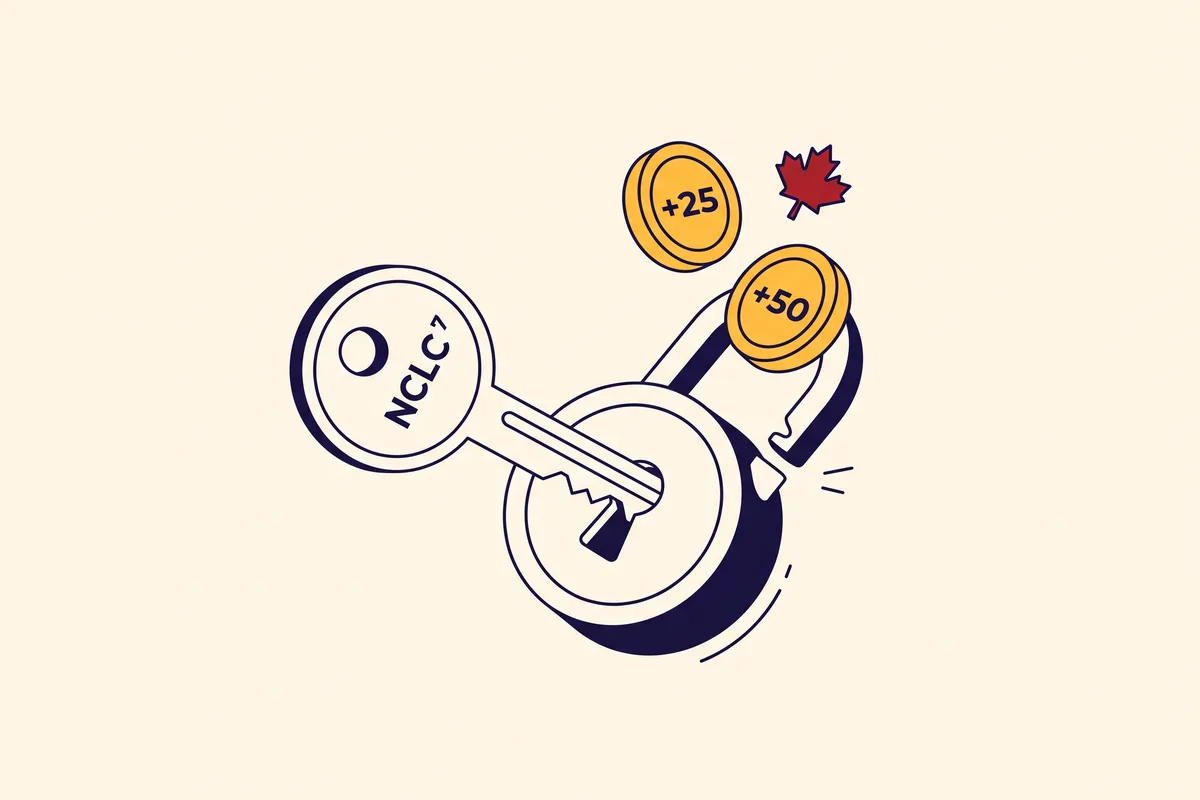
NCLC 7 in all four skills is the key: it unlocks the 25 or 50-point French bonus and category-draw eligibility.
- Core second official language points: if French is your second official language, each ability (Reading, Writing, Listening, Speaking) contributes core CRS points based on your NCLC level, up to a combined maximum of 24 points (22 if you apply with a spouse or common-law partner).
- The bilingual bonus: this is an “all-or-nothing” additional points bonus that rewards bilingualism. To qualify, you must achieve NCLC 7 or higher in all four French abilities:
- +25 points: you score NCLC 7+ in all four French skills and have CLB 4 or lower in English (or have no English test on file).
- +50 points: you score NCLC 7+ in all four French skills and CLB 5 or higher in all four English skills.
- French-language category draws: often considered more valuable than the bonus points themselves, achieving NCLC 7+ in all four skills qualifies you for dedicated French-language category draws. These draws consistently feature CRS cutoffs significantly lower than general draws, offering a strategic pathway to receive an Invitation to Apply (ITA) even with a lower CRS score.
By understanding these specific thresholds, you can strategically target the exact scores required to unlock these significant Express Entry advantages.
Sources: IRCC — Comprehensive Ranking System criteria · IRCC — Express Entry rounds of invitations
TCF score requirements by immigration program
Navigating the TCF Canada score chart requires knowing exactly what NCLC level your specific immigration path demands. While NCLC 7 is the “gold standard” for most competitive entry streams, minimum requirements vary significantly depending on the program.
The following table summarizes the minimum required NCLC levels for the primary federal economic immigration programs as established by Immigration, Refugees and Citizenship Canada (IRCC).
Minimum NCLC levels by program
| Immigration program | TEER category | Min. NCLC (all 4 skills) |
|---|---|---|
| Federal Skilled Worker (FSWP) | All | NCLC 7 |
| Canadian Experience Class (CEC) | TEER 0 or 1 | NCLC 7 |
| Canadian Experience Class (CEC) | TEER 2 or 3 | NCLC 5 |
| Federal Skilled Trades (FSTP) | All | S/L: 5 · R/W: 4 |
Important considerations
- FSWP and CEC (high skill): both programs effectively require a minimum of NCLC 7 in all four abilities to qualify as a principal applicant.
- FSTP requirements: this program is unique in its split requirements, allowing for slightly lower proficiency in Reading and Writing (NCLC 4) compared to Speaking and Listening (NCLC 5).
- Citizenship: while distinct from economic programs, applications for Canadian citizenship require proof of proficiency at a minimum of NCLC 4 in speaking and listening only, for applicants aged 18–54.
Always verify your specific TEER classification using the official National Occupational Classification (NOC) website to ensure you are aiming for the correct benchmark.
Sources: IRCC — Express Entry: language test results · IRCC — Citizenship: proof of language skills
Reading real TCF results: three examples
Understanding the TCF Canada score chart requires more than looking at your results in isolation; it requires applying the “all-or-nothing” rule IRCC uses to assess your eligibility. To show how these numbers translate into real-world outcomes, let’s look at three hypothetical candidates.
1. The qualifier: clearing the PR threshold
Results: Listening 470, Reading 465, Writing 10, Speaking 10.
Verdict: this candidate meets the NCLC 7 threshold in all four skills.
What this means: because every single skill is at or above the NCLC 7 minimum, this candidate is “green-lit” for the most critical French-language benefits. They are eligible for French-language category-based Express Entry draws, which often have significantly lower CRS cut-offs than general draws, and they qualify for the French bonus — 25 points even with no English test on file, or 50 points with CLB 5+ English results.
2. The high achiever: maximizing CRS points
Results: Listening 550, Reading 550, Writing 16, Speaking 16.
Verdict: this candidate achieves NCLC 10 across the board.
What this means: while NCLC 7 is the baseline, this profile is a powerhouse for Express Entry. Not only do they qualify for French-language category draws, but their scores also maximize their core language points and place them in the highest tier for bilingual bonus points. This profile is ideally positioned to secure an Invitation to Apply (ITA) even if general CRS cut-offs remain high.
3. The “just missed” candidate: the all-or-nothing trap
Results: Listening 460, Reading 460, Writing 10, Speaking 9.
Verdict: this candidate is NCLC 7 in three skills, but falls to NCLC 6 in Speaking.
What this means: despite having strong scores in Listening, Reading, and Writing, this candidate is disqualified from the French-language category draws and the bilingual bonus points because they failed to meet NCLC 7 in all four skills. This is the most common pitfall for candidates; IRCC does not average scores, and a single “weak” section nullifies the benefits of the other three high results. This candidate needs to specifically target Speaking practice to bridge that one-point gap to hit the NCLC 7 milestone.
If one skill falls short
If you miss your target in just one skill, the TCF Canada rules can feel harsh: the exam is not modular. You cannot register for or retake individual components; you must book and sit the full four-part exam again. Because IRCC evaluates each skill independently — and your overall eligibility is determined by your weakest section — one low score effectively nullifies the strength of your other three results.
The retake reality
- The waiting period: the official minimum waiting period between sittings of the same TCF version is 20 days. While some sources mention 30 days, 20 days is the standard floor set by France Éducation international (FEI), though individual test centres may impose stricter local policies. Always verify your specific centre’s terms before booking.
- Costs: a retake requires registering for a full session; fees are set per centre, typically $300–$450 CAD. Because fees are non-refundable and exam slots fill up, it is a significant investment that should not be made impulsively. Our TCF Toronto guide lists GTA test centres, dates and booking details.
Strategy: rewrite vs. more preparation
If you find yourself just one or two points shy of your target, do not immediately book another date. A “quick rewrite” without a change in strategy is rarely effective and often leads to the same outcome. Instead, prioritize a targeted preparation phase:
- Diagnose the weakness: use your official score report to identify the exact section that let you down. If it was Writing or Speaking, focus your training on the specific official TCF tasks (e.g., the structured interaction tasks or point-of-view exercises) rather than general French practice.
- Verify your path: since re-evaluation services for writing and speaking have been suspended for exams taken on or after September 1, 2026 (the service is planned to resume in autumn 2027), a full retake is the only path to improve these scores for upcoming tests.
- Simulate and repeat: before you invest in another full exam fee, perform full-length mock exams under strict, timed conditions. If you aren’t consistently hitting your target scores in these simulations, the best move is to delay booking and dedicate the extra weeks to closing that specific knowledge gap.
This approach ensures that when you do sit for the exam again, you are paying for an improved result, not just another attempt at the same mistakes.
Sources: France Éducation International — TCF Canada · Alliance Française Ottawa — TCF re-evaluation requests
How TCF scores compare with TEF scores
Candidates often try to compare raw scores between TCF Canada and TEF Canada, but this is a common mistake that can lead to setting the wrong preparation goals. Because these tests are developed by different organizations — the TCF by France Éducation international and the TEF by the CCI Paris Île-de-France — they use completely different raw scoring scales.
For example, while TCF Canada listening uses a 0–699 scale, TEF Canada uses a 0–360 scale for the same skill. Because the numerical values are calculated based on different methodologies, you cannot take a target score or “passing mark” from a TEF-specific guide and apply it to your TCF preparation; doing so will almost certainly lead to confusion about your progress.
However, there is one point where they perfectly align: the NCLC level. IRCC accepts both tests as equivalent for federal immigration pathways because both are officially calibrated to the same Canadian Language Benchmark (NCLC) scale. Whether you take the TCF or the TEF, your final result is converted into the same NCLC band (1–12), which is the only figure IRCC uses to calculate your CRS points and eligibility. Focus on hitting your target NCLC level, not on comparing the raw numbers between the two tests. If you are on the TEF instead, its bands live on our TEF Canada score chart — and if you are still choosing, our TEF vs TCF comparison goes format by format.
TCF Canada score chart FAQ
Is the TCF Canada score chart the same as a CEFR conversion?
No, they are distinct frameworks. While the TCF Canada score chart maps raw performance to the NCLC levels used by IRCC, the CEFR (Common European Framework of Reference for Languages) is an international standard ranging from A1 to C2. You must use the official IRCC conversion table to determine your Canadian immigration eligibility, rather than relying on general CEFR equivalents.
Can I average my scores if I am just below the NCLC 7 requirement?
No, you cannot average your scores across the four skills. IRCC evaluates Listening, Reading, Writing, and Speaking independently, and you must reach the minimum NCLC level in each skill individually to meet the requirement.
Why do my Listening and Writing scores look so different?
The TCF Canada reports scores on two different scales because the sections are assessed differently. Listening and Reading are objective, machine-scored tasks using a 0–699 scale, while Writing and Speaking are human-rated tasks that use a more compact 0–20 scale.
How long are my TCF Canada test results valid?
Your official TCF Canada test results are valid for two years from the date they are issued. They must still be valid both when you complete your Express Entry profile and when you submit your application for permanent residence, or you will need to re-sit the exam.
What is the difference between NCLC and CLB?
NCLC (Niveaux de compétence linguistique canadiens) and CLB (Canadian Language Benchmarks) are essentially the same 1–12 scale. CLB is used for English proficiency, while NCLC is the French-language equivalent, and they are treated as identical for immigration points.
Does NCLC 7 guarantee an Invitation to Apply (ITA)?
NCLC 7 is the baseline threshold to qualify for French-language category draws and claim bilingual bonus points, but it does not guarantee an ITA. Your chances depend on the current CRS cut-off scores for the specific draw type you are eligible for.
Can I retake just the section where I scored low?
No, the TCF Canada is not modular. If you need to improve your score in one specific skill, you must book and sit the full four-part exam again, as you cannot retake individual sections.
Is there a waiting period before I can retake the TCF Canada?
Yes, the standard minimum waiting period between sittings of the TCF Canada is 20 days. You should always verify the specific policy of your chosen test centre, as some may enforce different local rules.
How does TCF Canada compare to TEF Canada?
While both tests are accepted by IRCC and map to the same NCLC levels, they use completely different scoring scales and test formats. You cannot apply a “passing score” from a TEF preparation guide to your TCF goals; you must focus on the TCF-specific conversion table.
What is the “all-or-nothing” rule in TCF scoring?
The “all-or-nothing” rule refers to the requirement that you must hit the specific NCLC threshold (such as NCLC 7) in all four skills to qualify for certain immigration benefits. If you score NCLC 7 in three skills but fall to NCLC 6 in the fourth, you are disqualified from those specific benefits.
Do I need to be fluent in French to get a high score?
A “high score” depends on your immigration goal, but NCLC 7 (roughly B2 on the CEFR scale) is widely considered the threshold for functional, independent proficiency required for most economic programs. Achieving higher levels (NCLC 9–10) requires a more advanced, nuanced mastery of the language.
Where can I find the official score chart for Express Entry?
You can find the official conversion ranges on the IRCC website. Always use these official tables rather than third-party estimations to ensure your planning is accurate.

Get to your target score with Toronto French Academy
Reaching your target score takes more than just practice; it takes a clear strategy. At Toronto French Academy, we’ve been helping students master the TEF and TCF exams for Canadian immigration since 2018. Every student journey begins with a demo class, including a comprehensive level check to pinpoint your starting point. Whether you prefer our live online group classes from $249/month or personalized private tutoring, we are here to help. Join our community of successful candidates, rated 4.8 stars from over 239 Google reviews.
Book a demo class