
Francophone Community Immigration Pilot (FCIP) Guide

Simar Dua · French Program Lead
Updated:
The Francophone Community Immigration Pilot (FCIP) offers permanent residence to skilled workers who want to work and settle in one of six rural or remote Francophone-minority communities outside Quebec. It is run by Immigration, Refugees and Citizenship Canada (IRCC), and it is open in 2026.
To use it you need a job offer from a designated employer in one of the six FCIP communities and French at NCLC 5 in all four skills. That is well below the NCLC 7 that Express Entry’s French category asks for.
We prepare FCIP candidates for TEF Canada and TCF Canada, and we see the same thing every intake: the French result has to exist before the employer can act.
Francophone Community Immigration Pilot: Key Points
- Permanent residence for French speakers with a job offer from a designated employer in one of six communities outside Quebec: the Acadian Peninsula, Greater Sudbury, the Timmins Region, the Superior East Region, St-Pierre-Jolys and Kelowna.
- Requires NCLC 5 in all four skills on TEF Canada or TCF Canada, far below the NCLC 7 of Express Entry’s French-language proficiency category.
- You cannot apply on your own. The employer asks the community to recommend you, then you apply to IRCC for permanent residence.
- The job offer is the hard part. Employers in the pilot communities have told our students they submit a recommendation only once the test result is in hand, because the community verifies the score.
- The FCIP is open in 2026 and runs until 2029. Greater Sudbury’s allocation rose to 85 this year. The last 2026 intake windows are October 26 to 30 in Timmins, November 2 to 6 in Sudbury and the 15th to the 30th of each month in Kelowna.

On this page
What Is the Francophone Community Immigration Pilot?
A community-led route to permanent residence
Launched on January 30, 2025, the Francophone Community Immigration Pilot is a five-year, community-led pathway to permanent residence that runs from 2025 to 2029. Each community’s economic development organization works with IRCC to designate employers and recommend candidates.
The FCIP does not use an Express Entry profile, a Comprehensive Ranking System score or a provincial nomination. The community recommendation replaces them. IRCC accepts a maximum of 2,750 complete applications from principal applicants each year.
What FCIP stands for
FCIP is the acronym for the Francophone Community Immigration Pilot, or Programme pilote d’immigration dans les communautés francophones (PPICF) in French. The letters FCIP also stand for an unrelated insurance designation, Fellow, Chartered Insurance Professional.
FCIP and the Rural Community Immigration Pilot
The FCIP has a sister program, the Rural Community Immigration Pilot (RCIP), for 14 rural communities, with language proof in English or French. Greater Sudbury and the Timmins Region take part in both, which makes 18 communities across the two pilots. Together they replaced the Rural and Northern Immigration Pilot (RNIP), which is closed.
FCIP Requirements: Who Can Apply
The five requirements
To apply for the Francophone Community Immigration Pilot, you must have:
- A valid job offer from a designated employer in the community.
- At least 1 year (1,560 hours) of related work experience in the past 3 years, unless you qualify for the international graduate exemption.
- French proficiency at NCLC 5 in all four abilities, proven by an approved test.
- A Canadian educational credential or a foreign equivalent confirmed by an educational credential assessment.
- Proof of settlement funds to support yourself and your family.
You must also intend to live in the community that recommends you.
You apply through an employer, not on your own
There is no self-application for the FCIP. After you receive a job offer, your employer sends a community recommendation application on your behalf.
The community then verifies that the job is in a priority sector or occupation, that the offer is genuine, and that you meet all of the pilot’s requirements before it recommends you for permanent residence.
Already in Canada
Most FCIP candidates we meet are already in Canada on a work or study permit. Work experience gained in Canada counts only if you held temporary resident status and were authorized to work.
Greater Sudbury, for example, does not accept candidates who are in Canada as visitors or without valid status, and it asks employers for extra documents when a candidate is working on maintained status. You do not need to show proof of funds if you are already working in Canada with a valid work permit.
If your post-graduation work permit is close to its end date, our PGWP extension guide covers the permits that keep you working while you look for an FCIP employer.
Outside Canada
You can also apply from abroad. Among the candidates who write to us from outside Canada, most are in francophone Africa and the Maghreb. For them NCLC 5 is often already there, and the job offer is the whole problem.
FCIP Communities List 2026: The Six Communities
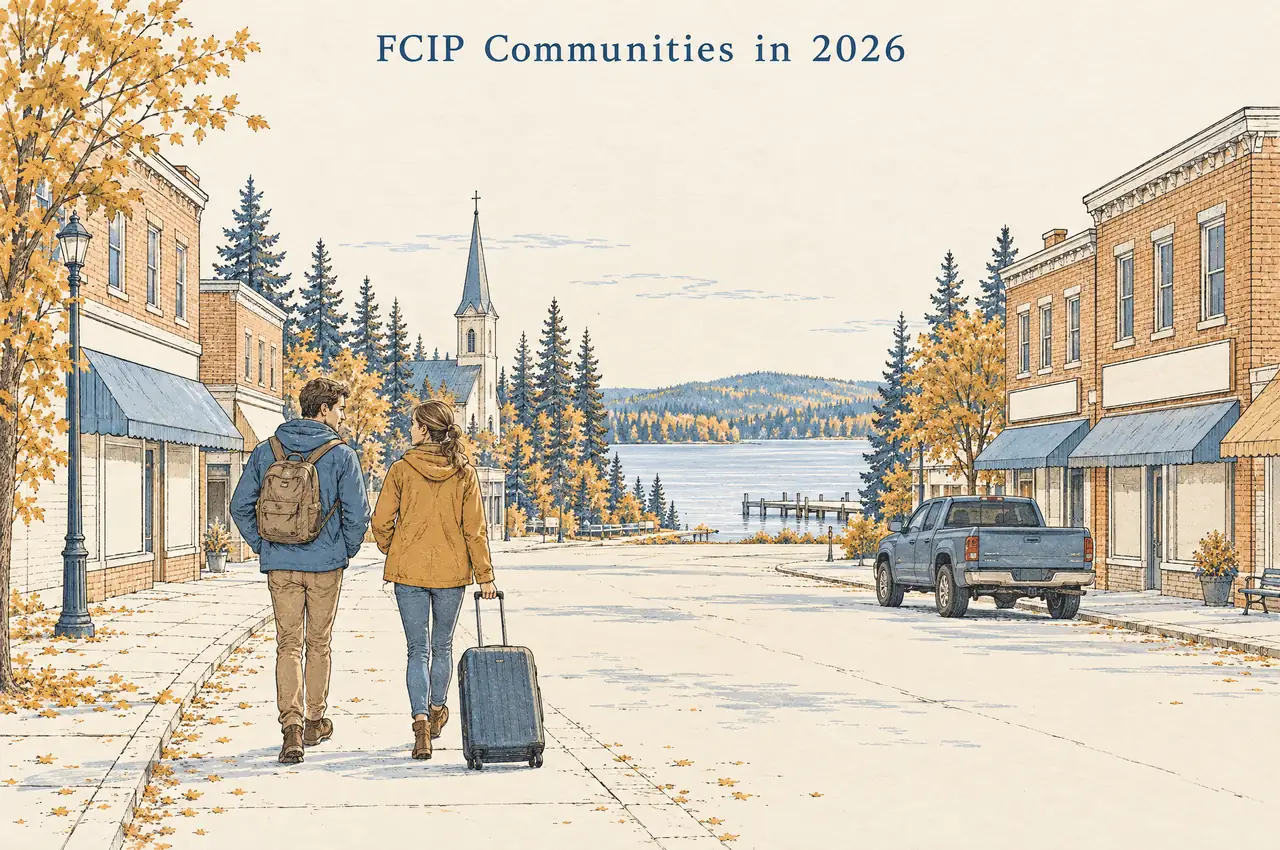
Six communities take part in the Francophone Community Immigration Pilot in 2026: one in New Brunswick (the Acadian Peninsula), three in Ontario (Greater Sudbury, the Timmins Region and the Superior East Region), one in Manitoba (St-Pierre-Jolys) and one in British Columbia (Kelowna). There are no FCIP communities in Quebec, Alberta or the other provinces.
| Community | Province | How it selects | Designated employers |
|---|---|---|---|
| Acadian Peninsula | New Brunswick | Points grid (50 minimum), monthly draws | Published list, job offers not centralized |
| Greater Sudbury | Ontario | First in, first out, during intake windows | 83 (August 2026) |
| Timmins Region | Ontario | Points grid (50 minimum), monthly draws | 25 (July 2026) |
| Superior East Region | Ontario | 25 priority occupations | 16, of which 15 hiring (October 2026) |
| St-Pierre-Jolys | Manitoba | Points grid (50 minimum), monthly draws | 6, of which 3 hiring (January 2026) |
| Kelowna | British Columbia | Monthly intake windows (15th to 30th) with caps | About 50, none hiring in early October 2026 |
What changed in 2026
The biggest change was in Greater Sudbury. Its 2026 allocation rose from 45 to 85 candidates on August 27. By the August intake it had recommended 44 candidates. Its September 28 to October 2 intake has closed, and its last intake window of the year is November 2 to 6.
All six communities also rewrote their lists of 25 priority occupations. Sudbury added 13 new occupations, Timmins four, Superior East two and Kelowna eight, while St-Pierre-Jolys replaced 10 of its 25.
Kelowna added business, finance and administration as a priority sector and eight new occupations to its 2026 list. Its sales and service sector, capped at six certificates a year, is already marked closed.
One requirement is the same everywhere: every FCIP community asks for NCLC 5 in all four abilities, whatever the job’s TEER level.
FCIP Acadian Peninsula (New Brunswick)
The pilot is run by Inspire Péninsule acadienne, based in Caraquet. Candidates are scored on a grid with a 50-point minimum and selected in monthly draws, and an application stays in the pool for up to six months. The recommendation certificate is valid for 6 months.
There are six priority sectors: business and finance, health, education and social services, sales and service, trades and transport, and manufacturing and utilities. The community operates in French and its program page is in French only. Job offers are not centralized, so you go to each designated employer’s own postings.
FCIP Sudbury (Greater Sudbury, Ontario)
The pilot is run by the City of Greater Sudbury’s economic development office (Invest Sudbury). Employers submit recommendation applications during intake windows, and complete, eligible applications are recommended first in, first out until the allocation is used.
Sudbury recommended 3, 7, 3, 7, 12 and 12 candidates in its first six intakes of 2026, 44 of the 85 places, and it had 83 designated employers in August. The last window of the year is November 2 to 6. Its 25 priority occupations run from administrative assistants and bookkeepers to early childhood educators, welders, carpenters and truck drivers.
Greater Sudbury also takes part in the RCIP, and the contrast is the point: in the same six intakes its RCIP recommended 392 candidates with cut-off scores of 87 to 90, while the FCIP side had no cut-off at all. For anyone with NCLC 5, the FCIP is by far the less crowded of the city’s two pilots. Two local rules apply: candidates in Canada as visitors or without valid status are ineligible, and a new graduate must have started working for the designated employer, with proof of the PGWP application, before the employer applies.
FCIP Timmins Region (Ontario)
The pilot is run by the Timmins Economic Development Corporation and covers Timmins, Hearst, Kapuskasing, Cochrane, Kirkland Lake and Temiskaming Shores. A complete application needs 50 points, with at least 10 in each of five factors, and enters a pool for monthly draws.
Each designated employer can make at most 5 recommendations in 2026, and 25 employers held an FCIP designation in July 2026. The last FCIP intake period listed for 2026 is October 26 to 30. The 25 priority occupations include registered nurses, early childhood educators, welders, heavy-duty equipment mechanics and truck drivers. The Timmins Region also takes part in the RCIP.
The 50 points only get a file into the pool. In Timmins’ 2026 FCIP draws, the lowest-ranked candidate selected scored 78 in March, 73 in April, 67 in May, 68 in June and 70 in July, so a bare 50 has not been enough to be drawn.
FCIP Superior East Region (Ontario)
The pilot is run by the Superior East Community Futures Development Corporation and covers Chapleau, Dubreuilville, Wawa, White River, Hornepayne and Manitouwadge, with the surrounding First Nations. It listed 16 designated employers in October 2026, 15 of them hiring: mostly motels, restaurants and service stations, plus a children’s centre, a health service and a forest-products company.
Its 25 priority occupations sit in health, education, sales and service, trades, mining, and wood and pulp processing. Licensed practical nurses, early childhood educators, cooks, electricians, carpenters and underground miners are on the list. Job inquiries go to the employer, not to the development corporation.
FCIP St-Pierre-Jolys (Manitoba)
St-Pierre-Jolys is a village 50 kilometres southeast of Winnipeg. The pilot is run by the Village with the Association des municipalités bilingues du Manitoba (AMBM) and the Conseil de développement économique des municipalités bilingues du Manitoba (CDEM).
Candidates need at least 50 points, with a minimum of 10 in each of five factors (job offer, work experience, language, education and intent to settle), and are selected in monthly draws. There are six priority sectors and 25 priority occupations in 2026. The village had 6 designated employers as of January 21, 2026, and 3 of them were hiring. It asks candidates not to contact employers directly but to watch their websites and job postings.
FCIP Kelowna (British Columbia)
Kelowna is the only FCIP community in British Columbia. Its pilot is run by the Société de développement économique de la Colombie-Britannique (SDÉCB). Intake windows run from the 15th to the 30th of each month, seven of them in 2026, from June to December.
Each designated employer is limited to 3 recommendations a year. Sales and service is capped at 6 certificates a year, with at most 2 per NOC code, and is already marked closed for 2026. Trades are capped at 3 recommendations per occupation. Fast-food restaurants, convenience stores, gas stations, vape stores and cannabis stores are not eligible.
SDÉCB lists about 50 designated employers, and in early October 2026 every one of them was marked as not hiring at the moment. SDÉCB’s own note explains why: most designated employers are not recruiting outside, they use the pilot to recommend workers they already employ. Kelowna also asks candidates not to contact designated employers directly. Applications go through SDÉCB’s own page, and without that no recommendation can be issued.
How to Choose an FCIP Community
Start with the occupation list, not the map
The most important factor in choosing among the FCIP communities is whether your specific occupation is in demand. Each community publishes its own list of priority occupations, identified by NOC code (25 in each community for 2026), and recommends only job offers in those occupations or priority sectors.
From our experience, the students who succeeded with the Francophone Community Immigration Pilot chose the community whose 2026 list held their exact NOC code, not the one they preferred on the map. A job title that matched but a NOC code that was not on the list got no recommendation.
First come or points
Next, consider how the community selects candidates, because it changes your strategy. Greater Sudbury recommends complete, eligible applications on a first-in, first-out basis during its intake windows. Timmins, the Acadian Peninsula and St-Pierre-Jolys use a points grid with a 50-point minimum and hold monthly draws, so a higher French level and more experience give you a better chance. Kelowna uses monthly intake windows with caps per employer and per sector.
Pro tip: Both the occupation lists and the designated employer lists can change during the year. Check the lists for your target community the week you apply.
Size of the employer pool
The number of designated employers varies a great deal between communities. Greater Sudbury had 83 in August 2026. Kelowna lists about 50, none of them hiring in early October 2026. Timmins had 25 FCIP-designated employers in July 2026, Superior East 16 in October, and St-Pierre-Jolys had 6 as of January 2026, of which 3 were hiring. A larger pool of employers who are hiring gives you more chances at a qualifying offer.
Life in French
Finally, think about the language you want to live in. The Acadian Peninsula operates in French and offers a fully immersive experience. The Ontario communities (Greater Sudbury, Timmins and Superior East) are bilingual, with services and community life in both French and English. Kelowna is an English-majority city, but its pilot is run by the SDÉCB for the city’s francophone community, which gives you a French-speaking network inside a larger anglophone area.
FCIP Designated Employers: How to Get a Job Offer

What makes an FCIP job offer valid
For the Francophone Community Immigration Pilot, a valid job offer must be genuine and meet several conditions. It must be:
- From an employer designated by the community.
- For full-time, non-seasonal work for an indeterminate period.
- Performed at least 75% within the community’s boundaries.
- At a wage within or above the Job Bank range for that occupation in the region.
- In an occupation whose TEER level matches your work experience.
For a regulated occupation, you must hold the licence or be able to obtain it.
Where to find FCIP designated employers
The communities and IRCC do not match you with a job. Each community posts its own list of FCIP designated employers, and IRCC’s “Get a job offer” page links to all six. You then apply to those employers’ own job postings.
In the Acadian Peninsula, offers are not centralized, so you consult employers’ websites, social media and job boards directly. Kelowna and St-Pierre-Jolys ask candidates not to contact designated employers directly: Kelowna routes every application through SDÉCB’s own page, and St-Pierre-Jolys tells you to watch employers’ websites and job postings instead.
In the communities that allow it, our students who received FCIP offers mostly did so by contacting designated employers directly, by phone or email in French, right after the list was published. The employer’s first conversation in French was the real screening test.
The employer files the recommendation
It is the employer, not you, who applies for the community recommendation. They complete form IMM 0251, with the business details, the job’s NOC code, wage and location, and your information.
The employer must also show that it could not fill the job locally. Timmins and Kelowna cap how many recommendations an employer can submit: Timmins allows a maximum of 5 in 2026, and Kelowna allows 3 a year.
Never pay for an offer
You must never pay for a job offer. An offer is invalid if it comes from a consulate, from a business owned by immigration consultants or lawyers, or from a business that is majority-owned or controlled by you or your spouse.
Work Experience: 1,560 Hours and the TEER Matching Rule
To qualify for the Francophone Community Immigration Pilot, you generally need at least 1 year (1,560 hours) of related work experience in the past 3 years.
What counts
Your experience must be paid employment. The rule counts hours, not job titles, so part-time work, in Canada or abroad, can be used to reach the 1,560 hours. Volunteer work, unpaid internships and self-employment do not count.
The work must have included the actions in the lead statement of your National Occupational Classification (NOC) code and most of its main duties. If your experience was in Canada, you must have held temporary resident status with authorization to work.
The TEER matching table
The TEER category of your work experience must be close to the TEER of your job offer.
| TEER of your job offer | TEER your experience must be in |
|---|---|
| TEER 0 or 1 | TEER 0, 1, 2 or 3 |
| TEER 2 | TEER 1, 2, 3 or 4 |
| TEER 3 or 4 | TEER 2, 3 or 4 |
| TEER 5 | The same 5-digit NOC code |
There is one exception for health care. If your experience is as a registered nurse or registered psychiatric nurse (NOC 31301), your job offer can be as a nurse aide, orderly or patient service associate (NOC 33102) or as a home support worker (NOC 44101).
The international graduate exemption
You do not need the work experience if you are an international student who graduated from a public post-secondary school in the recommending community, with a credential from a program of 2 years or longer, and you:
- Studied full-time for the entire program.
- Got the credential no more than 18 months before applying for permanent residence.
- Were in the community for at least 16 of the last 24 months of your studies.
A master’s degree or higher that took 2 years or less also qualifies, if you studied full-time and were in the community for the length of your studies. Programs that were more than half language training or more than half distance learning do not qualify.
Pro tip: We advise asking every past employer for a detailed reference letter that states your period of employment, main duties, NOC code, total annual salary and hours worked per week. Keep copies of your T4 slips and pay stubs as supporting evidence.
The French Level Required for the FCIP: NCLC 5 in All Four Skills
NCLC 5 in reading, writing, listening and speaking, whatever the job
The Francophone Community Immigration Pilot requires a minimum of NCLC 5 in all four abilities (reading, writing, listening and speaking) on TEF Canada or TCF Canada. This level applies whatever the TEER level of your job offer.
That is stricter than some other pathways. The Rural Community Immigration Pilot drops to CLB 4 for the same low-TEER jobs, and the Francophone Mobility work permit only tests speaking and listening.
The TEF Canada and TCF Canada scores for NCLC 5
Here are the scores you need for NCLC 5 on the two approved tests.
| Ability | TEF Canada (tests after Dec. 10, 2023) | TCF Canada |
|---|---|---|
| Reading | 352 to 392 | 375 to 405 |
| Writing | 330 to 378 | 6 |
| Listening | 352 to 392 | 369 to 397 |
| Speaking | 387 to 421 | 6 |
For TEF Canada tests taken between October 1, 2019 and December 10, 2023, the score for NCLC 5 was 350 to 399 in every ability. The full tables for every level are in our TEF Canada score chart and TCF Canada score chart.
What NCLC 5 means
The Centre for Canadian Language Benchmarks aligns NCLC 5 with a low B1 on the Common European Framework of Reference for Languages (CEFR). At this level, you can handle everyday situations and write a short, structured text.
In our experience with FCIP candidates, writing is the skill where students most often miss NCLC 5. Those who already use French at work usually meet the listening and reading requirements.
Pro tip: We train our FCIP students to score NCLC 6 consistently in mock tests. Students who reach that level in our mocks have held NCLC 5 or better in every skill on test day in nearly every case. Students scoring exactly NCLC 5 in mocks dropped below it in at least one skill about one time in three.
Results must be under two years old
Your TEF Canada or TCF Canada results must be less than 2 years old when you submit your application for permanent residence. The two years are counted to the day you apply, not to the day your employer files for the community recommendation.
Why NCLC 6 or 7 Beats NCLC 5 in Points-Based FCIP Communities
Timmins scores your French out of 25
NCLC 5 gets you in the door for the Francophone Community Immigration Pilot, but some communities score you against other candidates.
In Timmins, a complete application needs 50 points to enter the pool for the monthly draws, and language is worth up to 25 of those points.
- NCLC 5 earns 10 points, NCLC 6 earns 15, NCLC 7 earns 20, and NCLC 8 or higher earns 25.
- Each level is a five-point advantage in a system where work experience and education also top out at 25 points each.
Timmins also scores the job offer itself: 15 points for a job in trades and transport, natural resources or business and finance, 10 for health or education, plus 5 to 10 points for the specific occupation. And the 50-point minimum only gets a file into the pool. In the 2026 FCIP draws, the lowest-ranked candidate selected scored between 67 and 78, so each extra NCLC level has been the difference between a draw and another month in the pool.
The Acadian Peninsula and St-Pierre-Jolys also draw by points
Both the Acadian Peninsula and St-Pierre-Jolys also require a 50-point minimum and select candidates through monthly draws, so a higher French score is worth having there too.
Greater Sudbury recommends candidates first in, first out, and Kelowna uses monthly intake windows, so the score matters less there than the timing.
NCLC 7 keeps Express Entry open
Pushing on to NCLC 7 also opens a second route: Express Entry.
You need NCLC 7 in all four abilities to qualify for the French-language proficiency category draws. That level also adds 25 or 50 points to your CRS score.
Going from NCLC 5 to NCLC 7 took our students another 4 to 6 months. Those who did it had the FCIP as their sure route and Express Entry as a possible fast one.
How to Prepare for TEF Canada or TCF Canada for the FCIP
TEF Canada or TCF Canada
IRCC accepts TEF Canada and TCF Canada equally for the Francophone Community Immigration Pilot, so choose whichever test has the earliest date near you. Both must be taken as a full set in one sitting: the four sections of TEF Canada on the same day, or the four mandatory tests of TCF Canada. IRCC does not recognise a retake of a single section. If you need to retake the full test, a 20-day waiting period applies to both.
How long it takes to reach NCLC 5
The time you need depends on your starting point.
- From zero French, our students in daily group classes (20 one-hour classes a month) typically reach NCLC 5 in all four skills in about 6 to 8 months.
- From a solid A2 level (around NCLC 4), it takes about 3 to 4 months.
- Candidates who studied French at school years ago usually place at NCLC 3 to 4 on our first-session diagnostic and need about 3 months to reach the target.
Our guide on how long it takes to learn French for Canadian PR breaks the timeline down level by level.
Pro tip: Consistency is what counts. Our students doing five one-hour classes spread across the week reach NCLC 5 about a third sooner than students who do the same five hours over a single weekend.
Train the skill that fails first
For most FCIP candidates, writing is the section where they most often miss NCLC 5, and speaking is the slowest skill to raise. Reading is the fastest to improve: most of our students gain a full NCLC level in reading in about 6 weeks of daily practice.
Even students who speak French at work often freeze on the formal speaking tasks of the test.
Pro tip: Practise the skills that need the most work under test conditions. Every week, our students submit one timed speaking task and one timed writing task, and their tutor corrects both in detail. Most students have never written a formal text in French against the clock before.
Book the test before the employer files
In the Francophone Community Immigration Pilot, the language test comes before the job offer process is finished, not after. Employers in the pilot communities have told our students that they submit a recommendation only once the official test result is in hand, because the community must verify the NCLC 5 score before it issues its recommendation.
You can check dates and centres on our TEF Canada booking and TCF Canada booking pages.
Education, Settlement Funds and the Documents That Get Files Returned
Education
You must have a Canadian secondary school (high school) diploma, or a recognized Canadian post-secondary certificate, diploma or degree from a designated learning institution. A foreign credential is accepted with an educational credential assessment (ECA) report that is less than 5 years old on the day you apply.
The designated ECA organizations are:
- Comparative Education Service (University of Toronto School of Continuing Studies)
- International Credential Assessment Service of Canada
- World Education Services
- International Qualifications Assessment Service
- International Credential Evaluation Service
Pro tip: We recommend ordering your ECA report before you even start looking for a job. If the original ECA report is not submitted with the application for recommendation, the application is not considered complete and the entire file is returned.
Settlement funds
You must prove you have enough money to settle in Canada. You do not need this proof if you are already working in Canada with a valid work permit.
Acceptable proof includes bank account statements, bank drafts, cheques and money orders.
| Number of family members | Funds required (in Canadian dollars) |
|---|---|
| 1 | $10,507 |
| 2 | $13,080 |
| 3 | $16,080 |
| 4 | $19,524 |
| 5 | $22,143 |
| 6 | $24,975 |
| 7 | $27,806 |
| For each additional family member | $2,831 |
These are the amounts in IRCC’s table, last updated on July 29, 2025. Your family size includes yourself, your spouse or common-law partner, your dependent children and your partner’s dependent children, even if they are Canadian citizens or permanent residents, or are not coming to Canada with you.
Other documents
For your permanent residence application, you will also need:
- A valid passport
- Identity and civil status documents
- Police certificates for every country where you have lived for 6 months or more since the age of 18
- Photos that are not older than 6 months
How to Apply for the FCIP, Step by Step
The Francophone Community Immigration Pilot has a fixed order. Following it is what keeps an application inside the intake window.
The eight steps
- Take TEF Canada or TCF Canada and obtain NCLC 5 in all four abilities.
- Obtain an educational credential assessment (ECA) if your education is from outside Canada.
- Receive a job offer from a designated employer in a priority occupation.
- Your employer submits the community recommendation application during the community’s intake period.
- The community verifies your file and issues a recommendation certificate (valid for 6 months in the Acadian Peninsula).
- Apply for permanent residence online through the Permanent Residence Portal and pay the fees.
- After the acknowledgement of receipt, give your biometrics within 30 days of the biometrics letter (ages 14 to 79) and complete a medical exam.
- Optionally, apply for the 2-year employer-specific work permit while your application is processed.
At Toronto French Academy, the most common sequencing error we see is candidates starting French classes after an employer shows interest. The employer cannot submit the recommendation until your NCLC 5 score exists, and the community’s intake window passes.
The IRCC forms
The permanent residence application goes through IRCC’s Permanent Residence Portal. Four pilot-specific PDF forms are uploaded with it:
- IMM 0250, the document checklist for the Francophone Community Immigration Pilot.
- IMM 0251, the offer of employment, completed by your designated employer.
- IMM 0252, Schedule 1 for the pilot.
- IMM 0253, the recommendation from the community’s economic development organization.
The portal also holds the generic forms every applicant fills in: IMM 0008, IMM 5669 (background declaration), IMM 5406 (family information) and IMM 5562 (travel history). An incomplete application is rejected and must be resubmitted.
Fees
These are the government fees for the Francophone Community Immigration Pilot, from IRCC’s fee list in October 2026.
| Fee | Amount |
|---|---|
| Principal applicant | $1,590 (includes the $600 right of permanent residence fee) |
| Spouse or partner | $1,590 (includes the $600 right of permanent residence fee) |
| Each dependent child | $270 |
| Biometrics | $85 per person or $170 per family |
| Work permit | $155 |
| Open work permit holder fee | $100 |
Other costs include the language test, the educational credential assessment, the medical exam and police certificates. These are paid directly to the providers.
FCIP processing time
IRCC has not published a processing time for the Francophone Community Immigration Pilot. The first permanent residence applications under the pilot were only filed in 2025. Immigration firms estimate 6 to 12 months from biometrics, and the 2-year work permit IRCC attached to the pilot is sized for a wait of that order.
What IRCC does state: biometrics instructions arrive several weeks after a complete application, you then have 30 days to give them, and the medical exam follows. Expect the community step to take its own time first, since recommendations are issued only during intake windows or monthly draws.
The FCIP Work Permit While Your PR Is Processed
What the permit is
Once you have applied for permanent residence under the Francophone Community Immigration Pilot, you can apply for a 2-year, employer-specific work permit that is exempt from a labour market impact assessment (LMIA). This FCIP work permit lets you work only for the employer who made your job offer.
Who can apply and from where
To be eligible, you need an eligible offer of employment from your designated employer and a recommendation from the community. Your employer must give you an offer of employment number before you start the application.
You can apply from inside or outside Canada. In both cases you include proof that your permanent residence application was submitted, such as the acknowledgement of receipt, along with the community recommendation and the offer of employment form.
Your family
Your spouse or common-law partner can apply for an open work permit at the same time, valid for up to 2 years. It lets them work only in the same community as you.
The fee is $155 per person for the work permit, plus the $100 open work permit holder fee for an open work permit.
FCIP vs Express Entry, the RCIP and Francophone Mobility
Here is how the Francophone Community Immigration Pilot compares with Canada’s other routes for French speakers. All four apply outside Quebec.
The four routes side by side
| Route | French level | Job offer | What you get |
|---|---|---|---|
| Francophone Community Immigration Pilot | NCLC 5 in all four abilities | Yes, from a designated employer in one of six communities | Permanent residence through a community recommendation, no CRS score |
| Express Entry (French category) | NCLC 7 in all four abilities | No | Invitations to apply for permanent residence, by CRS score within the category |
| Rural Community Immigration Pilot | English or French at CLB 6, 5 or 4, depending on the job | Yes, from a designated employer in one of 14 rural communities | Permanent residence through a community recommendation |
| Francophone Mobility | NCLC 5 in speaking and listening only | Yes, from almost any employer | An employer-specific work permit with no LMIA, not permanent residence |
Who each route suits
The Francophone Community Immigration Pilot is a strong option for candidates whose age, education or work history gives them a lower Express Entry score.
The FCIP has no CRS score to compete on and sets a lower French bar at NCLC 5. The trade-off is that you must secure a job offer from a designated employer in a specific small community.
The Francophone Mobility stream, by contrast, is for those who want to start working in Canada quickly. It lets you work for almost any employer outside Quebec with NCLC 5 in speaking and listening only, but it gives a work permit, not permanent residence.
Mistakes That Cost FCIP Candidates Their Recommendation
Most FCIP refusals we hear about do not come from a lack of French. They come from simple errors in paperwork and timing.
- Starting French too late. The most common error we see is starting French classes only after an employer shows interest. The employer cannot file for a recommendation without your test score, and the intake window may close.
- Using the wrong TEF score table. The paperwork error we see most often is misreading TEF Canada results. The scores for NCLC 5 changed on December 10, 2023, and your test date decides which of IRCC’s tables applies.
- Aiming for exactly NCLC 5. About one in three students who score exactly NCLC 5 in mock tests drop below it in one skill on test day. We train to NCLC 6 to build a buffer.
- A non-priority NOC code. A community only recommends job offers in its priority occupations or sectors.
- An out-of-bounds or underpaid job. At least 75% of the work must be inside the community’s boundaries, and the pay must be within or above the regional Job Bank wage range.
- A missing original credential assessment. If the original educational credential assessment report is not submitted with your recommendation application, the entire file is returned as incomplete.
- Letting the recommendation expire. A recommendation is temporary. The Acadian Peninsula’s, for example, is valid for 6 months. You must file for permanent residence while the recommendation is valid and your language results are under 2 years old.
FCIP FAQ
What does FCIP stand for?
FCIP stands for Francophone Community Immigration Pilot, or Programme pilote d’immigration dans les communautés francophones (PPICF) in French. The letters also name the Fellow, Chartered Insurance Professional designation, an unrelated insurance qualification.
Who is eligible for the Francophone PR program?
To be eligible for the FCIP, you need a job offer from a designated employer in one of the six communities, one year of related work experience in the last three years, NCLC 5 in all four French abilities, a Canadian credential or an ECA, and settlement funds unless you already work in Canada on a valid work permit.
Is the Francophone Community Immigration Pilot still open in 2026?
Yes. The pilot is open in 2026 and runs from 2025 to 2029. Greater Sudbury’s allocation for 2026 was raised from 45 to 85 candidates on August 27, 2026, and its last intake window of the year is November 2 to 6.
What jobs are in demand in the FCIP communities?
Each community has a list of 25 priority occupations for 2026, revised each year. The lists vary, but occupations in health care, trades, education, and sales and service appear on most of them: nurses, nurse aides, early childhood educators, welders, heavy-duty equipment mechanics, cooks and truck drivers.
Where can I find the list of FCIP designated employers?
Each community publishes its own list of designated employers on its website, and IRCC’s “Get a job offer” page for the pilot links to all six. The lists change during the year, so check them the week you apply.
Can I get PR with CLB 5 in French?
Yes, through the Francophone Community Immigration Pilot. NCLC 5, the French equivalent of CLB 5, in all four abilities is its language requirement. You also need a job offer from a designated employer, a year of related work experience, an educational credential and, unless you already work in Canada, settlement funds.
Can I get PR in Canada if I speak French but have no job offer?
Not through the FCIP, which requires a job offer. Express Entry has a French-language proficiency category that does not require a job offer, but you must score NCLC 7 in all four French abilities.
Do I need English for the FCIP?
No. You do not need an English test for the Francophone Community Immigration Pilot. The only language requirement is French at NCLC 5 or higher in all four skills.
Can my family come with me?
Yes. Your spouse or common-law partner can get an open work permit that is valid only in the same community. Your spouse and dependent children are also counted in the settlement funds you must show, even if they are not immigrating with you.
Can I apply from outside Canada?
Yes. You can apply for the FCIP from outside Canada if you have your language test results, a valid job offer and the community recommendation. You can also apply for the 2-year work permit from outside Canada.
Which FCIP communities are in Ontario?
Three of the six FCIP communities are in Ontario: Greater Sudbury, the Timmins Region (Timmins, Hearst, Kapuskasing, Cochrane, Kirkland Lake and Temiskaming Shores) and the Superior East Region (Chapleau, Dubreuilville, Wawa, White River, Hornepayne and Manitouwadge). Sudbury and Timmins also take part in the Rural Community Immigration Pilot.
How long does FCIP processing take?
IRCC has not published a processing time for the FCIP. Immigration firms estimate 6 to 12 months from biometrics for the permanent residence application, and the optional 2-year work permit exists to cover that wait. Add the community step before it: intake windows in Sudbury, Timmins and Kelowna, or monthly draws in the Acadian Peninsula and St-Pierre-Jolys.
Is Kelowna really a francophone community?
Kelowna is the only FCIP community in British Columbia and an English-majority city. Its pilot is run for the city’s francophone community by the Société de développement économique de la Colombie-Britannique (SDÉCB).
Is the Francophone Mobility work permit still open?
Yes. Francophone Mobility is open in 2026. It is a work permit, not permanent residence: it asks for NCLC 5 in speaking and listening only, with a job offer outside Quebec. It can be a way to start working in Canada while you look for an FCIP employer or raise your French to NCLC 7.
Reaching NCLC 5 and Beyond with Toronto French Academy
Our step-by-step syllabus from A1 to B2 means you can reach NCLC 5 for the Francophone Community Immigration Pilot and continue to NCLC 7 for Express Entry on the same plan.
How we prepare FCIP candidates
Every course begins with a diagnostic session that places each of your four skills against the NCLC bands, so time goes to your weakest skill first.
You submit weekly speaking and writing tasks for detailed correction, and before your exam you take full mock tests under real timing, with NCLC 6 as the target.
Programs and prices
We offer live online French classes on Google Meet, taught by our 200+ certified tutors.
| Program | Classes a month | Days a week | Format | Price | Average time from A1 to B2 |
|---|---|---|---|---|---|
| Group Classes | 20 one-hour classes | 5 | 6 to 8 students | $249 per month | 10 to 12 months |
| Individual Classes | 12 one-hour private classes | 3 | Private | $369 per month | 8 to 10 months |
| Fast-Track Individual Classes | 20 one-hour private classes | 5 | Private | $549 per month | 6 to 8 months |
Book a 60-minute demo class with a C1/C2 instructor to see how we work and get an assessment of your current level.
Keep reading




Simar Dua, French Program Lead
Simar leads the TEF Canada and TCF Canada programs at Toronto French Academy and has guided hundreds of Express Entry candidates from their first French lesson to the NCLC 7 result. She hosts the academy’s free monthly French for Canada PR info session.