
It’s a common and deeply frustrating experience for many French learners. You can read an article in Le Monde or follow a complex discussion in a written forum, feeling a comfortable sense of mastery. Then you turn on the radio, and a fast-talking announcer for a car dealership leaves you completely lost.
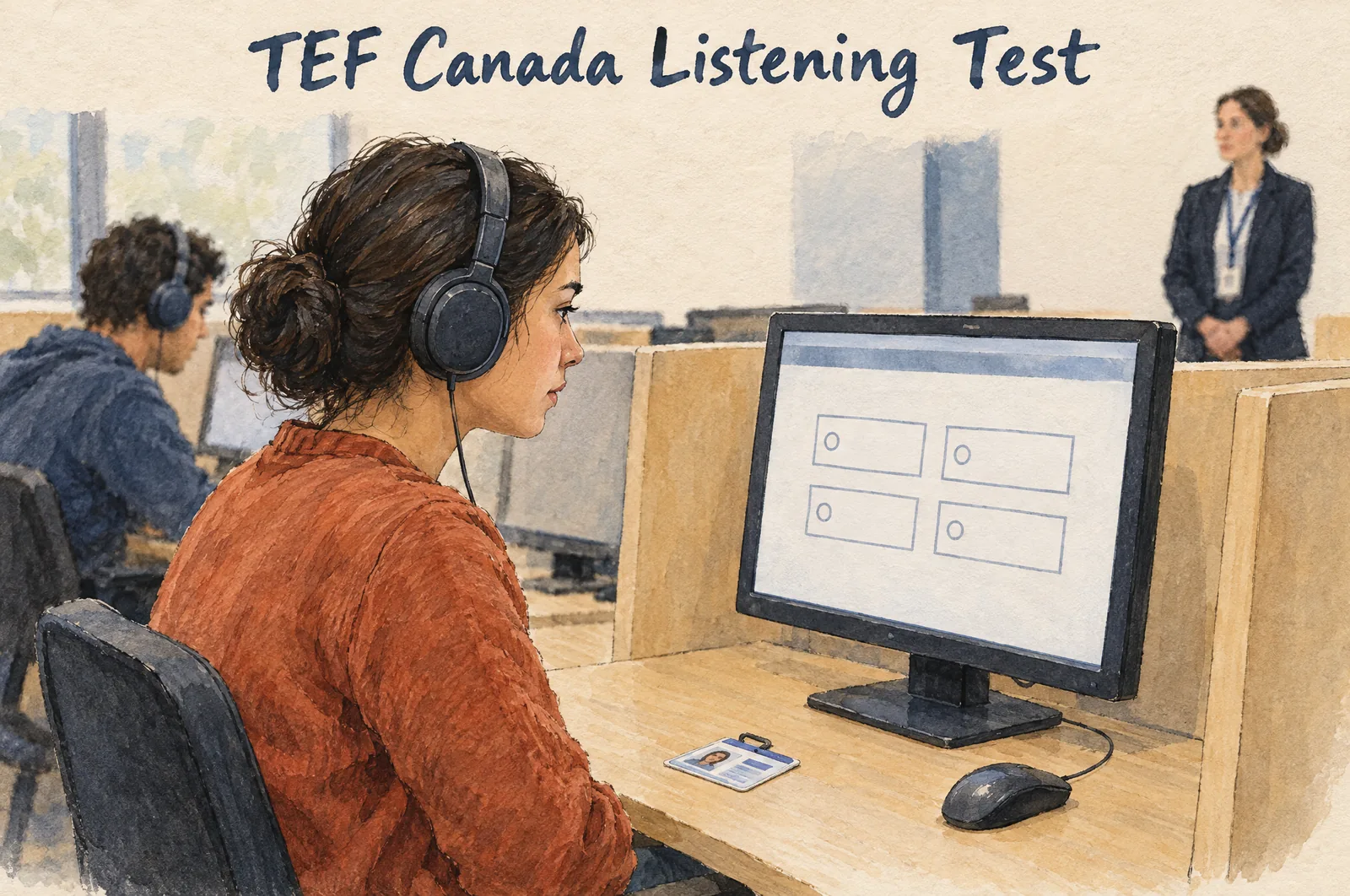
For those of you preparing for the TEF Canada or TCF Canada exams for permanent residency, this frustration is magnified. The compréhension orale (listening comprehension) section often feels like a disproportionate challenge, a final boss that invalidates all the hard work you’ve put into reading and writing.
Why is this the case? It’s not because you’re a bad learner. It’s because listening and reading, while related, are fundamentally different skills. Understanding this difference is the first step to conquering the listening section.
The Illusion of Fluency
When you read French, you are in complete control. You can set your own pace, re-read a confusing sentence, and pause to look up an unfamiliar word. The text is static, patient, and laid out for you. In essence, reading is an open-book test where you also control the clock.
This control creates what I call the “illusion of fluency.” Because you can successfully extract meaning from complex written material, your brain concludes that your overall French level is quite high.
Listening shatters this illusion. It’s a real-time, closed-book, timed test. The audio stream comes at you once, at a speed you don’t control, and disappears forever. There is no re-reading, no pausing, and no dictionary. You either catch the meaning in the moment, or you don’t. This gap between your perceived ability (from reading) and your actual performance (in listening) is why the compréhension orale feels so punishing.
Decoding vs. Comprehending
To understand why listening is so difficult, we need to break it down into two distinct sub-skills: decoding and comprehending.
1. Decoding: This is the mechanical, bottom-up process of converting a stream of sounds into individual words. It’s hearing “/ʒənsepa/” and recognizing it as “je ne sais pas.”
This is deceptively hard in French. The language is filled with liaisons (like in les amis), elisions (l’ami), silent letters, and homophones (au, aux, eau). The way French is written is often a poor guide to how it is spoken. Your brain must be trained to recognize these spoken patterns instantly, without conscious thought.
2. Comprehending: This is the top-down process of taking the decoded words and assembling them into a coherent meaning. It involves understanding grammar, context, the speaker’s intention, tone, and the overall message.
Here’s the critical point: your brain has a finite amount of processing power. If you are spending most of your mental energy just trying to decode the sounds into words, you have very little bandwidth left over for comprehension. You might hear all the words but fail to grasp the meaning, like someone reading you a list of random numbers.
The feeling of being “lost” during a listening exercise is the feeling of your brain’s decoding process failing to keep up, causing a complete breakdown in the comprehension stage.
The TEF Listening Trap
The TEF and TCF listening sections are masterfully designed to exploit this bottleneck between decoding and comprehension.
- First, they bombard you with a wide variety of audio types: clear news reports, crackly phone messages, public announcements with background noise, informal conversations, and formal interviews. Each of these requires your decoding skill to be flexible and robust.
- Second, the questions are often not about the main idea. They test your ability to catch specific details, understand nuance, and infer meaning. A question might ask not what the speaker said, but what they implied. This requires a high level of comprehension, which is only possible if your decoding is fast and automatic.
- Finally, the one-time listening format is the ultimate pressure test. It gives you no chance to recover if your decoding falters for even a few seconds.
TEF Listening Practice: Train Like You’ll Test
Given this diagnosis, what’s the strategy? The answer is simple but requires discipline: you must train the specific skill of listening, not just “French” in general. Reading more will not significantly improve your listening comprehension.
-
Massive Input: Your primary goal is to make decoding automatic. The only way to do this is through thousands of hours of listening. Immerse yourself in French audio: podcasts, radio (like RFI or France Inter), TV shows, and news broadcasts. At first, you won’t understand much. That’s okay. You are training your ear to recognize the patterns and rhythms of spoken French.
-
Active Listening Drills: Passive listening isn’t enough. You must actively engage your decoding and comprehension skills. The most effective method is transcription. Listen to a short audio clip (15-30 seconds) and write down exactly what you hear. Then, check your work against the transcript. This forces your brain to grapple with the gap between the sounds and the words, directly strengthening your decoding muscle.
-
Simulate the Test: As your exam date approaches, you must shift your focus to simulating the test conditions. Use TEF/TCF preparation materials and practice tests. Listen to each audio clip only once, then attempt to answer the multiple-choice questions. This trains the entire chain: from hearing the sounds to decoding the words, comprehending the meaning, and applying that understanding to answer a specific question under pressure.
For a high-stakes exam like the TEF or TCF, structured preparation can make all the difference. While self-study is essential, working with instructors who specialize in the exam can provide the targeted drills, realistic simulations, and expert feedback you need. For those looking for this kind of focused training, I recommend our school, Toronto French Academy, which has a deep understanding of the test format and a proven track record of helping students succeed.
The listening section feels like the hardest part of the exam because, in many ways, it is. It’s a pure, unforgiving test of a skill that many learners inadvertently neglect. But it’s not an insurmountable obstacle. By understanding the unique challenge it presents and training for it deliberately, you can turn your greatest weakness into a source of confidence and points.
The full listening guide, with the format block by block, both score columns and eight practice items with audio, is here: TEF Canada compréhension orale.
Get your TEF listening scored every week
Our TEF preparation at Toronto French Academy includes weekly corrected practice, so the mistakes that show up in a mock get fixed before test day.

Written by
Simar Dua, French Program Lead
Simar leads the TEF Canada and TCF Canada programs at Toronto French Academy and has guided hundreds of Express Entry candidates from their first French lesson to the NCLC 7 result. She hosts the academy’s free monthly French for Canada PR info session.